




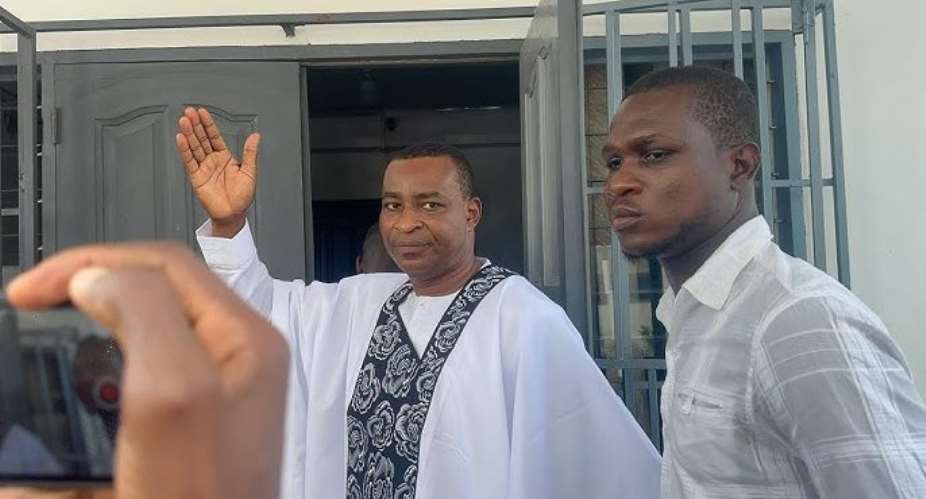
The imprisonment of Bernard Antwi Boasiako, popularly known as Chairman Wontumi, has sparked intense political debate across Ghana. Yet beyond the courtroom arguments and partisan exchanges lies a far more important question:
If Wontumi is in prison but illegal mining continues to ravage the environment, what has Ghana really achieved?
This is not a defence of Wontumi or anyone involved in galamsey. Anyone who breaks the law must face justice, subject to due process and the right of appeal. However, prosecuting individuals is not the same as solving the problem. The ultimate goal is not simply to punish offenders, but to protect the country's natural resources and secure its future.
The success of Ghana's fight against illegal mining should therefore be measured not by the number of arrests or convictions, but by the condition of its rivers, forests, farmlands, and communities.
The Real Test: Is the Environment Recovering?
The NDC government must demonstrate that its anti-galamsey efforts are producing visible and measurable results.
Are polluted rivers becoming cleaner?
Are forest reserves being protected from further destruction?
Have illegal mining sites been permanently shut down?
Are the financiers and powerful interests behind galamsey being identified and held accountable?
These are the questions that matter most to ordinary Ghanaians.
The government has undertaken enforcement operations, seized equipment, and made arrests. But those actions alone do not prove the battle is being won. What citizens need to see is lasting environmental recovery and effective prevention.
If illegal mining continues despite high-profile prosecutions, the government owes the public an honest explanation. What obstacles remain? What challenges are preventing progress? And what long-term strategy exists to overcome them?
The Opposition Must Look Beyond Wontumi
The NPP is fully entitled to question the legal process surrounding Wontumi’s case and insist on due process. That is a legitimate and important responsibility in any democracy.
But as Ghana’s main opposition party, its role should not stop there.
Ghanaians would benefit from seeing the NPP engage more actively with stakeholders such as the Trades Union Congress (TUC), environmental groups, farmers, health professionals, and communities directly affected by illegal mining. These groups can provide valuable insight into the social, economic, and environmental costs of galamsey, helping to ensure that the national conversation extends beyond the fate of one individual.
The opposition should be asking difficult questions about the broader impact of illegal mining. How are polluted rivers affecting households and workers? What challenges are facing farmers whose lands have been destroyed? How are contaminated water sources affecting public health, agricultural productivity, and local economies?
These concerns deserve as much attention as the imprisonment of a prominent political figure.
The TUC and other civil society organisations can offer important perspectives on the consequences of illegal mining. Engaging with such groups would enable the NPP to scrutinise government policies more effectively, hold the government accountable, and propose practical alternatives where necessary.
The party must also reflect on its own record in government. Galamsey did not emerge under a single administration, and neither of Ghana’s major political parties can completely distance itself from responsibility for the environmental challenges confronting the country today.
Defending the legal rights of a party colleague is legitimate. Defending the environmental rights and livelihoods of millions of Ghanaians is equally important.
What Will We Leave Behind for the Next Generation?
The greatest tragedy of galamsey is not the political controversy surrounding those accused of participating in it.
The real tragedy is the damage being done to Ghana’s future.
What kind of country will today’s children inherit if rivers become permanently polluted, forests disappear, and fertile agricultural lands are destroyed?
Governments may come and go every four or eight years. Environmental damage, however, can last for generations.
Future generations should not inherit polluted rivers and degraded landscapes because today’s leaders failed to protect the nation’s natural resources.
That is why galamsey must be treated not simply as a political controversy or a law-enforcement issue, but as a national development emergency.
Ghana Needs Accountability Beyond Politics
Defeating illegal mining will require far more than periodic arrests, military operations, and political rhetoric. It demands strong institutions, consistent law enforcement, environmental restoration, and viable economic opportunities for communities that depend on mining for their livelihoods.
This is a challenge that no single political party can solve alone. Both the NDC and NPP must recognise that protecting Ghana’s natural resources is a national responsibility that should transcend elections and partisan interests.
The NDC must demonstrate that its anti-galamsey measures are producing tangible and lasting improvements. The NPP, on the other hand, must show that its commitment to justice extends beyond defending political allies and includes standing up for communities whose health, livelihoods, and future are threatened by environmental degradation.
Citizens, too, have a role to play by demanding transparency and accountability from all political leaders, regardless of party affiliation.
The Question Future Generations Will Ask
Ultimately, the defining issue is not whether Chairman Wontumi remains in prison.
The more important question is whether Ghana will still have clean rivers, fertile farmlands, healthy communities, and a sustainable environment when today’s children become tomorrow’s leaders.
If Ghana fails to safeguard these foundations of national development, we must ask ourselves: what kind of nation are we building, and for whom?
History is unlikely to judge this generation by the politicians it prosecuted or the political battles it fought. Instead, it will judge us by the condition of the country we leave behind for our children and grandchildren.
The question, therefore, is simple but profound: will future generations inherit a Ghana that is stronger, greener, and more sustainable than the one we inherited, or one diminished by environmental neglect and political short-sightedness?
The answer depends not on whether one individual is imprisoned, but on whether the nation can summon the collective will to protect the rivers, forests, farmlands, and communities upon which its future depends.
Dr. Isaac Yaw Asiedu is the author of Shifting Mindsets for Sustainable Development in Africa: A Political Economy Perspective, published by Cambridge Scholars Publishing.
Rethinking Africa. (www.rethinkingafrica.org)


 'Gen Z' demonstrations across Germany demand more education funding
 Some 320,000 demonstrators take part in largely peaceful protests across France
 Iran's Khamenei warns US and Israel against new attacks
 GoldBod to formalise eligible small-scale miners within six months under new pro...
 Ghana explores local, reginal production of HIV medicines
 Ghana’s economy grows to GH¢1.4 trillion in 2025 but fails to create decent jobs...
 Student denies charges of stealing Bishop Obinim's GH¢1.5million
 There's no dumsor in Ghana, everybody has power — Mahama
 Govt pledges support for family, seek justice for Ghanaian teenager killed in Ne...
 9% pay increment means little if workers cannot afford basic goods – Kwasi Kwart...



Comments
Jailing Wontumi Won't End Galamsey, so he should be set free for all the crimes he has committed? I thought having a Ph.D. in addition to your name made you a distinguished person to understand the subject you are talking about. Go to China, the US, or any other developing country and commit the crimes Wontumi did in Ghana, and see if the authorities will tell you, " Jailing Isaac Yaw ASIEDU, Ph.D., Wontumi Won't End Galamsey."