




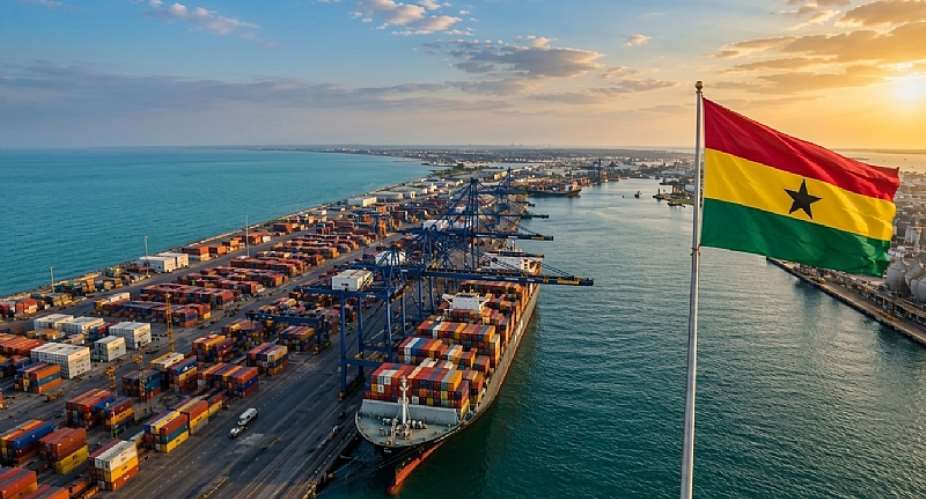
Tema is not just another city. It is Ghana's industrial hub, home to the country's largest seaport, a major manufacturing centre, and one of the most important drivers of the national economy.
Every day, goods worth millions of cedis enter and leave Ghana through Tema Port. The city's strategic location makes it Ghana's gateway to international trade and a critical pillar of economic growth. In many respects, the success of Ghana's economy is closely tied to the success of Tema.
Yet despite its strategic importance, many residents are increasingly concerned about the condition of the city.
A drive through parts of Tema reveals growing informal settlements, squatters occupying public lands, uncontrolled roadside trading, unauthorized structures, deteriorating public spaces, and increasing pressure on urban infrastructure. For a city that was carefully planned and designed to be a model urban centre, these developments raise serious concerns.
The question is simple:
Who is responsible for protecting and preserving the vision of Tema?
A City Built on Planning and Order
Tema was not a city that emerged haphazardly. It was deliberately planned as part of Ghana's industrialisation agenda.
Its roads, residential communities, industrial zones, public facilities, and commercial areas were carefully designed to function within a structured urban environment. The city's layout reflected a vision of order, efficiency, and long-term development.
For decades, Tema stood as an example of what planned urban development could achieve.
Today, however, many residents worry that the very principles upon which the city was built are gradually being eroded.
Informal settlements continue to expand in some areas. Public spaces are increasingly encroached upon by unauthorized activities. Roadside trading has spread beyond designated locations, while some developments appear to proceed with little regard for planning regulations.
The concern is not merely aesthetic. Uncontrolled urban growth places pressure on roads, sanitation systems, public services, security, and the overall quality of life.
Where Are TMA and TDC?
Two institutions sit at the centre of Tema's development and management: the Tema Metropolitan Assembly (TMA) and the Tema Development Corporation (TDC).
Given their responsibilities, residents are entitled to ask difficult but necessary questions.
How were informal settlements allowed to expand in a city that was meticulously planned?
Why do unauthorized structures continue to emerge in certain areas?
What measures are being taken to protect public lands from encroachment?
What long-term strategy exists to preserve Tema's character while accommodating population growth and economic activity?
The issue is not whether these institutions face challenges. Every growing city faces pressures arising from migration, unemployment, housing shortages, and expanding commercial activity.
The real question is whether TMA and TDC have responded effectively to these challenges.
Citizens deserve clear answers and visible results.
Meridian Enclave: A Symbol of a Larger Problem
Perhaps no example better illustrates the concerns of residents than the situation at Tema Community One Commercial Centre, commonly known as Meridian Enclave.
The area was specifically planned and dedicated as a commercial centre to support businesses, attract investment, create jobs, and provide a vibrant commercial environment for residents and visitors alike.
Today, many residents and business owners believe that the area no longer reflects that original vision.
Large sections of the enclave have been overtaken by squatter settlements, informal activities, and unauthorized occupation. What was intended to be one of Tema's premier commercial destinations increasingly appears disorganised and neglected.
For property developers and entrepreneurs who invested substantial resources in the area, the situation has become deeply frustrating. Many have watched the commercial appeal of the enclave diminish over time as encroachment, congestion, and disorder have made the area less attractive to both businesses and customers.
Some business owners openly express regret over their investments. They believe the deterioration of the environment has affected customer traffic, property values, investor confidence, and the long-term prospects of the commercial centre.
Accessibility has also become a major concern. Areas that were designed to facilitate commercial activity have become difficult to navigate because of unauthorized occupation and encroachment. For many residents, Meridian Enclave has become a visible reminder of what happens when planning regulations are not consistently enforced.
This raises serious questions for both TMA and TDC.
How did a commercial centre specifically designated for business development reach this state?
Why were early interventions not sufficient to prevent the encroachment?
What plans exist to reclaim, protect, and restore the enclave to the purpose for which it was originally established?
If one of Tema's flagship commercial centres can deteriorate in this manner, residents are justified in questioning whether enough is being done to preserve other public and commercial spaces across the city.
The situation at Meridian Enclave is about more than a single location. It has become a test of whether the institutions responsible for managing Tema are willing and able to uphold the planning principles upon which the city was built.
Tema Is More Than a Local Municipality
Tema's importance extends far beyond its residents.
It serves as Ghana's principal maritime gateway. It is one of the first places international investors, business partners, and visitors encounter when engaging with the country.
When investors assess Ghana's infrastructure and business environment, Tema often plays a central role in that evaluation.
For this reason, the city's condition is not merely a local concern. It is a national concern.
A poorly managed Tema weakens Ghana's image, competitiveness, and attractiveness as a destination for investment and business. Conversely, a well-managed Tema strengthens the country's economic prospects and international reputation.
The Cost of Looking Away
Urban decline rarely occurs overnight.
It often begins with small violations that go unenforced, temporary arrangements that become permanent, and planning regulations that gradually lose their authority.
What begins as isolated encroachments can evolve into extensive informal settlements. What starts as limited roadside trading can develop into chronic congestion and disorder. Problems that could have been addressed early become more difficult and costly to resolve.
The longer authorities delay action, the greater the challenge becomes.
That is why city management requires foresight, discipline, and consistent enforcement, not periodic interventions after problems have become entrenched.
Leadership Is About More Than Administration
Residents pay rates, taxes, fees, and other levies to local authorities. In return, they expect effective management of the city.
The responsibility of TMA and TDC goes beyond collecting revenue or processing permits. Their primary obligation is to ensure that Tema remains orderly, functional, attractive, and capable of supporting future growth.
Citizens expect well-maintained public spaces, adherence to planning regulations, proper sanitation, efficient infrastructure, and a clear vision for the future development of the city.
More importantly, they expect leadership.
A Call for Accountability
This discussion is not about assigning blame. It is about accountability.
Tema remains one of Ghana's greatest national assets. But assets do not maintain themselves. They require leadership, planning, investment, and consistent enforcement of standards.
TMA and TDC owe residents and the nation a clear explanation of how they intend to address the growth of informal settlements, squatting, unauthorized developments, sanitation challenges, and urban congestion.
More importantly, they must demonstrate that they have the capacity and commitment to protect the city from further decline.
The stakes are too high for complacency.
Citizens are increasingly demanding decisive action. Many residents believe the time for studies, consultations, and promises has long passed. What Tema needs now is a well-planned but swift exercise by TMA and TDC to restore order, enforce planning regulations, reclaim public spaces, remove unauthorized structures, and address the growing problem of squatter settlements and uncontrolled informal activities.
Orderly cities do not emerge by accident. They are the result of rules that are enforced and citizens who understand that development comes with responsibilities as well as rights. No city can maintain its standards when regulations exist only on paper.
Tema was designed to be Ghana's model city and remains the country's industrial and maritime gateway. Residents expect the institutions responsible for its management to act with urgency before today's challenges become tomorrow's crisis.
If Ghana considers Tema its gateway to the world, then TMA and TDC must move beyond administration and demonstrate leadership. The citizens of Tema are not merely asking for explanations. They are demanding immediate action to restore the order, discipline, standards, and vision upon which the city was built.
The question is no longer whether the problems exist. The question is whether TMA and TDC have the will and capacity to solve them.
About the Author
Dr. Isaac Yaw Asiedu is a researcher and commentator on sustainable development, environmental governance, urban planning, and public policy. He is the author of the peer-reviewed article "Broken Cities: Who's Behind Ghana's Urban Chaos?" published in Applied Economics and Finance. The article is available through the DOI: https://doi.org/10.11114/aef.v12i4.8209.


 'Gen Z' demonstrations across Germany demand more education funding
 Some 320,000 demonstrators take part in largely peaceful protests across France
 Iran's Khamenei warns US and Israel against new attacks
 GoldBod to formalise eligible small-scale miners within six months under new pro...
 Ghana explores local, reginal production of HIV medicines
 Ghana’s economy grows to GH¢1.4 trillion in 2025 but fails to create decent jobs...
 Student denies charges of stealing Bishop Obinim's GH¢1.5million
 There's no dumsor in Ghana, everybody has power — Mahama
 Govt pledges support for family, seek justice for Ghanaian teenager killed in Ne...
 9% pay increment means little if workers cannot afford basic goods – Kwasi Kwart...


