




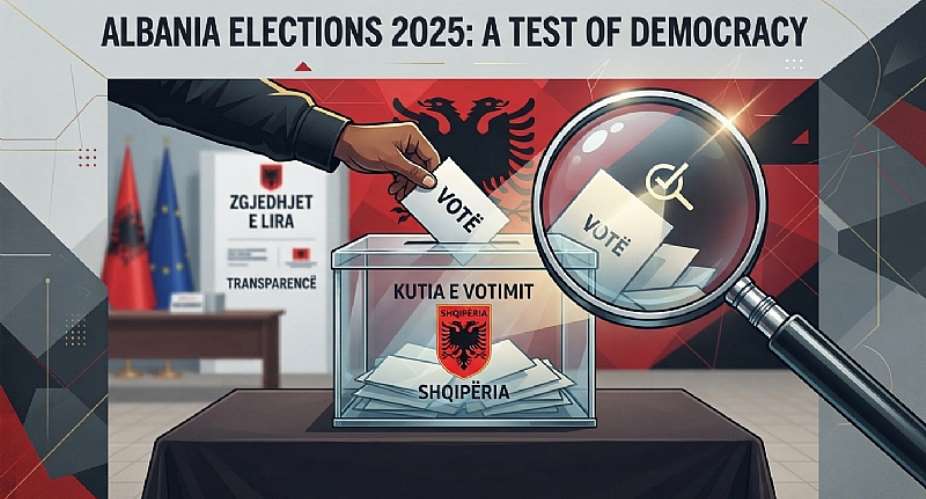
TIRANA — Albania is approaching its 9 May 2027 local elections with a problem that may prove more consequential than the mechanics of voting itself: a widening gap between citizens' willingness to take part in democracy and their willingness to trust the political system that delivers it.
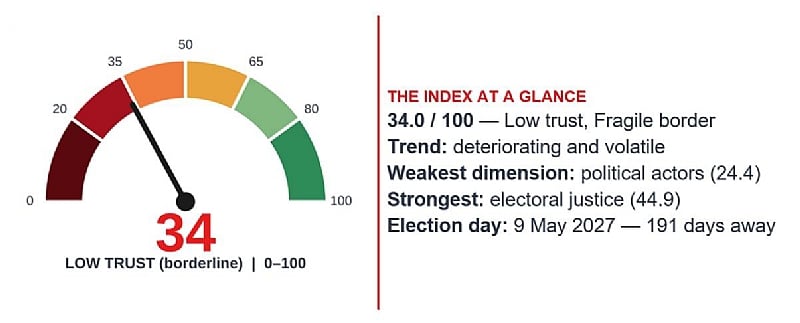
This study's assessment, drawing on institutional records, public-opinion research, election-observation findings and documented political developments, places Albania's Electoral Trust Index at 34.0 out of 100 — in the "Low Trust, Fragile Border" category. More significantly, it classifies the direction of trust as deteriorating and volatile.
Turnout has fallen from 55 per cent in 2001 to 42.2 per cent in the 2025 parliamentary elections. A partial local election in November 2025 produced a turnout of just 18.5 per cent, the lowest in Albania's post-communist history.
Albania has moved through 2026 with three forces converging on its electoral system: growing opposition hostility, protests outside the traditional party structure and a contested restructuring of the municipal map. The result is a political paradox. The machinery of elections still functions, but confidence in the political contest around that machinery is weakening.
This assessment acknowledges that the 2025 elections were competitive and professionally administered, with the Central Election Commission (CEC) demonstrating important strengths. Yet only 32 per cent of Albanians express confidence in elections, and confidence in political parties stands at just 24 per cent. In terms of electoral risks, the principal risk is not necessarily that Albania cannot administer an election. The deeper question is whether citizens and political actors will regard the contest and its outcome as legitimate
A 34-point warning light
This study's Electoral Trust Architecture measures eight dimensions of the electoral environment. The weakest is Political Actor Trust, at 24.4. Trust in the electoral institution and in results and acceptance each stand at 32.0. Ballot and counting trust are somewhat higher at 38.0, and electoral justice records 44.9.
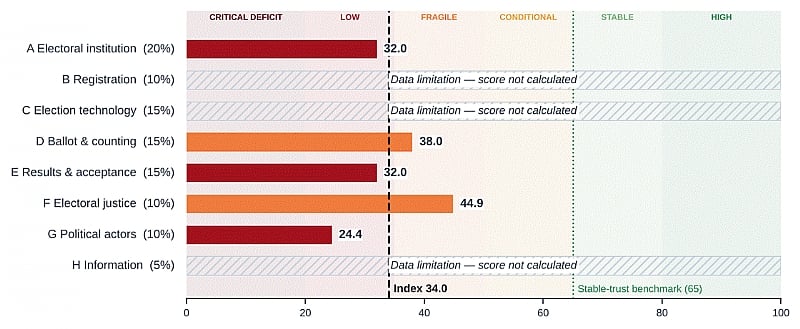
The Albania Electoral Trust Architecture : Registration, technology and information trust were not scored because no national survey measures them; the study did not estimate values. Source: Using Balkan Public Barometer 2025, ISP 2025 and IDM/UNDP 2023 data.
The pattern is revealing. The greatest problem is not the act of counting ballots. It is who contests the election, whether citizens believe the contest is fair and whether political actors will accept the result. This study calculates a 41-point gap between political-actor trust and its stable-trust benchmark of 65, and a 33-point gap for both the electoral process and results acceptance. It therefore identifies participation and acceptance as the critical threat zone.
Albania is not an outlier in the region. On every item measured by the Regional Cooperation Council's 2025 Balkan Barometer, its scores sit at or slightly above the Western Balkans average — a reminder that low trust in politics is a regional condition, even as Albania's own trajectory is shaped by domestic events.
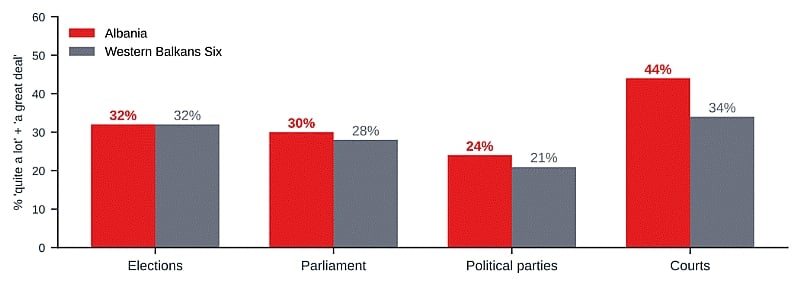
Confidence in core institutions: Albania vs. the Western Balkans Six. Source: Balkan Public Barometer 2025 (RCC), Albania n≈970.
The warning comes with a qualification. This study does not claim that the 2027 election will fail. It measures the conditions that could make failure, rejection or instability more likely.
Technically sound, politically fragile
The OSCE/ODIHR assessment of the 2025 election found the process competitive and professionally managed. The CEC was described as transparent and well prepared, and nationwide electronic voter identification and first-ever out-of-country voting were significant operational achievements. Yet public trust remains weak — what this study calls a conditional trust environment, in which citizens may trust the institution to follow its procedures but that confidence can quickly fade if the major political actors reject the rules.
Lower down the system, the picture is more complicated. Members of local electoral commissions are nominated by political parties, and ODIHR has repeatedly recommended depoliticising them. In 2025, only 80 per cent of voting-centre commissions were fully constituted shortly before polling. The study sums up Albania's election administration as "a credible centre, a politicised periphery. It must however be stated that Albania's strongest electoral asset is administrative competence. But competence becomes conditional when political consensus around the rules begins to disappear
The opposition boycott question
Perhaps the most immediate threat to the 2027 election is not technological but political. On 30 October 2026, five opposition parties declined the President's consultations on the election date. The decision follows the opposition's demands for the Prime Minister's resignation and early parliamentary elections, and opposition leader Sali Berisha has questioned whether his party should compete under what he describes as unequal conditions.
This study treats this not as evidence that a boycott will happen, but as a latent threat with precedent. In 2019, opposition parties boycotted local elections, leaving 31 races uncontested. A repeat in 2027 would change the question from "Who won?" to "Who was actually able to compete?" — which is why the study classifies opposition non-participation as critical.
The danger is sharper because voters themselves are not enthusiastic about boycotts. Research cited in the assessment shows that only 17 per cent support electoral boycotts, while 77 per cent say they would vote even under unfair conditions. Many citizens still want the ballot, even if they distrust the parties competing for it. The question is whether those parties will offer credible choices.
A political force outside the old party system
Albania's trust challenge is also being shaped by protest movements that do not fit the traditional Socialist Party–Democratic Party contest. In 2026, demonstrations targeted both the government and the main opposition. The Flamingo movement, which began over coastal development, and October's student mobilisation reflect a sentiment that rejects both major camps.
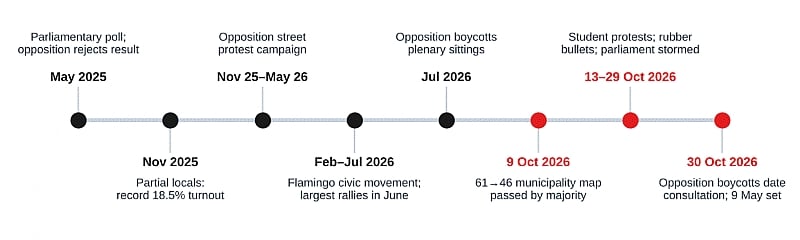
From the 2025 vote to the 2027 date decree: eighteen months of escalating contest. Sources: CEC, OSCE/ODIHR, Reuters, AP, AFP, Balkan Insight, Albanian media.
Significantly, the study identifies what it calls a representation gap: citizens who are politically mobilised but see no trusted vehicle through which to express their concerns at the ballot box. That may be more dangerous than apathy. An apathetic voter stays home; a mobilised but distrustful voter may take the conflict elsewhere. October's clashes, in which police fired rubber bullets, raised the stakes further.
In addition, the study identifies the combination of anti-system mobilisation and state force as one of its two most serious latent threats. It does not equate protest with electoral violence, but traces a conditional escalation pathway that warrants monitoring:
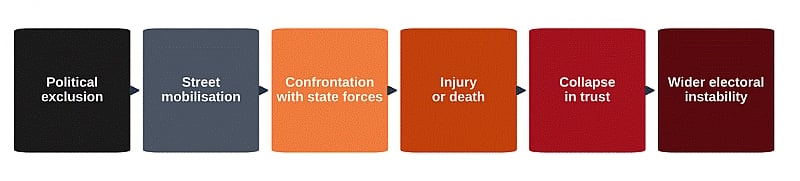
A conditional escalation pathway for monitoring — not a forecast. Source: This study.
For an effective democratic dispensation, political exclusions leading to a wider electoral instability needs to be avoided especially a danger is created when citizens who reject the established political system feel there is no credible ballot-box outlet for their dissatisfaction.
The 61-to-46 municipality problem
A further source of distrust is more local. On 9 October 2026, Parliament approved a territorial restructuring that cuts the number of municipalities from 61 to 46. The government presents it as administrative reform. For residents of affected towns, the question is more personal: who will govern us, and did we have a meaningful say?
The changes have already prompted protests and petitions in Prrenjas, Poliçan, Dimal, Divjakë, Klos, Patos and Memaliaj. In May, these communities will elect councils and mayors under the new structure for the first time, turning the election into a test of whether the new boundaries have local acceptance. The study further classifies the redesign as a RED-level threat: if citizens do not identify with their new municipality, a newly elected council may face a trust deficit before it begins governing.
Turnout may be the silent protest
Perhaps the most revealing number in the assessment is not 34 but 18.5 — the turnout in November 2025's partial local elections. If low participation becomes normal rather than exceptional, Albania could find itself holding elections in which ever fewer citizens choose those who govern them.
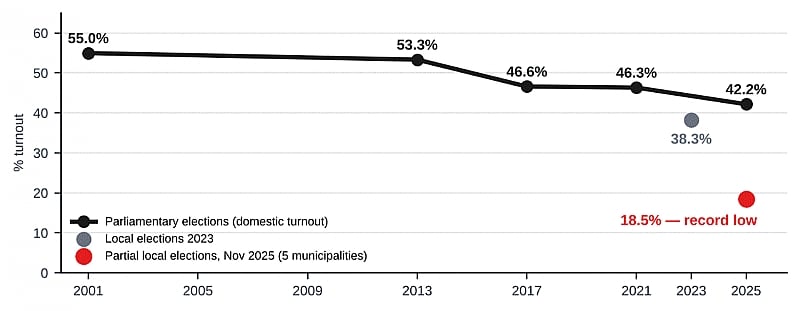
Domestic turnout in parliamentary elections, with the 2023 local vote and the November 2025 partial local vote. 2005 and 2009 are not shown. Source: Central Election Commission.
This study reads the decline cautiously and does not claim that every abstention is a protest. But alongside low institutional confidence, opposition hostility and the growth of protest politics, falling turnout becomes a significant behavioral signal. Citizens can continue to believe in elections as a principle while deciding that a particular contest is not worth their time — which is how trust erodes without anyone declaring they have lost faith in democracy.
The integrity of the vote is another fault line
Albania also faces questions over vote buying, criminal influence and ballot secrecy. Survey evidence cited by the study shows that 62 per cent expect criminal interference and illicit funding to go unchecked. OSCE/ODIHR recorded vote buying, intimidation, pressure on public employees and problems with ballot secrecy, with family voting observed in 11 per cent of voting centres.
A voter may believe the ballots will be counted accurately while doubting that the choice itself is free. This study concludes that confidence in the count is stronger than confidence that the vote is cast without pressure.
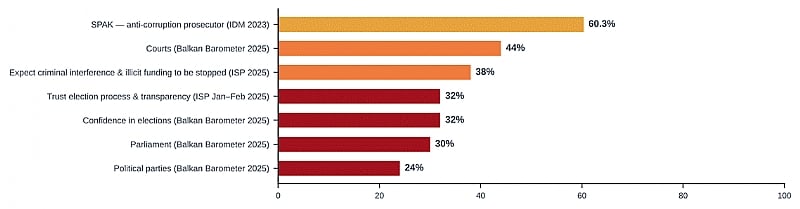
The trust stack: Albania's anti-corruption prosecutor commands far more confidence than its political actors. Sources: IDM/UNDP Trust in Governance 2023; Balkan Public Barometer 2025; Institute for Political Studies, Jan–Feb 2025.
The strongest counterweight is enforcement. The Special Structure against Corruption and Organised Crime (SPAK) is Albania's most trusted domestic institution in IDM/UNDP research, at about 60 per cent, and it opened 39 electoral-crime proceedings from 138 reports by May 2025. For this study, visible enforcement is one of the most transferable sources of trust before May: citizens may not trust parties, but they may trust an institution that shows electoral violations have consequences.
Three possible futures
This study does not predict what will happen on 9 May 2027. Instead, it sets out three conditional scenarios.
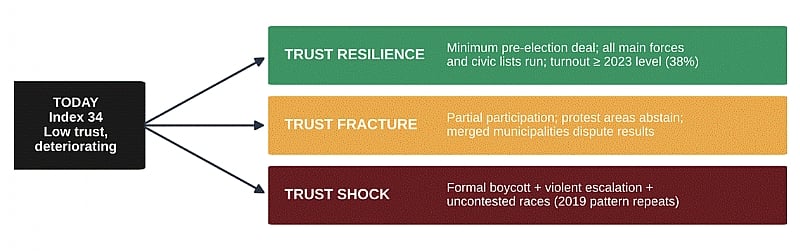
The study's three conditional scenarios for the 2027 local elections. Source: This study.
In Trust Resilience, a minimum-rules agreement is reached, the major forces and civic lists register candidates and protests de-escalate; trust could move back into the Fragile band and Albania would enter the 2029 parliamentary cycle on firmer ground. In Trust Fracture, the opposition participates selectively while merged municipalities and protest constituencies disengage; the vote takes place, but turnout is uneven and legitimacy is contested locally. In Trust Shock, a formal boycott combines with violent escalation and uncontested races, echoing 2019; trust would likely deteriorate rapidly, with the legitimacy deficit carried into 2029.
These are not predictions. The most damaging outcomes are pathways that can still be interrupted.
191 days to change the trajectory
The road to 9 May 2027. Source: Presidential decree, 30 October 2026; Electoral Code.
The calendar offers a limited but meaningful window. This study identifies five immediate priorities:
▪ A minimum-rules agreement covering commission composition, observation access and complaint procedures.
▪ Transparent transition arrangements for municipalities affected by the 61-to-46 restructuring.
▪ Electronic voting expansion only with broad political agreement.
▪ A stronger, more visible SPAK electoral-crime capacity.
▪ A new national electoral-trust survey. The most recent national evidence predates the 2027 campaign — a serious data gap, because there is no substitute for knowing what voters think.
Democracy can survive low trust — until it cannot
Albania's situation is not a story of a failed electoral system but of a fragile one. The country retains real resilience: a professionally capable CEC, relatively high confidence in SPAK, a large majority who say they would still vote under unfair conditions, and 86 per cent support for European Union membership — one of the strongest consensus anchors in the assessment.
But those assets coexist with 24 per cent trust in parties, 32 per cent confidence in elections, sharply falling turnout and political conflict that increasingly plays out beyond the traditional parties. Elections do not draw legitimacy solely from ballot boxes and counting procedures. They draw it from a wider belief that the contest was meaningful, the choice was free and the result deserves acceptance. Albania's 2027 local elections will test all three. It must be emphasized that this study is not predicting an electoral crisis in Albania. We are identifying the conditions under which trust could deteriorate rapidly. The advantage of measuring latent risk is that intervention remains possible before the risk becomes an overt crisis
With 191 days until 9 May 2027, Albania still has time to rebuild confidence. But the central question is no longer simply whether Albanians will vote. It is whether enough of them will believe that their vote — and the political system around it — is worth trusting.
| STUDY’S BOTTOM LINE | |
| Electoral Trust Index | 34.0 / 100 — Low trust, Fragile border |
| Trust Velocity | Deteriorating / volatile |
| Dimension scores | Political actors 24.4 · Electoral institution 32.0 · Results & acceptance 32.0 · Ballot & counting 38.0 · Electoral justice 44.9 |
| Most serious latent threats | Opposition boycott · anti-system mobilization combined with force · contested municipal restructuring |
| Resilience factors | Professional CEC administration · relatively high SPAK trust · continued willingness to vote · 86% EU support |
| Election | 9 May 2027 (local) · parliamentary elections by June 2029 |
| Study assessment | The greatest danger is not administrative failure, but low participation and contested legitimacy. |
This study is an independent, neutral, non-partisan and non-advocacy intelligence measurement activity. It does not endorse political parties, candidates or electoral outcomes. Its assessments measure observable and inferable indicators of public trust, latent threats and electoral risks using available evidence. Figures are drawn from the Balkan Public Barometer 2025, IDM/UNDP Trust in Governance 2023, the Institute for Political Studies (2025), OSCE/ODIHR and the Central Election Commission.


 'Gen Z' demonstrations across Germany demand more education funding
 Some 320,000 demonstrators take part in largely peaceful protests across France
 Iran's Khamenei warns US and Israel against new attacks
 GoldBod to formalise eligible small-scale miners within six months under new pro...
 Ghana explores local, reginal production of HIV medicines
 Ghana’s economy grows to GH¢1.4 trillion in 2025 but fails to create decent jobs...
 Student denies charges of stealing Bishop Obinim's GH¢1.5million
 There's no dumsor in Ghana, everybody has power — Mahama
 Govt pledges support for family, seek justice for Ghanaian teenager killed in Ne...
 9% pay increment means little if workers cannot afford basic goods – Kwasi Kwart...


