




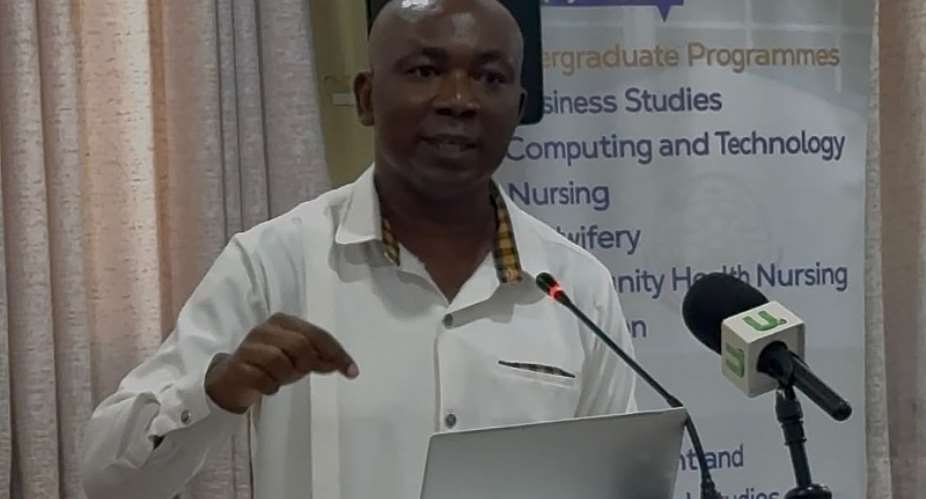
Economist Professor Godfred Bokpin has urged Ghana to develop a clear strategy for its proposed membership of BRICS, cautioning that the country’s economic development will ultimately depend on decisions and actions taken at home.
He said Ghana should identify the specific opportunities presented by the bloc and determine how those opportunities could be leveraged to advance the country’s economic interests.
Professor Bokpin was speaking at a policy dialogue organised by the Business School of Wisconsin International University College (WIUC) in Accra on Tuesday, October 27, where participants discussed Ghana’s proposed BRICS membership.
He noted that the growing influence of BRICS in global economic affairs makes the bloc an important grouping for Ghana to consider, particularly amid shifts in global economic and geopolitical power.
According to him, BRICS accounts for about 40 per cent of global gross domestic product (GDP) and has emerged as an influential platform for countries seeking greater representation in the international economic and political system.
He, however, cautioned against viewing membership of the bloc as an automatic solution to Ghana’s economic challenges.
Professor Bokpin said external partnerships could complement Ghana’s development efforts but could not replace the need for sound domestic policies, responsible economic management and deliberate national choices.
He stressed that Ghana must approach the proposed membership as a means to achieve clearly defined development objectives rather than treating it as an end in itself.
Ghana must identify benefits of BRICS membership
Chief Executive Officer of Dalex Finance, Joe Jackson, also called for a careful assessment of the proposed membership, arguing that Ghana must establish the additional benefits BRICS would provide beyond those available through its existing international partnerships.
Mr Jackson said joining the bloc was not necessarily a bad decision but questioned whether Ghana had clearly defined what it expected to gain from membership.
He noted that Ghana already participates in several major international organisations and initiatives, including the United Nations, the Commonwealth and the African Continental Free Trade Area (AfCFTA).
He therefore said policymakers must determine what BRICS membership would offer that Ghana could not obtain through its existing relationships.
For Mr Jackson, the decision should not be driven simply by the prominence or growing influence of the bloc. Ghana must first establish the practical value of membership and develop a strategy to maximise the opportunities it presents.
Strategy needed to advance Ghana’s BRICS ambitions
The views expressed by the two speakers point to the need for Ghana to establish clear objectives before committing to the proposed partnership.
While BRICS could provide opportunities for Ghana to deepen economic and diplomatic relations with member countries, Professor Bokpin stressed that the country must take responsibility for determining how those opportunities contribute to its development.
Mr Jackson similarly emphasised the importance of identifying measurable benefits, particularly because Ghana already has access to several international platforms through which it pursues economic and trade interests.
The debate over Ghana’s proposed BRICS membership, therefore, should extend beyond the question of whether the country should join the bloc.
It should also focus on what Ghana intends to achieve, how it plans to secure those benefits and what measures will be used to determine whether membership is contributing meaningfully to the country’s economic transformation.
The policy dialogue at Wisconsin International University College provided a platform for these issues to be examined as Ghana considers its position within an evolving global economic order.

 'Ghana Airways will be back in the air before I leave office' — Ghana's Presiden...
 'You can’t make money in journalism' — Speaker Bagbin
 GES sets November 16 date for payment of 2025 promotion arrears
 Wontumi’s lawyers seek recall of prosecution witness in illegal mining case
 Minority urges independent audit of GHS49.7m South Africa evacuation
 Some prison inmates attempted to poison Wontumi – Palgrave
 NACOC Boss reveals how 'smart' suspected drug traffickers are diverting proceeds...
 Minerals Commission defends termination of Northern Ashanti Mines lease over US$...
 Northern Ashanti Mines says moves to reassign disputed concession began before l...
 Ablakwa will be prosecuted in 2029 under Bawumia – Kwadwo Poku warns


