




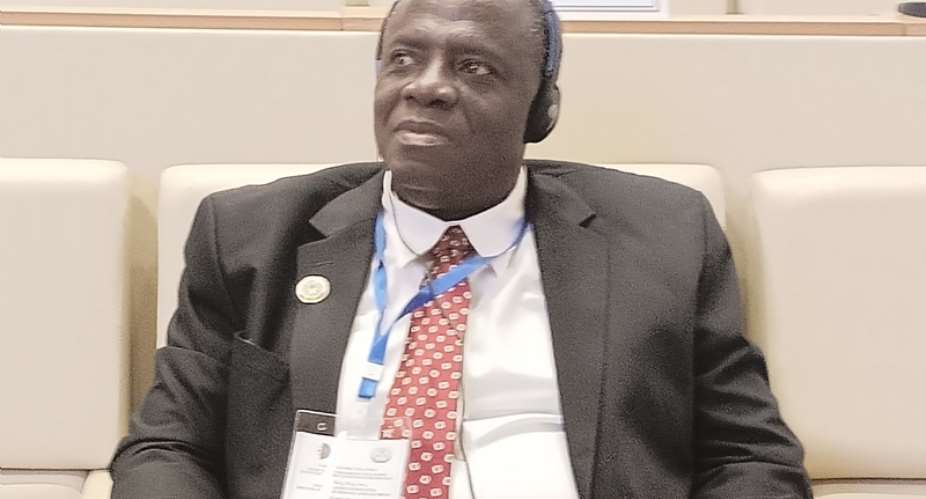
A Judge of the African Court on Human and Peoples’ Rights, Sir Justice Dennis Dominic Adjei, has cautioned that judicial independence must not be interpreted as freedom from accountability.
He warned that Ghana’s accountability system could become a routine exercise of identifying financial waste and institutional failures without taking the necessary steps to prevent them from recurring.
Justice Adjei made the observation when he delivered the inaugural Annual St. John the Baptist Memorial Lecture organised by the Joint Board of the Supreme Subordinate Commandery and Ladies’ Auxiliary of the Knights of St. John International, Ghana, in Accra.
Speaking on the theme, “Speaking Truth to Power: Upholding Justice, Morality, and National Accountability,” he examined the constitutional and institutional mechanisms for enforcing accountability in Ghana, with particular emphasis on Section 8 of his presentation, which focused on institutions and practical enforcement.
Justice Adjei, who is also a Judge of the Supreme Court of Ghana, said Articles 125 and 127 of the 1992 Constitution safeguard the judiciary from political interference and guarantee judicial independence.
However, he stressed that such independence does not place the administration of the courts beyond scrutiny.
He cited Article 187(2), which places the public accounts of the courts within the mandate of the Auditor-General.
According to him, the judiciary has the responsibility to protect rights, determine legal liability, review unlawful administrative action and enforce its decisions within its jurisdiction.
He said public confidence in the courts, however, depends on the quality of their decisions and the effectiveness of their procedures, including timely hearings, accessible processes, available avenues of appeal and lawful mechanisms for dealing with misconduct.
Justice Adjei also clarified that Ghana’s accountability system derives its authority from both the Constitution and legislation.
He said institutions such as the Judiciary and the Auditor-General have direct constitutional foundations, while the National Media Commission (NMC) operates under a constitutional mandate supported by legislation. Parliamentary committees, he added, derive their authority from the Constitution and Parliament’s Standing Orders.
On the NMC, Justice Adjei said Articles 166 and 167 of the Constitution, together with the NMC Act, 1993 (Act 449), provide the framework for protecting media freedom, promoting professional standards and handling complaints against the media.
He said the Commission is also mandated to protect state-owned media from governmental control.
Its effectiveness, he noted, should ultimately be measured by “how it safeguards independent journalism and how credibly it addresses legitimate complaints.”
Turning to parliamentary oversight, Justice Adjei said the Public Accounts Committee (PAC) plays a key role in examining issues arising from the Auditor-General’s reports and presenting its findings to Parliament.
He explained that Article 187(6) requires Parliament to consider the Auditor-General’s reports and, where necessary, establish a committee to investigate matters in the public interest.
Article 103, he added, provides the broader framework for parliamentary committees and gives them investigative powers, including the ability to request documents and summon witnesses.
“Hearings expose failures, demand explanations, and support recommendations; they do not themselves replace a criminal trial,” he said.
Justice Adjei said parliamentary oversight extends beyond the PAC to include the Finance Committee, Budget Committee, relevant sector committees and oversight of public enterprises.
Parliament, he explained, scrutinises public expenditure from the stage of proposed allocations and authorisation through implementation and the subsequent examination of accounts.
He stressed that Parliament’s own use of public funds must equally remain subject to lawful audit and scrutiny.
The Supreme Court Judge warned against treating parliamentary hearings as the end of the accountability process.
He said Parliament must monitor the implementation of its recommendations, identify outstanding actions and demand explanations where failures are repeated.
Political affiliation, he added, must not determine the level of scrutiny applied to public officials or institutions.
On the Auditor-General, Justice Adjei said Article 187 provides for the auditing and reporting of Ghana’s public accounts and those of specified public institutions.
The office, he said, has access to relevant records and is required to submit its annual report within six months after the end of the preceding financial year.
He also noted that the Constitution protects the Auditor-General from direction or control in the performance of the office’s functions, a principle further supported by the Audit Service Act, 2000 (Act 584).
Justice Adjei highlighted the significance of Article 187(7)(b), which empowers the Auditor-General to disallow unlawful expenditure and surcharge individuals responsible in circumstances including unaccounted funds and losses resulting from negligence or misconduct.
“This power is more than an invitation to publish adverse observations. It provides a mechanism for personal financial accountability,” he said.
He added that Article 187(9) gives persons affected by a disallowance or surcharge the right to appeal to the High Court.
Justice Adjei also pointed to the principle of reciprocal accountability, noting that Article 187(15) requires the accounts of the Auditor-General’s office itself to be audited and reported on by an auditor appointed by Parliament.
“Independence sustains a mandate; it does not remove the duty to account,” he said.
He proposed four key measures to strengthen Ghana’s accountability system.
First, he said public decisions must be traceable through the proper preservation of procurement records, contracts, payment information and the reasons behind significant administrative decisions. He encouraged citizens to use the Right to Information Act, 2019 (Act 989), to obtain relevant records.
Second, financial findings must lead to concrete action. He said the Public Financial Management Act, 2016 (Act 921), provides responsibilities and mechanisms, including audit committees, which institutions should use effectively.
Institutions, he added, should maintain publicly accessible records showing accepted recommendations, responsible officers, deadlines, recoveries and unresolved matters.
Third, complaints must be directed to the appropriate institutions. Justice Adjei explained that constitutional challenges, human rights complaints, audit concerns, media complaints and suspected corruption require different avenues for redress.
He said institutions such as the Commission on Human Rights and Administrative Justice (CHRAJ), investigative agencies and the Office of the Special Prosecutor should complement the work of the core accountability institutions.
Finally, he said accountability must be measured by tangible outcomes.
“How much has actually been recovered? Which unlawful practice has stopped? Has the complainant remained safe? Has the excluded community gained access? A published finding with no follow-through is an unfinished exercise in accountability,” he said.
Justice Adjei concluded by saying that accountability should not be confined to state institutions but must also be rooted in society’s moral foundations.
He identified the family as the primary social unit, citing Article 18(1) and (2) of the African Charter on Human and Peoples’ Rights, and urged teachers, lecturers, faith leaders and professional associations to promote fairness and integrity.
He cautioned faith leaders and associations against sacrificing their moral independence for political patronage, urging them instead to emulate the courage of John the Baptist by standing for truth, fairness and human dignity.








 NACOC Boss reveals how 'smart' suspected drug traffickers are diverting proceeds...
 Minerals Commission defends termination of Northern Ashanti Mines lease over US$...
 Northern Ashanti Mines says moves to reassign disputed concession began before l...
 'Was I facing union problems everyday when I was in charge, compare and contrast...
 Ablakwa will be prosecuted in 2029 under Bawumia – Kwadwo Poku warns
 Ghana deports South Korean man wanted over $3.6bn cocaine haul
 Minority threatens vote of censure on Ablakwa if fails to resign over South Afri...
 Ghana targets 70% local fuel supply by 2028 — MD
 UEW students express shock as SRC spending reveals over GH¢574,000 blown on camp...
 Judicial independence does not shield judges from scrutiny, accountability — Jus...


