




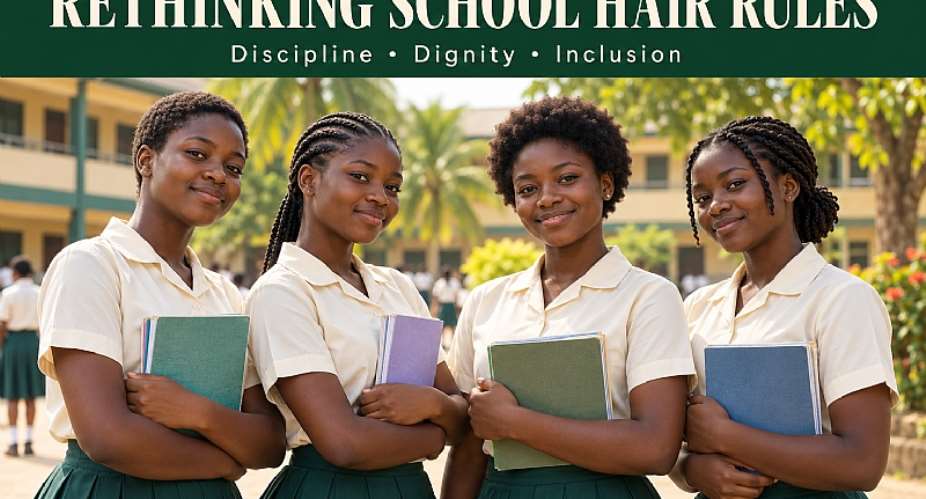
A school should help children develop knowledge, confidence and respect for others. Its rules should serve those purposes. Yet the continuing debate over compulsory haircuts in Ghana and elsewhere in Africa raises a difficult question: when does a grooming requirement become an unnecessary restriction on a student’s identity?
For many families, short hair is an affordable, convenient choice. The controversy concerns whether every girl should be compelled to adopt it, particularly where students report different treatment according to nationality, ancestry or hair texture.
In February 2025, Graphic Online reported that development communicator Akua Manfo, popularly known as Blakofe, had appealed to Ghanaian ministers to reconsider compulsory hair cutting for schoolgirls. Drawing on research undertaken for her master’s degree, she described girls feeling inferior when required to cut their hair while some classmates of other backgrounds retained theirs. These reported experiences deserve investigation rather than dismissal.
Supporters of strict grooming rules also deserve a fair hearing. School administrators must manage large student populations, limit competition over appearance and help families contain expenses. In October 2025, Education Minister Haruna Iddrisu publicly defended the enforcement of approved hairstyles at senior high schools, citing discipline, uniformity and equity. His remarks demonstrate that the practice has institutional support and that reform requires a serious discussion about educational priorities.
However, these objectives do not settle the question of whether compulsory cutting is necessary. Schools should explain how a particular restriction supports learning and whether less restrictive alternatives could achieve the same result. Cleanliness, affordability and orderly appearance can guide a policy that accommodates several simple hairstyles.
The wider African experience offers a warning about rules that appear neutral but are applied through narrow assumptions about acceptable hair. In 2016, protests at Pretoria High School for Girls brought international attention to students’ complaints about the treatment of natural African hair. South Africa’s government acknowledged the allegations and announced an investigation and a review of the school’s code of conduct.
The University of Pretoria’s Centre for Human Rights argued that allowing some girls to wear their natural hair while denying others that opportunity was discriminatory. It also urged schools to involve learners in developing rules. That principle has relevance beyond South Africa: standards become more credible when those affected understand their purpose and have a meaningful opportunity to raise concerns.
Historical attitudes also deserve examination. Scholars and campaigners have connected the policing of African hair to inherited ideas that associate European appearance with respectability. This does not establish that every short-hair requirement has an identical origin or that every teacher enforcing one intends harm. It does underline the need to question definitions of neatness that treat natural African textures as inherently troublesome.
Reform should begin with clear, written standards developed through consultation with students, parents and teachers. Schools could permit manageable options such as short natural hair, cornrows, twists and modest braids, while setting reasonable limits on elaborate accessories and costly styling. Practical safety requirements should be explained and applied consistently.
Any exceptions should have transparent reasons. A student’s complexion or perceived foreignness should never determine how much freedom she receives. Schools should also provide a respectful complaints process and avoid public humiliation when addressing grooming concerns.
Short hair should remain an acceptable choice. Equally, a girl who maintains another simple, clean hairstyle should be able to understand why it is permitted or restricted through a fair and defensible policy.
Education prepares young people to exercise judgment, respect differences and participate confidently in society. School hair rules should reflect those lessons. The strongest discipline is supported by fairness, and the most valuable uniformity is a shared commitment to learning and mutual respect.


 ECG announces 7-hour power outages in parts of Ashanti Region on Tuesday
 World Cup visa scandal deepens discontent among NDC grassroots – Prof Smart Sarp...
 'It is frivolous' – State declines to respond to motion challenging its oppositi...
 Bawumia recalls how late former Savelugu MP prayed for him from hospital bed in ...
 TOR records GH¢1.24bn profit before tax in 2025 — MD
 TOR plans expansion to 100,000 barrels of crude oil per day — MD
 'We still have feelings' — Wontumi proposes conjugal visit facilities for marrie...
 'Young men must work and eat' – Prophet Badu Kobi backs Sammy Gyamfi on galamsey
 'My greatest fear was going to prison, but now I’m here' — Wontumi reflects on l...
 Foreign Affairs Ministry seeks names of evacuees allegedly shortchanged in GH¢5,...


