




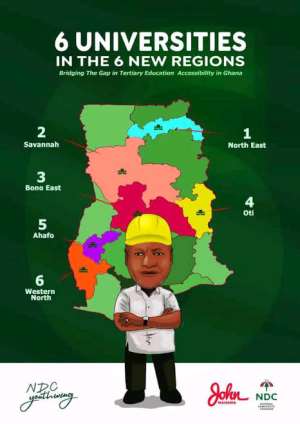
Ghana’s public university network continues to expand, but its geographical distribution raises an important question: how can the country ensure that access to higher education reaches communities beyond its established academic centres?
The widely circulated figure of 26 public universities—16 traditional universities and 10 public technical universities—requires updating. As checked on October 26, 2026, the Ghana Tertiary Education Commission’s institutional dashboard displays 17 institutions in its “Traditional University” category and 10 public technical universities, indicating a combined category total of 27. This differs from the 26 reported in an earlier October regional breakdown.
One important omission from the earlier list is the University of Engineering and Agricultural Sciences at Bunso in the Eastern Region. GTEC now lists the institution as active under its traditional university category. Its inclusion means that the earlier description of Eastern Region as hosting only the University of Environment and Sustainable Development and Koforidua Technical University needs revision.
The classifications themselves also require careful interpretation. “Traditional university” is an administrative category rather than a description of identical academic mandates. Institutions grouped under it include universities specialising in communications, management, technology, health, education and natural resources. Ghana’s public university system therefore combines broad academic education with specialised professional and technical training.
The geographical imbalance remains significant. The earlier October mapping placed six institutions in Greater Accra, three each in Ashanti and Central, and two each in Bono, Northern, Volta, Upper East, Upper West and Western. Eastern’s earlier total of two must now be read alongside GTEC’s listing of the Bunso university.
Ahafo, Bono East, North East, Oti, Savannah and Western North were identified in that mapping as having no main campus within the two university categories counted. This finding concerns institutional headquarters: it does not establish that these regions have no tertiary education, university programmes, satellite campuses or distance-learning opportunities. Counting universities and measuring actual access are different exercises.
For families, however, location can have practical consequences. Studying far from home may require additional spending on accommodation, transport and daily living. These pressures can make admission difficult to translate into attendance, particularly for students from households with limited incomes.
The policy response should therefore extend beyond announcing new universities. Government should assess where additional teaching capacity would deliver the greatest benefit, considering population, travel distances, existing institutions, student demand and local economic opportunities.
Well-equipped campuses could connect higher education more closely to agriculture, food processing, renewable energy, environmental management and manufacturing. Such investment would be more useful when supported by qualified lecturers, laboratories, reliable internet, accommodation and partnerships with local employers.
Technical universities also deserve sustained attention. Their contribution to development depends on practical training that equips graduates to operate equipment, improve production and solve problems in businesses and communities.
Ghana’s next phase of university expansion should be judged by educational quality, affordability and regional opportunity. A larger institutional count matters, but the stronger achievement will be ensuring that a student’s place of residence does not unnecessarily limit the opportunity to learn, qualify and contribute to national development.


 ECG announces 7-hour power outages in parts of Ashanti Region on Tuesday
 World Cup visa scandal deepens discontent among NDC grassroots – Prof Smart Sarp...
 'It is frivolous' – State declines to respond to motion challenging its oppositi...
 Bawumia recalls how late former Savelugu MP prayed for him from hospital bed in ...
 TOR records GH¢1.24bn profit before tax in 2025 — MD
 TOR plans expansion to 100,000 barrels of crude oil per day — MD
 'We still have feelings' — Wontumi proposes conjugal visit facilities for marrie...
 'Young men must work and eat' – Prophet Badu Kobi backs Sammy Gyamfi on galamsey
 'My greatest fear was going to prison, but now I’m here' — Wontumi reflects on l...
 Foreign Affairs Ministry seeks names of evacuees allegedly shortchanged in GH¢5,...


