




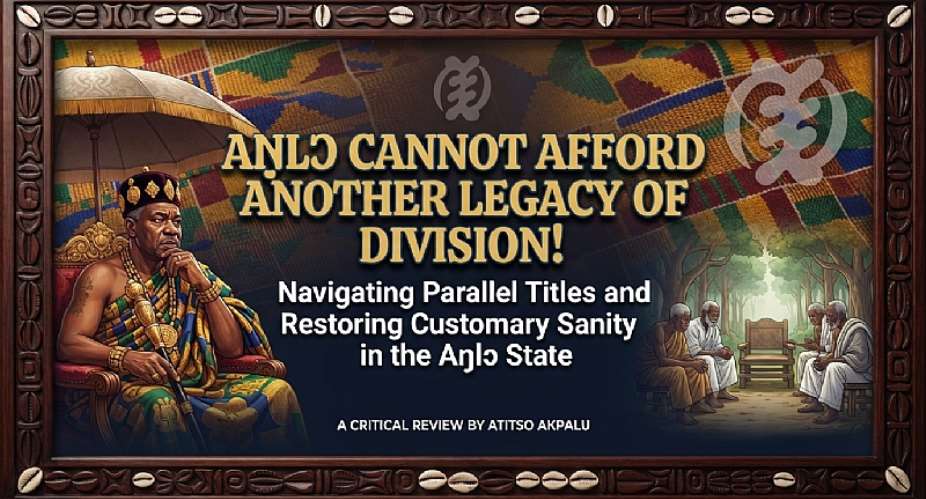
The sacred canopy of the Aŋlɔ State, historically woven with threads of absolute valor, meticulous traditional hierarchy, and spiritual cohesion, faces an internal philosophical and structural tremor. Traditional authority is fundamentally designed to be an immutable source of communal unity, historical preservation, and structural peace—not a breeding ground for overlapping jurisdictional mandates or conflicting ancestral claims. As our elders wisely say, “Ame ɖeka pɔ mado go kpo o”—one person alone cannot build a community, nor can an individual rewrite the ancient boundary lines of our heritage without tearing the social fabric apart. Following the passing of the revered Tɔgbi Addo VIII of Klikɔ, the traditional landscape has been forced into an unavoidable moment of profound introspection. The contentious creation of parallel arrangements, including the enstoolment of a second "Tɔgbi Ʋenya" and a queenmother whose background has generated massive social friction, leaves the state at a critical historical juncture. Aŋlɔ has endured enough fractional stress; it can no longer afford to sweep these systemic anomalies under the customary carpet or pretend that institutional dilution comes without severe modern consequences. “Nku tsi anyi hã, manya fia mɔ o”—the eye may be blind, but it must never forget the path to its own home. It is time to look back at our true foundations.
The Core Chieftaincy Anomalies and Structural Friction Points
- The Proliferation of Parallel Titles: The installation of a secondary Tɔgbi Ʋenya title directly undermines the central historical architecture of the Aŋlɔ State, fracturing clear lines of lineage authority and violating the sacred tenet that “Fia eve nɔa anyie ɖeka dzi o”—two kings cannot sit upon a single stool.
- The Secularization and Dilution of Chieftaincy Sanctity: The enstoolment of traditional figures whose public backgrounds clash directly with the deeply sacred, spiritual, and moral expectations of customary offices has eroded public reverence for these positions, proving that “Ati gbadza mefia mɔ o”—a crooked branch cannot provide a straight path for the community.
- Jurisdictional Overlaps Post-Tɔgbi Addo: With the demise of Tɔgbi Addo VIII, the sub-traditional arrangements he personally engineered lack clear institutional legitimacy, creating an immediate power vacuum and competing claims regarding who holds the rightful authority to maintain or dissolve them.
- The Risk of Inter-Communal Discord: Allowing uncoordinated traditional titles to persist creates an inheritance of discord for the youth, dividing families, clans, and communities across the Volta Region along factional lines rather than uniting them under the absolute authority of the Awɔmefia.
- Exploitation of Customary Flaws: The ongoing friction leaves our time-tested traditional institutions vulnerable to external socio-political manipulation, reducing sacred spaces to tools for personal aggrandizement and ignoring the timeless biblical truth that “A kingdom divided against itself cannot stand” (Mark 3:24).
Strategic Recommendations and Customary Suggestions
- Immediate Invocation of the Aŋlɔ Traditional Council Mandate: The Awɔmefia, Tɔgbui Sri III, in coordination with the institutional structures of the Aŋlɔ Traditional Council, must take decisive, formal custody of all outstanding jurisdictional disputes left behind in the wake of Tɔgbi Addo's demise.
- Comprehensive Customary Audit of Contested Enstoolments: Establish an independent committee of state linguists, stool fathers (Fiasigawo), and custodians to scrutinize the legitimacy of the secondary Tɔgbi Ʋenya title and determine its alignment with native law and custom.
- Enforcement of Strict Moral and Character Benchmarks: Codify unambiguous customary eligibility criteria for prospective chiefs and queenmothers, ensuring that any individual elevated to a sacred stool possesses an unblemished public standing that reflects the absolute dignity of the ancestors.
- Formal Dissolution or Merging of Sub-Arrangements: Transition the controversial arrangements into existing, historically recognized clan structures to prevent the permanent institutionalization of parallel traditional hierarchies.
- Youth-Centered Heritage Education: Launch targeted community workshops and educational symposia across the Volta Region to re-educate the younger generation on the definitive history of the 15 clans of the Anlo State and the specific, unalterable roles of historic leadership offices.
History remains a dispassionate recorder of our collective actions and our silent compromises. The legacy we leave for the coming generations must not be an untamed jungle of competing traditional titles, court injunctions, and moral ambiguities. As the legendary Dagomba proverb popularized by ABA Fuseini reminds us, “No matter how long a log stays in the water, it can never turn into a crocodile.” Temporary political expedience can never transform a manufactured title into an ancestral truth. Aŋlɔ’s greatness was never built on the fragile foundations of division, but on the unshakeable rock of structural solidarity and absolute respect for ancient truth. As custodians of a glorious past, our contemporary leaders, stool fathers, and citizens owe it to the memory of our ancestors to clean the state's traditional slate with courage and transparency. Let this chapter be remembered not as the era when Aŋlɔ fractured under the weight of uncoordinated individual ambitions, but as the golden moment when her people chose unconditional unity, institutional integrity, and structural sanity over a legacy of discord. Aŋlɔ Kotsiklolo, naketi ɖeka nɔ dzo me bi nu! Let us unite for the peace and development of our homeland.
✍️By A Concerned Retired Senior Citizen
For and on behalf of all Senior Citizens of the Republic of Ghana 🇬🇭
Teshie-Nungua
[email protected]


 Transport Minister calls for efficient, digitalised ports to strengthen Ghana’s ...
 GPHA honours industry players, former leaders and staff at 40th anniversary awar...
 Nii Lante Vanderpuye confident of winning NDC national chairmanship despite Gold...
 E/R: Motor rider killed, one injured in Asiakwa crash
 Agalga dismisses critics, assures Builsa North of progress on Sandema–Wiaga Road
 NDC Lawra constituency polls: We are not going to disappoint you – Chairman Bati...
 Ghana's President Mahama calls for new West African security accord, stronger AU...
 France and Britain test NATO readiness with major airborne exercise in Germany
 Israel to close all West Bank land crossings on election day
 What to know as Brazilians choose between Lula and Bolsonaro in tense presidenti...


