




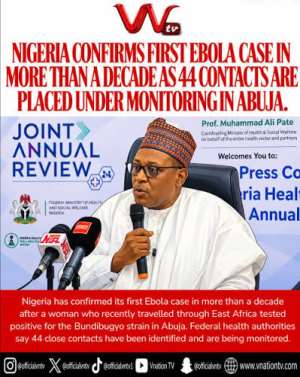
Nigeria has confirmed an imported case of Ebola in Abuja, prompting contact tracing and heightened infection-control measures as a major outbreak continues in the Democratic Republic of the Congo.
The World Health Organization said laboratory testing confirmed Bundibugyo virus disease on October 20, 2026, in a woman who had recently travelled to Uganda. According to its account, she developed symptoms on October 7, four days after arriving in Nigeria, and sought care at a private health facility on October 11. She was subsequently placed in isolation for medical care.
The case is Nigeria’s first reported Ebola infection in more than a decade. On October 22, Health Minister Muhammad Ali Pate said it remained isolated, with no evidence of community transmission. That assessment provides reassurance, although continued surveillance is necessary to identify any additional infections.
WHO’s initial announcement reported that 44 contacts had been identified and were being monitored, while investigations continued into the patient’s travel history and likely source of infection. Travel through an affected region does not, by itself, establish where exposure occurred. The Nigeria Centre for Disease Control and Prevention activated its incident management system to coordinate the response.
The wider outbreak remains severe. WHO’s situation report, using data available on October 19, recorded 9,637 confirmed cases and 4,646 confirmed deaths in the Democratic Republic of the Congo, representing a reported case-fatality ratio of 48.2 per cent. Transmission had affected 66 health zones across eight provinces. Insecurity, displacement and restricted humanitarian access were complicating surveillance and response operations. These dated figures should not be presented as a live regional total.
The Bundibugyo virus responsible for the outbreak has no licensed vaccine or specific treatment, according to WHO. Research into candidate medical products is continuing. This makes early detection, effective clinical care and interruption of transmission particularly important.
The absence of a specific medicine does not mean patients cannot be helped. Early supportive treatment, including rehydration and management of symptoms and complications, can improve survival. Ebola spreads through direct contact with infected blood or other bodily fluids, or contaminated materials. Initial symptoms can resemble other illnesses, making careful clinical assessment and laboratory testing essential.
Nigeria’s immediate challenge is to find potentially exposed people, monitor them and rapidly investigate any symptoms. Protecting healthcare workers is equally important, particularly in facilities where patients may first seek treatment before Ebola is suspected.
For neighbouring countries, the case reinforces the value of preparedness across the health system. Border monitoring must be supported by alert clinicians, safe laboratories, equipped treatment facilities and clear communication with communities. People need accurate information that encourages early reporting without exposing patients, families or travellers to stigma.
Nigeria’s experience demonstrates why an imported infection requires a prompt response without assuming that widespread transmission has occurred. The priority is sustained, transparent public-health action: identify cases quickly, protect those providing care and keep communities informed as evidence develops.


 Attorney-General appeals ruling halting trial of former Buffer Stock CEO, wife
 NAIMOS destroys 1,970 changfans, 863 Illegal mining structures in three months —...
 Let's see how Asiedu Nketia becomes NDC flagbearer with same people he conspired...
 Asiedu Nketiah opts out of NDC chairmanship race amid flagbearership speculation
 NDC insists Nkwanta North elections will proceed despite court injunction
 'My side of the story will shock you; I'm waiting for court days' – Obuasi SHTS ...
 Obuasi SHTS sexual abuse: 'GES must distant itself, allow the law to work' — For...
 Upper East: Fear grips nine Kusaug communities over mysterious fish deaths in da...
 NDC suspends Amasaman Communications Officer over 'irresponsible' remarks on Obu...
 Parliament secures religious leaders’ support to end witchcraft accusations


