




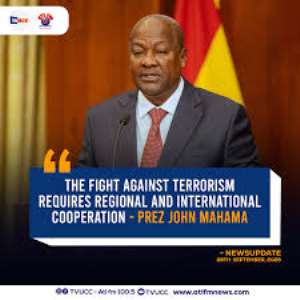
President John Dramani Mahama has expressed openness to international assistance against terrorism in West Africa, placing emphasis on a partner’s commitment to regional security. Speaking at the Financial Times Africa Summit in London on October 21, 2026, he said he was not concerned about Russian security assistance in the Sahel. He also attributed delays in deploying a West African standby force to the absence of a United Nations resolution that could help secure financing, Reuters reported.
His position reflects Ghana’s wider approach to foreign relations. According to the Ghana News Agency, Mahama reaffirmed the country’s non-aligned outlook and called for renewed regional security cooperation. He noted that Ghana already works with the United Kingdom, Germany, France and the United States through intelligence sharing and joint training, while encouraging Sahelian countries to accept assistance from partners willing to help confront terrorism.
The remarks raise an important policy question: how can countries with different international relationships cooperate effectively against a shared threat?
Regional political divisions make that task more complicated. Burkina Faso, Mali and Niger formally withdrew from the Economic Community of West African States on January 29, 2025. Their departure changed the institutional framework through which neighbouring governments manage common challenges.
Withdrawal from a regional organisation, however, does not remove the need for practical cooperation. Border surveillance, intelligence exchange and coordinated responses depend on communication between neighbouring authorities. A workable security arrangement must therefore find ways to connect ECOWAS members with the three Sahelian states while respecting national sovereignty.
Mahama’s financing concern also deserves careful interpretation. The United Nations already has a framework for supporting certain African-led operations. Security Council Resolution 2719, adopted in December 2023, allows qualifying African Union-led peace support missions to receive UN assessed contributions covering up to 75 per cent of their annual budgets, subject to case-by-case authorisation. That framework does not automatically finance every proposed regional deployment.
The practical implication is that political agreement to establish a force must be followed by a clear mandate, operational planning and dependable financial commitments. Troops require transport, equipment, medical support, communications and sustained logistics. Announcing a deployment without securing these foundations risks creating expectations that governments cannot fulfil.
International assistance should likewise be assessed through its results. Useful partnerships should strengthen national institutions, improve civilian protection and support accountable security operations. Transparency over responsibilities and respect for human rights should form part of that assessment, alongside military effectiveness.
A durable response must also extend beyond armed operations. Governments need to protect livelihoods, maintain essential services and build confidence between communities and public authorities. Security measures are more likely to endure when citizens can report threats safely and trust the institutions responsible for protecting them.
Mahama’s remarks offer an opening for a broader conversation about cooperation across West Africa’s political divisions. Turning that opening into progress will require clear agreements, reliable funding and shared responsibility. The ultimate measure should be whether communities become safer and governments become better equipped to prevent violence.


 Attorney-General appeals ruling halting trial of former Buffer Stock CEO, wife
 NAIMOS destroys 1,970 changfans, 863 Illegal mining structures in three months —...
 Let's see how Asiedu Nketia becomes NDC flagbearer with same people he conspired...
 Asiedu Nketiah opts out of NDC chairmanship race amid flagbearership speculation
 NDC insists Nkwanta North elections will proceed despite court injunction
 'My side of the story will shock you; I'm waiting for court days' – Obuasi SHTS ...
 Obuasi SHTS sexual abuse: 'GES must distant itself, allow the law to work' — For...
 Upper East: Fear grips nine Kusaug communities over mysterious fish deaths in da...
 NDC suspends Amasaman Communications Officer over 'irresponsible' remarks on Obu...
 Parliament secures religious leaders’ support to end witchcraft accusations


