




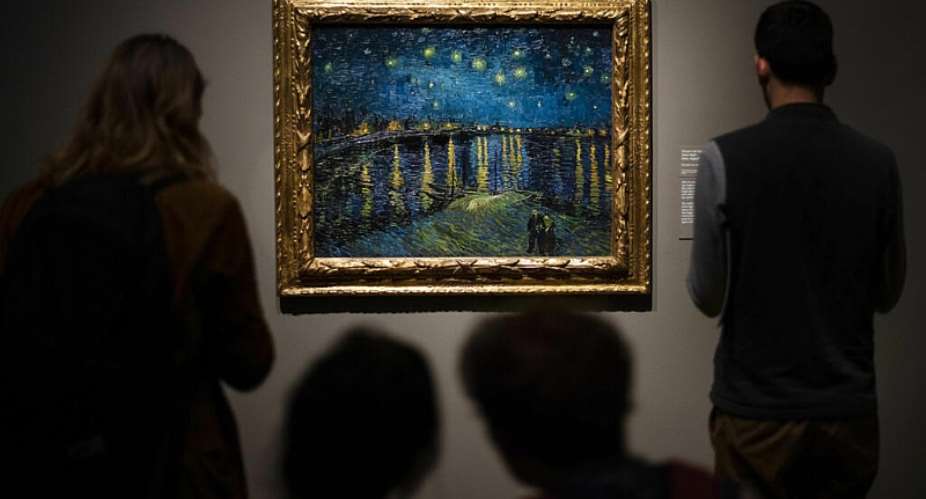
Scientists doubling as art detectives have traced Vincent van Gogh's painting “The Starry Night” to a celestial scene that suggests a new date for one of the world's most famous paintings.
Their findings indicate that rather than being a product of van Gogh's imagination, “The Starry Night” may have been inspired by what he saw as he gazed heavenward from his French asylum 137 years ago.
A South Korean team reported Thursday that after years of forensic astronomy and research into the Dutch artist, they have matched his masterpiece to a predawn sky over France's Saint-Remy de Provence right around July 22, 1889.
That's a month later than the long-accepted time frame for the postimpressionist painting depicting a crescent moon and Venus surrounded by a sky of swirling stars with a village nestled below and cypress trees looming on one side.
Read more Climate activists target art: Van Gogh's masterpiece 'Sunflowers' defaced
Art historians have long dated the painting to June 1889, soon after Van Gogh checked into the asylum. He'd cut off his left ear several months earlier during an argument with painter Paul Gauguin.
A team led by Elijah Jeong-hyun Kim, the CEO of a Seoul telescope maker, is now disputing that date in a study appearing in the journal Scientific Reports.
The sky that is most similar to the painting occurred around July 22, 1889, said Kim, who is also a doctoral candidate at Kyung Hee University. He noted that the few days before and after could have inspired van Gogh as well.
“No two skies are the same. Something always changes. I believe Vincent noticed those changes and put them into the painting,” Kim said in an email.
He added: “I am confident that July 22 is the better date. I will bet on this date.”
The latest study addresses “a real puzzle” that in mid-June 1889, the moon was not the thin crescent painted by van Gogh, said Jose Luis Aragon at the National Autonomous University of Mexico. He has studied “The Starry Night” as a physicist, but did not take part in the new research.
“Still, I would see the July date as an intriguing hypothesis rather than a settled answer,” Aragon said in an email.
Long fascinated by van Gogh's art, Kim traveled to France in 2019, the first time in mid-June and the second around July 22. He found brilliant stars rising in July's predawn sky, unlike June.
Kim and his team discovered through further celestial sleuthing that around July 22, 1889, the shape of the moon before dawn appeared like the one in the painting, with the Hyades star cluster in the constellation Taurus rising in the east alongside Venus. The sky should have been clear enough for van Gogh to see all this, based on their weather analyses.
Van Gogh is thought to have suffered a seizure around that time in July. But Kim and his team contend that the seizure occurred later in July, based on their analyses of letters between the painter and one of his brothers. Some of those letters refer to cicadas, another clue that points toward the hotter July, according to Kim.
The researchers tested and verified their methods on night skies in other paintings, making for what Aragon considers “a careful and genuinely interdisciplinary study”.
Read more Postcard provides clue to exact spot of Van Gogh's last painting, says researcher
Since van Gogh painted in a studio at the asylum from sketches and memory, “the sky is likely a composite of many nights as the authors themselves acknowledge", Aragon said.
“What I find most convincing is the broader message: The painting is not pure fantasy. Van Gogh watched the real sky very closely," Aragon said.
Despite all his research, Kim has never seen “The Starry Night” at the Museum of Modern Art in New York.
“Now that the paper is out, I really have to go and see 'The Starry Night' in person, don't I?” he said.
(FRANCE 24 with AP)


 Attorney-General appeals ruling halting trial of former Buffer Stock CEO, wife
 NAIMOS destroys 1,970 changfans, 863 Illegal mining structures in three months —...
 Let's see how Asiedu Nketia becomes NDC flagbearer with same people he conspired...
 Asiedu Nketiah opts out of NDC chairmanship race amid flagbearership speculation
 NDC insists Nkwanta North elections will proceed despite court injunction
 'My side of the story will shock you; I'm waiting for court days' – Obuasi SHTS ...
 Obuasi SHTS sexual abuse: 'GES must distant itself, allow the law to work' — For...
 Upper East: Fear grips nine Kusaug communities over mysterious fish deaths in da...
 NDC suspends Amasaman Communications Officer over 'irresponsible' remarks on Obu...
 Parliament secures religious leaders’ support to end witchcraft accusations


