




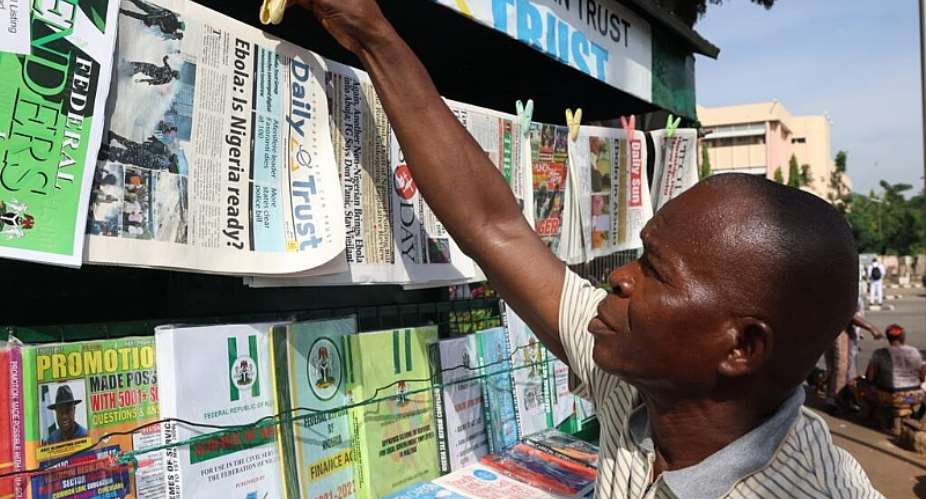
The Nigerian patient is a woman who returned to the capital, Abuja, from Uganda on 3 October. Kaseya said she had stayed in Kampala, the Ugandan capital, and had never visited the Democratic Republic of Congo (DRC). If his account is correct, it would point to transmission in Uganda, which the Ugandan authorities deny.
Uganda's health ministry said the woman had travelled to eastern DRC on business and only passed through Uganda. On Thursday, Pavel Ursu, the World Health Organization (WHO) representative in Nigeria, said the travel information supplied to the global body mentioned Uganda but no other country.
Kaseya said the woman was not diagnosed until 16 days after arriving in Nigeria, leaving health officials potentially facing a large number of contacts to trace. The WHO said 44 contacts had been identified and were being monitored, while investigators worked to establish where she became infected.
Widening crisis
The epidemic was declared in the DRC on 15 May. It is now the second-largest Ebola outbreak on record, the US Centers for Disease Control and Prevention (CDC) said. Its latest figures, which cover the period from the Strat of the outbreak until Wednesday, show 9,735 confirmed cases and 4,690 deaths – overwhelmingly in the DRC.
This epidemic has been caused by the Bundibugyo virus, a type of Ebola for which there is no approved vaccine or specific treatment. WHO declared the outbreak a global health emergency on 17 May.
Ebola spreads through direct contact with the blood or other bodily fluids of someone who is unwell with the disease or has died from it, or with contaminated materials. People do not transmit it before symptoms appear. Symptoms can take up to 21 days to develop, which is why contacts are monitored for 21 days.
Kenya searches for missing Ugandan contact as Ebola cases rise
Kaseya told RFI that countries needed to strengthen Ebola surveillance, and clarified comments he had made about international funding for the response which had attracted criticism.
RFI: How worrying is Nigeria's first Ebola case in this outbreak?
Jean Kaseya: It shows that the outbreak is serious. We expect a large number of contacts. I speak very regularly with Nigeria's health minister, Muhammad Ali Pate, who is doing an excellent job.
The patient returned to Abuja on 3 October and developed symptoms on 6 October. She went to one private health facility, then another, before being admitted to hospital on 11 October. She was diagnosed on Monday. So we do expect a large number of contacts.
RFI: Before arriving in Abuja, the woman passed through Entebbe airport in Uganda after travelling from the DRC. Is that right?
JK: No, she never went to the DRC. She spent two weeks in Kampala with her husband and never left the city. She then travelled from Kampala to Abuja via Addis Ababa. She said she had no symptoms when she arrived in Abuja. The symptoms began a few days later.
Remember, symptoms can appear anywhere from zero to 21 days after infection. You could catch the virus one day and fall ill three days later, six days later or as late as day 20.
RFI: Does that mean there are Ebola cases in Uganda, contrary to what its authorities are saying?
JK: That is something we will discuss with the Ugandan authorities, to establish exactly where the woman stayed and who she was in contact with. I am also calling a major meeting of all African ministers on Wednesday to discuss cross-border movement.
Above all, we need to recognise that no country is safe unless we strengthen surveillance, not just at borders but in private and public health facilities too. Jean Kaseya, director general of the Africa Centres for Disease Control and Prevention, said countries must strengthen Ebola surveillance at borders and in health facilities.
RFI: Has the outbreak passed its peak?
JK: First, it is spreading geographically within the DRC, where eight provinces are now affected. Second, it is spreading across Africa. Third, there are still around 65-70 new cases a day. With the virus continuing to circulate, and many cases emerging in the community, we say the outbreak remains serious and is not yet under control.
RFI: Kenya has recorded nine cases, including one death. Is next June's Africa Cup of Nations football tournament, which Kenya is co-hosting with its neighbours Uganda and Tanzania, at risk?
JK: No. Let me be very clear. The Africa Cup of Nations is not at risk at this stage because Kenya is doing an excellent job. All nine cases identified in Kenya were already on the contact list. Uganda now has a very extensive contact list, with around 140 people on it. Uganda has done an excellent job.
We need to search thoroughly for cases. The outbreak remains serious in the DRC, and you will have seen the case of the person who travelled through Uganda to Kenya. I think important work is being done in both countries.
So I am not particularly concerned about the Africa Cup of Nations. I will discuss it with Patrice Motsepe [president of the Confederation of African Football]. We will have a meeting to discuss all this. But I think my advice to him will be that, at this stage, there is no cause for concern about the Africa Cup of Nations.
RFI: Last week in Kinshasa, the DRC's capital, you said the country's authorities had no information about roughly $700 million of the $962 million raised by the international community, and that this was unacceptable. Some people took your comments about a lack of clarity in the management of Ebola funding to imply that the money had been embezzled…
JK: There is no need to read between the lines. I said it very clearly. I said there was a lack of clarity because the government had no knowledge of these resources. I never said the money had been embezzled. I never said it had been misused. All we want is for governments to know about everything coming into their countries. That is what the African sovereignty we promote every day should mean.
RFI: So you have no suspicions?
JK: We have no suspicions. We are seeking information. We are building a partnership based on respect and transparency. African governments want to work with everyone. Africa CDC works with everyone. But we want partners who come and work with us to be fully transparent.
This story was adapted from the original version in French by Christophe Boisbouvier, using additional information from newswires.


 Attorney-General appeals ruling halting trial of former Buffer Stock CEO, wife
 NAIMOS destroys 1,970 changfans, 863 Illegal mining structures in three months —...
 Let's see how Asiedu Nketia becomes NDC flagbearer with same people he conspired...
 Asiedu Nketiah opts out of NDC chairmanship race amid flagbearership speculation
 NDC insists Nkwanta North elections will proceed despite court injunction
 'My side of the story will shock you; I'm waiting for court days' – Obuasi SHTS ...
 Obuasi SHTS sexual abuse: 'GES must distant itself, allow the law to work' — For...
 Upper East: Fear grips nine Kusaug communities over mysterious fish deaths in da...
 NDC suspends Amasaman Communications Officer over 'irresponsible' remarks on Obu...
 Parliament secures religious leaders’ support to end witchcraft accusations


