




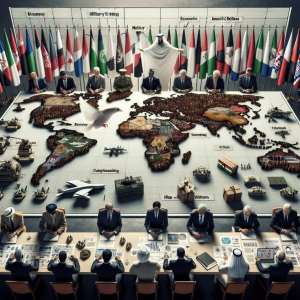
For most of the last decade, artificial intelligence meant machines that read and wrote. They could finish your sentence, summarise your contract, and pass your exam. Impressive, certainly, but it all happened on a screen.
That is changing. The World Economic Forum and Frontiers put "world models" at the top of their Top 10 Emerging Technologies of 2026 list, describing AI systems that learn how the physical world behaves from multi-modal data and can predict outcomes in scenarios like superstorms. The report was published on 23 June 2026, in its 14th edition, and unveiled at the Summer Davos forum in Dalian, China.
One line in the coverage stayed with me. Eight of the ten technologies on the list act directly on physical systems. The machine has stopped being only a talker. It is learning how rain falls, how a bridge bends, how a body reacts to a drug. And if you are reading this from Accra, Lagos, Nairobi, Kumasi or Manchester, you should be asking a plain question: who owns that understanding?
The 2026 spark
A world model is not a chatbot with better manners. Think of a child learning that a dropped cup falls and breaks. Nobody gives the child a rulebook; they build an internal picture of how things work and use it to predict what comes next. World models try to give machines that picture, so they can run a thousand "what ifs" before anything real is touched.
The Forum's own framing is that these technologies are becoming more personal, designed around one patient or one context rather than a standardized whole, and that many do more with less. The methodology matters too. The workflow screened more than 1,200 candidate technologies before expert review whittled the list down. The Forum says these technologies are expected to reach real-world impact within the next three to five years.
That is not a distant horizon. It is roughly one presidential term, or one university degree. Some of the children now starting primary school will be entering the job market when it lands.
Data extraction, physical AI and geography
Here is the uncomfortable part. A world model is only as good as the world it was shown.
Teach a machine about weather using decades of satellite and sensor data from Europe and North America, and it will understand those skies well. Ask it about a rainy season in the Volta basin, a flooded street in Kumasi, or soil in the Sahel, and it may be guessing. The same goes for maps, faces, accents, crops, diseases and traffic. Data is not neutral. It is collected somewhere, by someone, for a reason.
This is what I call the geography of intelligence. The raw material, which is data about our farms, our hospitals, our voices and our cities, is often gathered from the Global South and processed elsewhere. The value is then sold back to us as a subscription. Anyone who knows the history of cocoa will recognise the shape of that story. We grow the beans, and somebody else makes the chocolate and keeps the profit.
Physical AI raises the stakes, because mistakes now have weight. A language model that gets a fact wrong embarrasses you. A model that misreads a road, a tumour or a flood plain can hurt you.
Algorithmic reparations
Which brings me to an idea that will make some readers uneasy: algorithmic reparations.
The argument runs like this. If the systems of tomorrow are built partly from data extracted from communities that never saw the benefit, then fairness demands more than a polite thank-you. It could mean local data ownership, revenue sharing, compute and training facilities built on the continents that supplied the data, and models trained on African languages and African realities by African engineers.
Critics will say this is unworkable, that data is borderless and that markets do not do reparations. Fair points. But the same critics were once certain that mobile money would never work in Africa, and Ghanaians have been paying for kenkey with their phones for years. The question is not whether the idea is tidy. It is whether we are willing to design the rules before the machines harden them into place.
The 2050 horizon: cognitive sovereignty
If 2026 is the spark, 2050 is the question of who holds the match.
By cognitive sovereignty I mean the right of a nation, a community or a person to think with their own tools, on their own terms, without renting their intelligence from someone else. Energy independence and food security were the big arguments of the last century. Cognitive independence may be the argument of this one.
A country that cannot build, audit or host its own AI is not truly sovereign over its health system, its farms, its schools or its security. It is a tenant.
The inventions waiting on the road
The rest of this article is forward-looking. What follows are expectations drawn from where research is heading, not guarantees, and I would not bet my pension on any particular date.
Medicine at the smallest scale. Nanomedicine aims to deliver drugs to exactly the cells that need them, leaving healthy tissue alone. Picture tiny carriers that find a tumour the way a good courier finds a house in a crowded estate. "Nano-medics" is an idea still being explored, but the direction is clear: treatment that is precise rather than blunt.
Digital twins. A digital twin is a living computer copy of something real, such as a heart, a factory or a whole city. Doctors could test a treatment on your twin before they ever touch you. Engineers could crash a bridge virtually a million times. World models are the engine that makes such twins believable.
CRISPR and regenerative medicine. Gene editing has already moved from the laboratory to patients in some inherited blood disorders, and sickle cell disease is a condition many Ghanaian families know painfully well. If the cost falls, this could change lives here. If it stays in the price bracket of a luxury car, it becomes another medical gap between rich and poor. Regenerative medicine, which grows or repairs tissue instead of replacing it, follows the same fork in the road.
Brain-computer interfaces. Early systems already help paralysed patients move cursors and communicate through thought. The promise is enormous. So is the privacy question: if a device can read intention, who is allowed to read the reading?
Quantum computing and AGI. Quantum machines could one day simulate molecules and materials in ways ordinary computers cannot, which matters for drugs, batteries and fertiliser. Artificial general intelligence, a system that can handle any intellectual task a human can, remains the most argued-over idea in the field. Serious scientists disagree about whether it is years away, decades away, or a mirage. Anyone who gives you a confident date is selling something.
Moving faster and further. Autonomous and high-speed transport, from driverless freight to maglev and hyperloop-style ideas, could shrink distances. Personal air vehicles, the so-called flying cars, are being tested in several countries, though regulation, noise and safety will decide whether you ever see one above Spintex Road. Further out, lunar bases and orbital manufacturing sit in the realm of serious planning by space agencies and private firms, built on the logic that some materials can be made better in microgravity.
Powering all of it. Controlled nuclear fusion, the process that powers the sun, would offer abundant clean energy if it can be made to produce more power than it consumes at commercial scale. Researchers have shown the science can work in the lab, but turning that into a power station is an engineering marathon. Alongside it, biotechnology and carbon capture aim to feed people and clean up the atmosphere. None of them is a magic switch, and each is expensive.
I should be honest about one thing. I have confirmed from the Forum's published material that world models topped the 2026 list. I could not verify here that every item above appears in it, so I treat many of them as the wider horizon rather than as the Forum's official ranking.
Cognitive equity: the real battle
Look across that list and one pattern repeats. Each technology can be a ladder or a wall, depending on who is allowed to climb.
Cognitive equity means that the benefits of machine intelligence, and the ability to shape it, are not hoarded. It means a student at a technical university in Accra can build and test world-class systems, not only consume them. It means health models that understand African bodies, farming tools that understand African soil, and legal and educational systems that speak our languages.
The Forum's own managing director has said that what happens next depends on the choices being made now. I agree, and I would add that those choices should not be made in rooms where we are absent.
What now?
Governments can fund local compute and open data standards. Universities can train engineers who build rather than only operate. Companies can share value with the communities whose data they use. And ordinary people, readers like you, can demand to know where their data goes and who profits from it.
The machines are learning the world. The only question left is whether the world, all of it, gets a say in what they learn.
Chief Tutu Baffour Brownsy Williams is an author, columnist, filmmaker and founder of Brownsy Silva Company.


 NDC suspends Amasaman Communications Officer over 'irresponsible' remarks on Obu...
 Parliament secures religious leaders’ support to end witchcraft accusations
 New Economy policy must address Ghana’s skills gap and import dependence – Sam O...
 GES mourns four pupils killed in Aboabo Junction accident
 CSA, NITA issue seven-day directive to government agencies to patch critical PHP...
 Critics unfairly expect Prof Opoku-Agyemang to make emotional statements about i...
 Obuasi SHTS sexual abuse: Let's not get overly emotional to hang an innocent man...
 Africa faces 'complex' Ebola outbreak after spread to Nigeria: WHO
 Kwame Dzokoto reportedly dead
 Ghana intensifies airport screening and Ebola surveillance amid reported cases i...


