




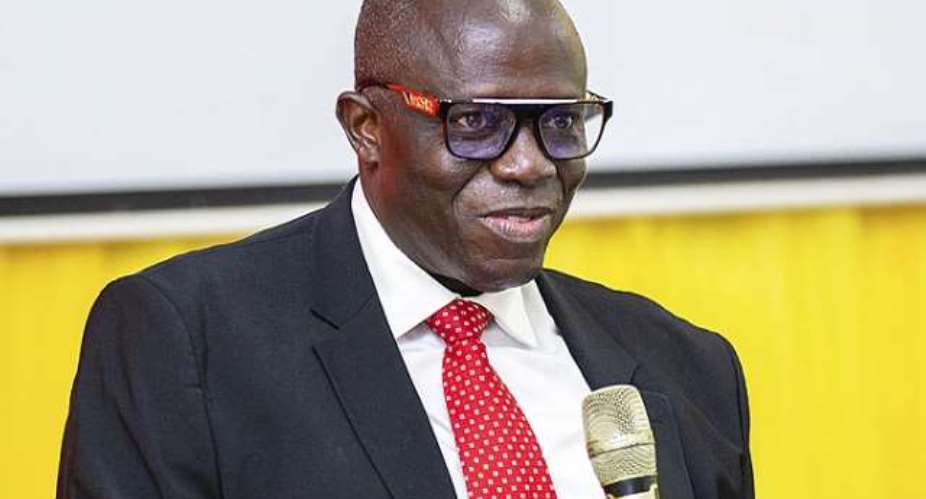
Sir Justice Dennis Dominic Adjei, a Justice of the Supreme Court of Ghana and Judge of the African Court on Human and Peoples’ Rights, has stressed that justice must be measured by the extent to which ordinary citizens can access their rights and public services.
He said justice emanates from the people but should not be assessed through opinion polls or abstract measures, but by examining whether vulnerable citizens can access the courts and essential services.
“It is measured whether children in remote communities have teachers and whether the aged live with dignity. Judicial justice must resolve disputes and protect rights through fair procedures,” he stated.
Sir Justice Adjei made the remarks at the inaugural Annual St. John the Baptist Memorial Lecture in Accra, organised by the Joint Board of the Supreme Subordinate Commandery and Ladies’ Auxiliary of the Knights of St. John International, Ghana.
The lecture, held on the theme, “Speaking Truth to Power: Upholding Justice, Morality, and National Accountability,” brought together the Vice-President, Speaker of Parliament, superior court justices, religious and traditional leaders, members of the diplomatic corps and other dignitaries.
Sir Justice Adjei said the quality of constitutional citizenship should be assessed by the actual conditions in which people live rather than the existence of policies, programmes or physical infrastructure.
“A country may have an impressive court building while leaving the poor unable to reach it. It may publish an education policy while children in remote communities lack teachers. These are questions about the substance of constitutional citizenship,” he stated.
Children’s rights
Citing Article 28 of the 1992 Constitution, the Supreme Court Justice said the state has a responsibility to provide special protection for children and ensure that their interests remain paramount.
He said children must be protected from work that threatens their health or education, while Article 28(4) protects them from being denied medical treatment or education solely because of religious beliefs.
“Children’s opportunities should be tested in the classroom and clinic, not measured only by the number of programmes announced,” he stated.
Rural-urban inequality
Sir Justice Adjei also referred to Article 36(2)(d), which provides for even and balanced development and the correction of rural-urban imbalances.
He said access to basic infrastructure and services such as roads, safe drinking water, agricultural support and healthcare directly affects citizens’ standing within the Republic.
“A usable road, safe drinking water, agricultural support and accessible health care concern people’s standing within the Republic. The remoteness of a community cannot make its needs constitutionally remote,” he stated.
He further cited Article 37(6) and Article 18(4) of the African Charter in emphasising the need for respect for older persons to be reflected through access to care, income security and protection from exploitation.
Witch camps
The African Court Judge also expressed concern about the plight of persons living in so-called witch camps, particularly women who face accusations and violence.
He said the dignity of such persons should not depend on their ability to disprove allegations of supernatural wrongdoing.
“Their dignity does not depend upon disproving an allegation of supernatural wrongdoing. Articles 15 and 17 protect dignity and equality; Article 26(2) prohibits dehumanising customary practices and those injurious to physical or mental well-being. No appeal to tradition can legitimise assault, degrading treatment or coercion,” he stated.
He called for immediate protection of victims, investigations into alleged violence, access to healthcare and legal assistance, as well as safe and voluntary reintegration into communities.
He cautioned that simply closing the camps without addressing the safety of the affected persons could expose them to further danger.
Fairness in resource allocation
Sir Justice Adjei said fairness in national development did not necessarily require identical spending on every community, arguing that equal dignity could demand greater support for areas facing deeper disadvantages.
“What matters is whether priorities rest on defensible needs and transparent criteria rather than partisan loyalty, family connections or electoral importance,” he stated, citing Articles 35(3), 36(2)(d) and 37 as constitutional standards.
Directive Principles of State Policy
The Supreme Court Justice also clarified the legal status of the Directive Principles of State Policy under Chapter Six of the 1992 Constitution.
Citing Articles 34(1) and 34(2), he said the Supreme Court had affirmed a presumption of justiciability for constitutional provisions, including those contained in Chapter Six.
“It would be legally misleading to dismiss the entire chapter as mere aspiration. It would also be misleading to treat every policy objective as an identical, immediately enforceable individual entitlement,” he said.
“The availability and form of a remedy still depend on the particular provision and claim. But the chapter’s express obligations to guide decision-making and report progress remain significant whatever the precise remedy,” he added.
Sir Justice Adjei said Chapter Six provides an important framework for building a just and free society and should therefore be used to scrutinise explanations and decisions made by public authorities.
The memorial lecture, instituted to promote national reflection on conscience, law and accountability, is intended to provide a Catholic-inspired but nationally relevant platform for dialogue on constitutional governance and public responsibility.





 Asiedu Nketiah opts out of NDC chairmanship race amid flagbearership speculation
 NDC insists Nkwanta North elections will proceed despite court injunction
 'My side of the story will shock you; I'm waiting for court days' – Obuasi SHTS ...
 NDC suspends Amasaman Communications Officer over 'irresponsible' remarks on Obu...
 Parliament secures religious leaders’ support to end witchcraft accusations
 GES mourns four pupils killed in Aboabo Junction accident
 CSA, NITA issue seven-day directive to government agencies to patch critical PHP...
 Critics unfairly expect Prof Opoku-Agyemang to make emotional statements about i...
 Obuasi SHTS sexual abuse: Let's not get overly emotional to hang an innocent man...
 Africa faces 'complex' Ebola outbreak after spread to Nigeria: WHO


