




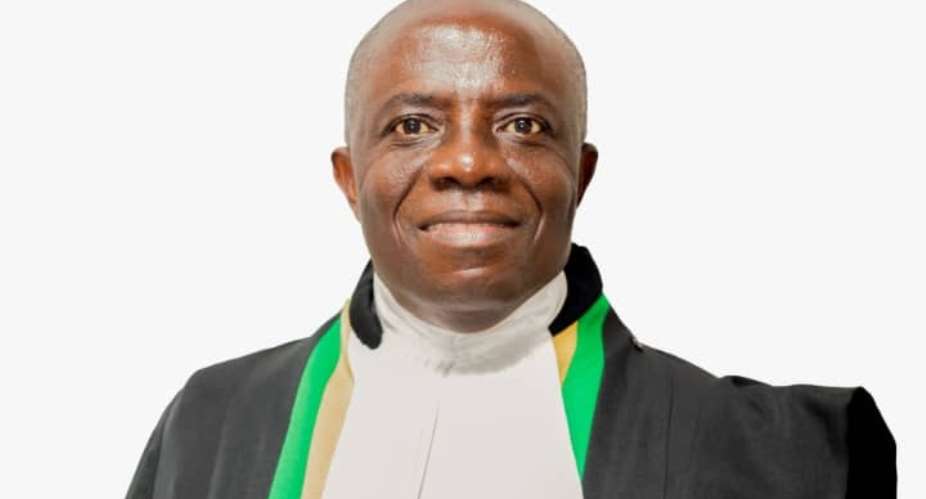
A Justice of the Supreme Court of Ghana and Judge of the African Court on Human and Peoples’ Rights, Sir Justice Dennis Dominic Adjei, has called on the state to move beyond political rhetoric and uphold its constitutional obligations on education, political inclusion and national development.
Speaking at the inaugural Annual St. John the Baptist Memorial Lecture in Accra, he said the 1992 Constitution provides clear principles to guide the country’s development and ensure that citizens benefit equitably from national resources.
The lecture, organised by the Joint Board of the Supreme Subordinate Commandery and Ladies’ Auxiliary of the Knights of St. John International, Ghana, was held on the theme, “Speaking Truth to Power: Upholding Justice, Morality, and National Accountability.”
The event was attended by the Vice-President, Speaker of Parliament, superior court justices, religious and traditional leaders, members of the diplomatic corps and other dignitaries.
Sir Justice Adjei based his presentation on Chapter Six of the Constitution, which sets out the Directive Principles of State Policy. He argued that although the principles are often described as non-justiciable, they remain important benchmarks for assessing the country's progress.
On education, he cited Article 38(1), which requires educational facilities at all levels and in all regions to be provided to the greatest extent feasible. He also referenced Article 38(3)(a), which calls for equal and balanced access to secondary, pre-university and university education, with particular emphasis on science and technology.
He said financial constraints often cited by governments should result in honest prioritisation rather than a failure to explain disparities in educational provision.
"Government should be able to show where facilities are lacking, how teachers are deployed, which learners face barriers, and how spending will improve learning. Admission without a realistic opportunity to attend and learn is an incomplete achievement," Sir Justice Dominic Adjei asserted.
He stressed that measuring educational progress should go beyond enrolment figures to include the quality of education, access for persons with disabilities, provision in rural communities and the circumstances of disadvantaged households.
The Supreme Court Justice also examined the political objectives of the Constitution under Article 35, describing them as a coherent framework for democratic governance.
According to him, the Constitution links democracy, freedom and justice with popular sovereignty while protecting national independence and unity and requiring just and reasonable access to public facilities.
He further drew attention to Article 35(5) and (6), which prohibit discrimination and prejudice based on factors including origin, birth, ethnicity, gender and religion, while requiring national loyalty to transcend sectional interests.
Sir Justice Adjei said the Constitution also calls for reasonable regional and gender balance in public recruitment, freedom of movement of people and goods, and effective administrative and financial decentralisation that enables citizens to participate in decision-making.
"These provisions challenge exclusionary public administration. Decentralization must allow people to influence decisions, not merely relocate an office. National unity requires institutions in which a citizen need not belong to the governing party, the predominant ethnic group, or the majority religion to obtain a public service," he stated.
On economic development, he said Article 36 connects economic management to citizens' welfare, livelihoods, suitable employment and assistance for people in need, while recognising private initiative and social responsibility.
He also highlighted the constitutional provisions concerning the management of public, stool, skin and family lands, stressing that managers of such lands are fiduciaries accountable to beneficiaries.
Referring to Article 36(9), which deals with environmental protection for future generations, he said economic achievements should be assessed by examining both those who benefit from development and the costs imposed on others.
"Economic achievement must therefore be examined through who benefits and what costs are imposed upon others," he explained.
Sir Justice Adjei further cited Article 37, which calls for a social order founded on freedom, equality, justice, probity and accountability, and Article 39, which requires the state to promote Ghanaian cultural values and languages while eliminating traditional practices that are harmful to health and well-being.
He argued that the constitutional framework does not support a development model that focuses solely on material output while neglecting human dignity, participation and cultural identity.
The Supreme Court Justice urged public officials and other duty bearers to regard constitutional accountability as a patriotic responsibility rather than an act of political opposition.
He said speaking truth to power should be understood as an effort to defend justice, morality and the interests of the Ghanaian people.
The Joint Board of the Knights of St. John International said the memorial lecture was inspired by the organisation's patron saint, St. John the Baptist, who fearlessly spoke truth to power even at the cost of his life.
It said the annual lecture would continue to serve as a platform for holding leaders accountable to the ethical responsibilities associated with public office.






 Asiedu Nketiah opts out of NDC chairmanship race amid flagbearership speculation
 NDC insists Nkwanta North elections will proceed despite court injunction
 'My side of the story will shock you; I'm waiting for court days' – Obuasi SHTS ...
 NDC suspends Amasaman Communications Officer over 'irresponsible' remarks on Obu...
 Parliament secures religious leaders’ support to end witchcraft accusations
 GES mourns four pupils killed in Aboabo Junction accident
 CSA, NITA issue seven-day directive to government agencies to patch critical PHP...
 Critics unfairly expect Prof Opoku-Agyemang to make emotional statements about i...
 Obuasi SHTS sexual abuse: Let's not get overly emotional to hang an innocent man...
 Africa faces 'complex' Ebola outbreak after spread to Nigeria: WHO


