




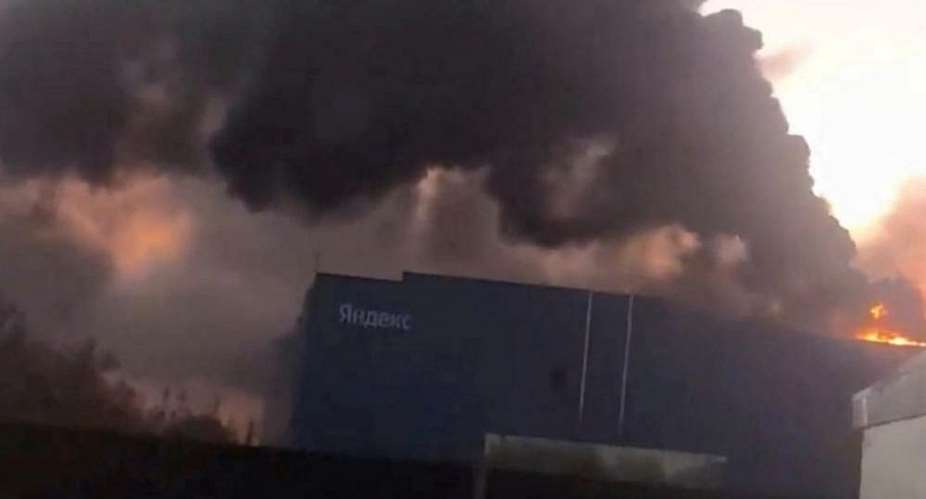
Every summit is a performance of strength. The third Russia-Africa Summit, due in Moscow on 28 and 29 October, is meant to show African leaders that Russia remains a confident, well-connected partner despite sanctions, isolation and a costly war. Between 8 and 11 October, Ukrainian drones complicated that script. Three data centres operated by Yandex, the technology giant behind much of Russia’s digital economy, were reportedly struck in the Ryazan, Kaluga and Vladimir regions. For Moscow and for its African guests, the episode poses a security dilemma that no communiqué will resolve.
The first attack, on the night of 7 to 8 October, reportedly set fire to a facility in Sasovo, in Ryazan region, and suspended operations. A second strike hit a site in Kaluga; a third, in Vladimir region, followed on 11 October. Yandex runs payments, email, navigation, ride-hailing, delivery and cloud computing, so the effects spread quickly. Meduza reported disruptions to Yandex Pay, Mail, Disk and Go, while businesses that depend on Yandex Cloud described outages of their own. One user told the outlet: “All my money is on Yandex, so I have no money for food.” The company says customers’ funds are safe, but the episode shows how one point of failure can become hardship for ordinary people within hours.
Recovery may be slow. Reports suggest that replacing specialised equipment could take months, and Russian officials have reportedly acknowledged the difficulty. That matters beyond one company. Moscow has spent years encouraging reliance on domestic platforms as Western technology withdrew. The Yandex strikes show that domestic ownership is not the same as security. Technological sovereignty also means being able to protect, maintain and restore systems under attack.
Moscow will call such strikes aggression against civilian targets. Yet they come after years of Russian missile and drone attacks on Ukrainian cities and energy infrastructure, so the exposure Russia now faces cannot be separated from the war it chose to launch. That context does not make the risk to visitors any smaller; it explains why it is unlikely to disappear before the summit.
Here lies the first half of the dilemma, and it is Moscow’s. Hosting African leaders in the capital is a statement of confidence, but it also puts that confidence on display. Russia must keep airspace open, transport moving and digital systems running while the war reaches ever deeper into its territory. On 20 September, roughly 450 drones were reportedly aimed at the capital; on 6 October, around 650 struck the Moscow region. Every intercept shows that defences work. Every strike that lands, and every airport closure, suggests the opposite. The summit cannot merely proceed; it must avoid becoming a showcase for exposure. Moscow will almost certainly respond with heavy security, restricted airspace and tightly managed movement. That may protect delegates, but it also turns the gathering into a fortress, held in spite of the war rather than in a country at ease with itself.
None of this proves that Russia cannot protect the summit. Vulnerability to long-range drones is not the same as losing the ability to defend territory, and the more widely a country’s civilian and commercial infrastructure is distributed, the harder it is to shield. Delegations may well land, meet and leave without incident. But that is a probability, not a guarantee, and guarantees are precisely what Russia is selling.
That brings us to the second half of the dilemma, which belongs to African governments. The immediate question is personal safety. In early September, Air Tanzania suspended its Dar es Salaam to Moscow route after a risk assessment, then resumed it days later. Further attacks could prompt airspace restrictions, diversions and tighter security that complicate movement between airports, hotels and venues. These are scenarios, not confirmed disruptions, yet every government weighing the trip must price them in, including the level at which it chooses to be represented.
The deeper question is strategic. Security cooperation is the core of Russia’s offer to Africa: Moscow says it has military agreements with more than 40 African states, and Russian security personnel are embedded in countries such as Mali and the Central African Republic. Governments that rely on that protection are tying their own security to a partner that is itself under sustained attack. A security provider at war is also a provider that is stretched, distracted and targeted. The more a government leans on Russia to guarantee its safety, the more it imports the risks of Russia’s war.
“The more a government leans on Russia to guarantee its safety, the more it imports the risks of Russia’s war.”
Call it a dilemma of dependence. The relationship meant to be a source of protection can become a channel for exposure, and the closer the embrace, the harder it is to step back.
What should African governments do? Engage, but with open eyes. They can ask for written security and contingency arrangements for their delegations, diversify their security partnerships so that no single patron’s vulnerability becomes their own, and insist that cooperation strengthens national institutions rather than simply protecting incumbent governments. Strategic autonomy means having choices. It does not mean choosing between Moscow and everyone else, or accepting one patron’s risks as the price of its protection.
The Kremlin wants the summit to show that sanctions have not isolated Russia. The Yandex strikes complicate that message without defeating it. They pose a simple test for any partner who offers security: can it secure itself? The answer will not come from speeches in Moscow. It will come from whether the summit runs smoothly, and from what follows. Until then, African leaders have every reason to listen politely, travel carefully and commit slowly.
Joseph McCarthy is an analyst and researcher specialising in governance, security and political transitions in the Sahel. He writes on geopolitics, development and African diplomacy. [email protected]
 New Economy policy must address Ghana’s skills gap and import dependence – Sam O...
 GES mourns four pupils killed in Aboabo Junction accident
 CSA, NITA issue seven-day directive to government agencies to patch critical PHP...
 Critics unfairly expect Prof Opoku-Agyemang to make emotional statements about i...
 Obuasi SHTS sexual abuse: Let's not get overly emotional to hang an innocent man...
 Africa faces 'complex' Ebola outbreak after spread to Nigeria: WHO
 Kwame Dzokoto reportedly dead
 Ghana intensifies airport screening and Ebola surveillance amid reported cases i...
 15,000 aspirants to contest NDC constituency executive elections this weekend
 October 22: Cedi sells at GHS12.25 on forex market, GHS11.66 on BoG interbank


