




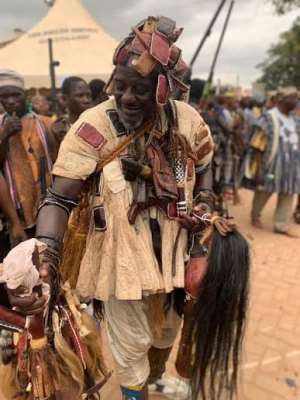
In the history of West African resistance, few names carry the weight of the Nanuŋ Sapashininima (also known as the Kambɔnsɩ). The word Sapashinini is derived from the Akan word Asafohene, meaning “Head of a battalion” or “Military General.” This is translated in Nanuŋ as the Kamonakpema, who heads the Nanuŋ Sapashininima.
These men were not merely a collection of armed fighters; they were a highly disciplined, institutionalized military class bound by a sacred oath to the Kuhá (the Stool). For a Sapashini, the biological instinct to survive was always secondary to the spiritual mandate to protect the sovereignty of Nanuŋ land. Their motto was carved in blood and courage:
“It is better to be a dead lion in the soil of Nanuŋ than a living slave in a foreign land.”
According to Nanung oral traditions, Naa Gmantambu, founder of the Nanuŋ kingdom, established the Nanuŋ Tɔbihi (initially called the Gbandari) — the Nanuŋ army — after migrating to and settling in Nanuŋ towards the end of the fourteenth century. The army was created primarily to protect the land, safeguard the people, and support Naa Gmantambu in the wars of conquest that followed his arrival.
At the head of this formidable force was the Tɔbihi Kpɛma (later known as the Kamonakpema), the supreme military commander who received orders directly from the Bimbilla Naa, mobilizing generals, lieutenants, and rank‑and‑file soldiers through a strict and efficient chain of command.
Contemporary Role and Privileges
Today, the descendants of this legendary martial class continue to hold a unique and esteemed status within the royal court, marked by extraordinary privileges:
- The Nanuŋ Kambɔnsɩ serve as Royal Guards during durbars and public gatherings. They stand vigilantly behind traditional leaders as a human shield. By custom, they never squat when greeting the King, Chiefs, or Queens, as all others are expected to do.
- While Nanuŋ traditional laws strictly forbid ordinary citizens from wearing footwear inside the royal court, the Sapashininima hold a historic exemption. They proudly wear footwear inside the palace — a symbol of their perpetual state of military readiness.
- Their striking ceremonial dress features a distinctive cloth wrapped tightly around the body, known locally as the Chinchini, resembling the war dress of ancient Asante generals. They also wear the Gbɔgnɔ — a vest of armlets and talismans believed to be a local bulletproof vest, spiritually fortified against danger. This parallels the bulletproof vests worn by the Ghana Army during combat operations.
Civil and Economic Duties
Beyond their supreme duty of national defense, the Sapashininima also perform vital civil and economic functions that sustain the kingdom:
- They are exclusively responsible for building and maintaining the royal court (Nayili‑Zɔŋ) and royal rooms meant for the Bimbilla Naa, Queens, and all divisional chiefs.
- They manage the personal and royal farms of the chiefs. Leaders like the Bimbilla Kamonakpema and the Chirifo take direct charge of cultivating the Bimbilla Naa’s farm, with similar arrangements replicated across all divisional chiefs. They ensure that royal granaries in every community remain well‑stocked.
They hold powerful appellations such as:
- Nyɛɛ Zim mi ni wɔligu
- Birigi mɔhu ka tumo labi yiŋŋa
- Kali liɣiri Dari kum
- Chɛ soli ka Dari gbiggbama
They respond to emergency situations such as war, floods, road construction, and the building of local bridges across rivers and streams. Their work mirrors the intervention units of the Ghana Armed Forces responsible for engineering and construction.
The Sacred Stool
The symbol of authority is the Stool, usually kept by the serving Kamonakpema, who leads at any given time. Historically, the stool never appears without pacification; whenever it is brought out, it must be ritually cleansed with milk and a ram. This demonstrates the power and reverence attached to it by the Nanuŋ Kambɔnsɩ. The stool is occasionally carried by a virgin girl to designated locations.
Historical Connections to Asante Warriors
Among the Mole‑Dagomba, the Sapashininima share naming traditions similar to the Asante Asafo warriors who fought in the Asante encounters with the Nanumba and Dagomba. Names such as Kwame, Kofi, Kojo, Kwaku, Kwabena, Asamoah were common among the Asante army, while names like Otchere (Achiri), Montana, Anim, Edu (Adu), Acheampong, Karatia, Boadu (Buaru), Chirifo, Daasu, Jahinfo, Chuanfo represented the warlords under the Asafo head — known to the Nanumba as the Kamonakpema.
Occasions such as Eid festivals and major funerals are moments when the powerful stool is publicly seen.
Warrior Dance
The Sapashininima have a dance called Kambɔnwaa / Sapashiniwaa (the warrior’s dance). They fire muskets during the performance to portray bravery, resilience, and unwavering commitment to serving the land at all costs.
Bound by blood and an iron oath to their ancestors, the Nanuŋ Sapashininima stand as an eternal shield for the land — proving that empires may rise and fade, but the fierce resilience of a true Nanumba warrior never breaks.
[email protected]
Abdul Jelil Maldini
0540366350
References
- "Ghana Districts: A repository of all Local Assemblies in Ghana". www.ghanadistricts.com. Retrieved 2024-03-03.
- Mahama, I. (2004). History and traditions of Dagbon. Tamale, Ghana: GILLBT Printing Press
- Manning, S. (2021). Britain at war with the Asante nation, 1823–1900: "The white man's grave". Pen & Sword Military.
- Montana, I. (2007). Nanung Sapashininitali ni pili shɛm [Unpublished project work]. University of Education, Winneba.
- Motariga, A. I.-H. (2024). The untold history of the Dagbamba people.
- Owusu-Ansah, D. (1991). Islamic talismanic tradition in nineteenth-century Asante. Edwin Mellen Press.
- Sebald, P. (2005, January 11). From Ewe country to Dagomba: The German occupation of 1888–1900 [Lecture]. Goethe-Institut, Accra, Ghana.
- Sebald, P. (Ed.). (2014). Die Eroberung von Nordtogo 1896–1899: Tagebücher und Briefe von Valentin von Massow [The conquest of Northern Togo 1896–1899: Diaries and letters of Valentin von Massow]. Edition Falkenberg.
- Yakubu, F. (2024). History of the Gbewaa kingdoms.

 New Economy policy must address Ghana’s skills gap and import dependence – Sam O...
 GES mourns four pupils killed in Aboabo Junction accident
 CSA, NITA issue seven-day directive to government agencies to patch critical PHP...
 Critics unfairly expect Prof Opoku-Agyemang to make emotional statements about i...
 Obuasi SHTS sexual abuse: Let's not get overly emotional to hang an innocent man...
 Africa faces 'complex' Ebola outbreak after spread to Nigeria: WHO
 Kwame Dzokoto reportedly dead
 Ghana intensifies airport screening and Ebola surveillance amid reported cases i...
 15,000 aspirants to contest NDC constituency executive elections this weekend
 October 22: Cedi sells at GHS12.25 on forex market, GHS11.66 on BoG interbank


