




Episode 1
This narrative is a true account of an evening encounter in Accra, once upon a time in mid-October 2026. The genesis was my decision to acquire and use of an electric vehicle (EV) that presents a more cost-effective way of commuting from my abode beyond Amasaman to East Legon (my office). It has been a wise choice, and I have had no regrets.
On this particular day, I took a decision to wash it. The local access roads leading to the main Amasaman-Achimota arterial road was the determiner. When it rains, the gullies leave trademark dirt on the tyres, and when it has not rained for about four days, the dust pounded by vehicular movements are sprayed evenly on every part of the vehicle. For someone who has risen in rank to receive both local and international guests and potentially take them out in private arrangements, cleaning my vehicle twice a week is not an option. It is a must! I do this mostly at home.
Fortunately, just opposite my office is a washing bay, noted for its huge daily traffic of vehicles.
I discussed the option and fears of cleaning my EV at this joint with my trusted colleague, Danlad, an unrepentant optimist. He is a man whose presence is difficult to ignore. Of stout build and adorned with a thick, black beard that commands both respect and admiration (but sometimes the beard scares me too and I have told him that in the face), he carries himself with the quiet confidence of a man comfortable in his own skin. More importantly, he is the very embodiment of what one might call a gentleman's gentleman; courteous, dependable, generous to a fault, and ever willing to inconvenience himself for the comfort of others.
On this memorable late afternoon, Danlad willingly became the sacrificial lamb, offering to take the EV vehicle to the washing bay. In the spirit of generosity that characterises him, he not only entrusted the vehicle to Richard the washer but also overpaid him for services rendered. Little did he know that the decision would set the stage for an adventure none of us had planned.
When water somehow found its way into the vehicle's electronic system and the car refused to move, Danlad did not abandon his post. Like a soldier standing firm in the heat of combat, he offered to remain with me throughout the night if necessary. There was no complaint, no attempt to shift responsibility, only a steadfast determination to see the crisis through. Eventually, after much anxiety and effort, the vehicle responded, and he succeeded in moving it from the washing bay to a safer position a little beyond the front of the office gate. Then the vehicle gave up its gear locomotion again.
Quite against my convention, this particular Monday, I had propped myself in a white shirt with a pair of beltless black trousers. This was the first time I had worn these trousers to the office and given the balloon hips created because of a little adjustment I had earlier made to the waistband, I really felt like one of those Commanders mostly seen in war movies. I ended my day with a well-coloured shirt, as if designed for a tye-and-dye context. I had to inspect the car from underneath, its bonnet, its braking system, etc. oblivious of the fact that I was adorned in a white shirt.
We tried many options by consulting AI apps and Ghanaian specialists in EV repairs (who could not be physically come over because of the wee hours of the day and their current locations, despite our pleading to offer some hefty allowances to whoever would come over), and the recommendations were virtually the same!
- Your EV does not actually hate water! Electric vehicles are designed to drive in rain, through ordinary road splashes, and to be washed. The problem is that certain electrical connections and electronic components must remain protected from water intrusion.
- In your particular case, I'm concerned because your vehicle stopped moving immediately after a visit to the washing bay, displayed “Please check the gear,” remained in Park (P), and would not show READY even though the battery was at 83%. That sequence gives us a useful clue: water may have affected an electrical connection, sensor, or control system, but it does not prove that water entered the battery.
- High-pressure water entered a vulnerable connector. This is more plausible if the washing staff directed a pressure-washer jet at the front compartment, underbody connectors or wheel areas.
- Moisture affected a gear-position sensor or its wiring. The vehicle may then be unable to confirm the selected gear and refuse to enter READY.
- A separate electrical fault appeared at the same time. A weak 12-volt battery, control-module fault or another pre-existing issue could have become apparent after the wash.
- Wiring harnesses and electrical connectors: High-pressure water can force moisture past damaged seals or into connectors that should normally be protected. This can cause temporary signal faults, corrosion or short circuits.
- The 12-volt battery, fuses and control modules: Your EV relies on its 12-volt system to operate computers, contactors and vehicle controls. A voltage problem or a wet electrical connection can prevent READY from appearing even when the main traction battery is well charged.
- Wheel-area sensors and underbody connectors: These areas are exposed to road spray. Water intrusion or a damaged connector can trigger warning messages, although a wheel-speed sensor fault alone would not necessarily explain your car remaining in Park.
- High-voltage battery and drive system: The traction battery, inverter and electric motor are designed with protective enclosures. Ordinary washing should not damage them. Water intrusion, damaged seals or a direct high-pressure jet aimed at vulnerable areas can still create a serious fault.
On what I should do to get the vehicle moving, both AI and the EV experts (some of whom have since become friends for offering free advice) we contacted on phone advised on the following:
- Keep the car parked and secure.
- Do not keep trying to force it into Drive or Reverse, and do not repeatedly restart it.
- Do not open or dry high-voltage components yourself.
- Avoid heat guns, compressed air directed into connectors, and disconnecting electrical cables.
- Arrange EV-compatible recovery.
- Tell the recovery operator that the vehicle cannot select a gear and READY is absent. Request a flatbed and the correct EV recovery procedure; do not drag the car with its drive wheels on the road unless the manufacturer-approved procedure permits it.
- Ask an EV technician to scan the vehicle before replacing parts. Request a diagnostic scan of the gear selector, vehicle control unit, 12-volt supply and relevant connector faults. Ask them to inspect for moisture and retrieve fault codes before clearing them.
Until I encountered this challenge, I never knew I had such good friends in the office. As offices had wound up their activities for the day and staff were departing to their homes, any who saw me in that stranded environment stopped to offer some assistance or advice. And it was these faithful friends described below who stood by me for the two hours of torrential mental torture.
On the evening of this Great EV Saga, Chiefy and Charles were preparing to leave for the day when they noticed an unusual gathering a few metres from the office gate. There stood the immobilised vehicle, barely ten metres from safety, surrounded by office colleagues Kwadwo, Telly, Kofi, and my good self, amidst a cloud of uncertainty.
Chiefy, the little giant of multimedia, is proof that stature and substance are not measured by the same scale. Arguably the smallest among the men in my organisation, he more than compensates for his modest physical frame with a towering intellect, boundless resourcefulness, and an entrepreneurial drive that would make many business executives envious. While others may depend solely on their monthly salaries, Chiefy has cultivated multiple streams of income, turning his expertise in multimedia into a thriving enterprise. His weekends are rarely his own; they are booked solid with photography, videography, event coverage, editing assignments, and other multimedia engagements that keep him perpetually in motion.
Within the office, Chiefy is known not merely for his technical competence but also for his unwavering commitment to colleagues. When he and Charles spotted the issue I had encountered, they could easily have excused themselves and headed home. Instead, they chose to stay behind and see the matter through.
Chiefy sprang into action as daylight was fading and the prospect of resolving the issue grew increasingly uncertain. Demonstrating the initiative and decisiveness that have become his trademark, he personally scouted nearby mechanic shops in search of auto electricians who could diagnose and rectify the problem. Unfortunately, the lateness of the hour meant that most had already closed for the day. Undeterred, Chiefy quickly devised a Plan B. Appreciating the fact that electric vehicles are not designed to be pushed over distances without risking further damage to their electronic and mechanical systems, he recommended that the vehicle be professionally towed. It may have seemed excessive to tow a vehicle barely fifty metres, from the roadside into the office compound, but Chiefy understood that prudence often lies in taking the seemingly inconvenient option.
With characteristic determination, he searched for towing services, hoping to secure a flatbed truck that would allow the vehicle to be safely rolled aboard and transported without causing additional harm. Despite his best efforts, none of the available tow trucks could provide the flatbed arrangement required. Faced with this limitation, and recognising the potential risks, Plan B was reluctantly abandoned.
Sir Charles, the gentle saint of the TV Unit, is a man who carries the calm dignity of middle age with remarkable grace. Somewhere in his early forties, he is easily recognised by his neatly groomed black-and-white beard, which lends him an air of wisdom and quiet maturity. As a sound engineer in the TV Unit, he works behind the scenes, ensuring that what others see and hear comes together seamlessly. Yet beyond his professional competence, Charles is perhaps best known for his gentle nature. If ever there was a man who could be described as a lamb led to the slaughter, it is Charles. Soft-spoken, unassuming, and almost incapable of agitation, he approaches life with a patience that borders on saintly.
Sensing the gravity of the situation, Charles also suspended his departure plans and joined the rescue mission. Unlike the other colleagues who had gathered and whose instincts pushed them towards mechanics, towing services, and technical diagnostics, Charles adopted an altogether different strategy. He turned to the heavens. At his religious best, he prayed earnestly that something extraordinary would happen and that the vehicle would somehow move. Whether divine intervention was at work or whether science and engineering eventually prevailed may never be known. What is indisputable is that the vehicle did move eventually. Perhaps Charles was right. Perhaps he was not. But the facts remain stubbornly in his favour: he prayed, and the vehicle moved after a two-hour encounter.
Kwadwo, who lives around Ablekuma asked for a ride in the EV and was joining me for the first time. He had taken his vehicle to the mechanic for upholstery, preparing it for his wife-to-be to have a fresh taste of aura when they tie the knot in less than two weeks. Kwadwo was a man whose reputation walked into a room a full minute before he did. His suits are always cut clean, pressed sharp, and fit for purpose. On this particular day he wore a blue-black suit that held the colour of a midnight sky just before rain, a white shirt crisp enough to make paper feel ashamed, and a tie that matched with the quiet confidence of a man who had never known a crooked knot. His black shoes were polished to a mirror’s insolence; they caught the light, flung it back, and for a moment you saw your own face in them before you remembered to look away.
Kwadwo was the brain behind the calls to the EV experts, having sourced their contacts online. Additionally, he was the IT consultant of the night, taking snapshots of the dashboard and sending queries to ChatGPT, DeepSeek and the other AI apps. He did a good job and perhaps he, rather than Charles’ prayer intervention, or maybe both of them, were the reason the vehicle eventually moved.
Telly stands out as the only woman who earns a proper description in this narrative, although others, including Elsie, Cindy and Sandra, came by to offer their sympathies. She is my regular travelling companion after work. Even on days when we have spectacular quarrels, usually instigated by yours truly for the sole purpose of making her uncomfortable, we still drive home together, each staring stubbornly ahead while silence occupies the passenger seat.
Telly possesses the kind of beauty that makes a room forget its own furniture. Of average height, she carries herself with such confidence that one could swear nature quietly gifted her a few extra inches. She has a naturally elegant Coca-Cola silhouette, curves that seem to move in rhythm with an invisible melody, and a way of making even the simplest dress look as though it were tailored exclusively for her. Her catwalks are legendary among those fortunate enough to witness them.
Yet her greatest weapon is neither her appearance nor her bearing. It is her voice. Soft, angelic, and remarkably clear, it has the rare ability to transform the most ordinary words into something memorable. She could read out a bus timetable and somehow make it sound like scripture.
But she has two faults, and they are stubborn faults. The first is that she is leaning toward being a candidate for Covent (or for some quiet cloister of the unmarried), seeming in no hurry to answer nature’s ancient command to replicate and replenish the earth. The second is her speed of response: she fires off opinions on matters that are none of her concern, and on the matters that truly matters her answers are mostly conjecture, not fact. It makes one want to zip her thoughts and her mouth shut. Still, beneath all that is a heart of gold, and she is always nice to be with.
Telly left us when the EV broke down simply because we wanted her to while we men stayed behind doing our own calculations, including the possibility of spending the night in the car because of security concerns.
As discussions continued regarding the fate of the stranded vehicle, other practical suggestions emerged. Kofi and another gentleman whose identity has regrettably escaped memory argued that the vehicle should simply be left by the roadside and towed the following day, a recommendation that aligned perfectly with the advice received from the EV specialists and the apps Kwadwo had consulted. Their proposal was logical, sensible, and technically sound.
Unfortunately for them, they underestimated my determination. I reminded the gathering of a story dating back to 1984, when thieves reportedly stole all four tyres of a police vehicle parked overnight directly in front of a police station somewhere in Akuapem. If law enforcement could not guarantee the safety of its own vehicle under such circumstances, what confidence could I possibly have in leaving an EV unattended by the roadside?
My position was simple: if the vehicle was not moving, then neither was I. I would rather spend the night inside the vehicle than wake up to discover that it had been dismantled component by component under cover of darkness. To my surprise, my colleagues accepted the argument with little resistance. Kofi, ever the consummate storyteller, even strengthened my case by recalling a similar incident at one of the police stations in Accra. In that tale, the thieves displayed a peculiar sense of courtesy. After relieving the police vehicle of its wheels, they thoughtfully placed blocks beneath it to keep the vehicle properly suspended. Criminal enterprise, it appeared, need not exclude proper engineering practice.
In this whole saga, I still held my admiration for Charles. Through it all he remained the embodiment of serenity. He neither argued nor protested. He simply stood among us, offering moral support, spiritual reinforcement, and silent appeals to divine providence. In a crisis populated by strategists, mechanics, drivers, and would-be logisticians, Charles occupied the role of faithful intercessor.
There is a saying that when the going gets tough, the tough gets going. I took my destiny in my hands, stepped aside, consulted online for EV experts not yet called and dialled one number. The responder, Mr. Stone, was not in Cape Coast that night but offered some suggestions that may help bypass the challenge. He believed water may have entered the electronic system but if I did not want to leave the vehicle behind along the road and could not tow it that night, I should step on the breaks hard for some time and shift the gear. Eureka!!!! Two minutes of my foot on the brake pad, the gear selector moved to ‘DRIVE’ and I moved it about two meters! What an applause, and I could hear the chilling shrill voices of two of the ladies around me, Cindy and Sandra, cutting through the noises of the vehicles passing along. Out of excitement, I stopped the engine from running, restarted it and the problem on the dashboard reflected again. The vehicle could not move. I got down, consulted with Mr. Stone and got in again. But my colleagues and I had resolved that if the vehicle could move again, they would stop the vehicles from both directions for me to make a 270-degree turn to drive back into the office.
And the vehicle moved the second time I applied the Stone solution. What a day, or a night it had been so far. Yet this is not the end of the story but the end of an episode.
Episode 2
With the immediate danger averted, Danlad offered Kwadwo and I a ride to Atomic Junction, from where we would connect via trotro and commence our respective journeys home to Ablekuma and Ablorhman.
Admirable as he was throughout the earlier ordeal, fortune may well have been Danlad's greatest ally that evening. Had Kwadwo and I not insisted on alighting and walking back towards the Atomic Junction trotro station, our loyal chauffeur would likely have dropped us off at a location marked quite prominently with the warning: "NO PARKING." One shudders to imagine the potential consequences. Whether it would have been an encounter with the authorities, an unexpected fine, or a lecture on traffic regulations delivered with official enthusiasm, the outcome would certainly have added yet another chapter to an already eventful evening.
Kwadwo and I alighted at the Atomic Junction trotro station and promptly joined what could only be described as a human snake, a long, winding queue of weary commuters bound for Pokuase. It was about 7:00 p.m., and although we stood patiently for well over an hour, the queue hardly moved an inch. The reason was painfully obvious: there were no vehicles.
As the minutes stretched into an eternity, we considered abandoning the queue altogether and ordering a Bolt or Yango. A quick look at the fares, however, brought us back to our senses. The prices being quoted seemed determined to punish desperation rather than provide transportation. Reluctantly, we stayed put, convincing ourselves that patience was still cheaper than convenience.
While we waited, we called our loved ones to explain our predicament and prepare them for our delayed arrival home. Their reactions ranged from sympathy to quiet resignation, accompanied by prayers and wishes for travelling mercies.
At 8:30 p.m., with patience wearing thin and hope beginning to negotiate its own surrender, we made a strategic decision. We boarded a waiting trotro, one of those legendary commercial vehicles whose upholstery seemed designed to snag clothing and whose windows had long ago given up any acquaintance with air-conditioning. The plan was simple enough: get to Achimota New Market, find another vehicle to Pokuase, and part ways from there.
The journey to Achimota was surprisingly smooth, a small mercy in what had already become a long evening. For a brief moment, it seemed as though our transportation woes were behind us. But Accra's commuting experience rarely ends where one expects.
Once we alighted, we were confronted with the next challenge: the long trek from New Station to Neoplan. What appeared manageable from a distance quickly revealed itself to be an endurance exercise. Armed with tired feet, fading energy, and the determination of people who simply wanted to get home, Kwadwo and I joined the stream of commuters making the same pilgrimage through the night.
The sad part was this particular evening’s encounters was that Kwadwo had to walk, with his leather briefcase gripped firmly in his right hand as though it contained state secrets. Accra's heat clung stubbornly to him like a damp hand that refused to let go. To make matters worse, every passing trotro seemed to provide an audience. Passengers craned their necks through windows while pedestrians stole curious glances at this impeccably dressed gentleman navigating the roadside. He looked less like a commuter and more like a rare bird that had somehow strayed into the wrong habitat.
Yet Kwadwo's concerns were not about the distance still ahead, nor the inquisitive eyes following his progress. His attention was fixed on far more pressing catastrophes. There was the first faint whisper of a scuff threatening the perfection of his polished shoes, and the steadily expanding crescent of perspiration beneath his collar. Each step appeared to deepen his anxiety.
He marched forward like a man carrying a fragile empire on his feet, guarding his appearance with the vigilance of a museum curator. The condition of his shoes seemed of greater consequence than the road beneath them, the heat pressing down upon him, or the curious city observing his passage. To Kwadwo, the evening was not a battle against distance but a desperate campaign to preserve the dignity of his dress from the combined assault of sweat, dust and circumstance.
At Achimota, Kwadwo was on the verge of expiration. He stopped repeatedly, citing fatigue, hunger, and what he described as the general unfairness of life. He would have easily given stranded passengers a lift but why was none of the drivers driving past even look his way. The prospect of walking any farther appeared to him not merely inconvenient but an outright violation of human rights.
For a moment, I feared the journey would end right there, with Kwadwo establishing a permanent settlement somewhere between New Station and Neoplan. However, with a combination of persistent encouragement, lively storytelling, and the occasional reminder that home was still many miles away, I gradually coaxed him forward.
There was little doubt that getting a vehicle to Pokuase would be easier after 9:00 p.m. By then, the notorious traffic had largely dissolved into the night, and the balance of power had shifted. Earlier in the evening, passengers had scrambled desperately after vehicles; now it was the vehicles that pursued passengers, their mates calling out destinations with the enthusiasm of market vendors determined to clear stock before closing.
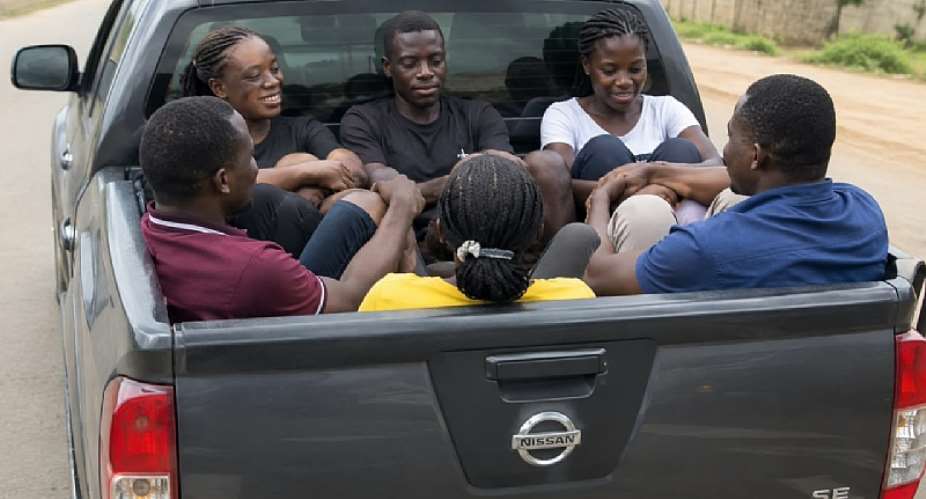
Fortune finally decided to smile on us. Barely a minute after we arrived at the Achimota Neoplan lorry station, the first vehicle to approach was a Nissan double-cabin pickup. The driver slowed down and signalled that he was heading towards Amasaman. We exchanged uncertain glances. A pickup truck was hardly our preferred mode of transport, especially after the long and exhausting evening we had endured.
Our hesitation, however, did not last long. We noticed several passengers already seated in the cabin, while another five occupied the bucket at the back. Their presence served as a form of social proof. If they had judged the arrangement safe and acceptable, perhaps we could do the same.
Besides, the alternative was to remain at the station and continue gambling with fate. After spending hours waiting, walking, complaining, perspiring, and calculating transport options, our standards had become remarkably flexible. The pickup might not have been comfortable, but it was moving in the right direction, and at that stage of the night, that alone qualified it as luxury.
Without further debate, we climbed aboard and joined our fellow travellers, grateful that our journey home had finally resumed. Little did we know that the evening still had a few chapters left to write.
There was only one space left in the cabin and, considering Kwadwo's immaculate appearance, there was no chance I was going to consign him to the bucket of the pickup. His polished shoes had already endured enough psychological trauma for one evening. I volunteered to take the remaining place at the back instead.
It was there that I received an unexpected lesson in transport economics from my fellow passengers. The fare structure, I was informed, was based not merely on destination but on dignity. Those fortunate enough to sit in the cabin paid twice as much as those of us in the bucket. Apparently, comfort carried a premium, while exposure to the elements came at a discount.
To my surprise, the ride turned out to be rather enjoyable. We sat with our legs folded tightly against our chests to create room for one another, transforming the bucket into an improvised exercise in human geometry. The cool night air rushed freely against my face, blowing away a good portion of the fatigue that had accumulated throughout the evening. My greatest concern was the possibility of rain, but the weather showed mercy. Not a single drop fell during the short journey toward Ablekuma. Equally reassuring was the fact that the hooks securing the bucket door, against which I was leaning with complete trust and very little choice, remained firmly in place.
Somewhere along the route, fortune smiled again. A passenger occupying the front seat alighted, and I was invited to take his place in the cabin. After an initial display of modest reluctance, I accepted the offer and gladly upgraded my travel status.
The driver, perhaps judging from my appearance that I was a respectable citizen unlikely to abscond with his vehicle, struck up a friendly conversation. Before long, he was lamenting the poor state of street lighting across the city and the dangers it created for motorists and pedestrians alike.
His complaint immediately transported my thoughts to an earlier article I had written, Okada, Aboboyaa and Streetlights in Accra: How to Survive Daily Death Assassination on the Road. Listening to him, I realised that the concerns I had raised on paper were not merely observations but lived realities for countless road users every night. As the pickup rolled through the darkness, the sparse and uneven streetlights seemed to support his argument better than words ever could. The city moved around us in patches of light and shadow, and one could not help but wonder how many accidents, near misses, and anxious journeys unfolded each evening under the cover of inadequate illumination.
I started reflecting again on the daily commute in Accra for thousands of residents, especially those living in peri-urban areas and working in the city. It is a test of endurance that begins before sunrise and ends well after sunset. This frustration is rooted in a combination of factors: a shortage of commercial vehicles, poor road conditions, and severe traffic congestion that turns what should be short trips into hours-long ordeals.
The human cost is immense with commuters often arriving home so late that their children are already asleep, erasing family time and contributing to a decline in mental and physical well-being. Indeed, many workers leave home as early as 4:00 a.m. just to try and beat the gridlock, and by 6:00 a.m., major arteries into the city are already swollen with traffic. The result is a life lived in a state of perpetual exhaustion.
For commuters via commercial vehicles starting their journey either before or in Amasaman, the frustration begins at the lorry station itself. Long queues form well before dawn, with passengers often waiting for over two hours just for a vehicle to show up. The situation is exacerbated by the poor condition of the road, particularly the stretch around Achimota near the overhead bridge and in areas like Amasaman and Hebron, which slows down traffic and forces some drivers to abandon the route entirely. What I have gotten to know was that the scarcity of vehicles has bred exploitation. Trotro drivers engage in the "tot-tot" system, deliberately shortening their routes to force passengers to pay multiple fares. A commuter might be charged to go from Amasaman to Pokuase, then again from Pokuase to Achimota, and a third time from Achimota to Accra, dramatically inflating the cost and hassle of the trip. The overall result is that a journey that should be manageable becomes a grueling, unpredictable, and costly start to the day.
A recent intervention, the Aayalolo Bus Rapid Transit (BRT) contraflow system, offers a glimpse of what is possible. By providing dedicated lanes for buses during peak hours, it will definitely allow some commuters to reclaim their mornings. However, the service is currently limited, and passengers are pleading for more buses and an extension of the evening service beyond its current cutoff to fully realize the benefits.
The common thread currently across these routes is a daily cycle of lost time, financial strain, and profound physical and mental fatigue. The traffic congestion is not merely an inconvenience but reflects a structural crisis that is actively eroding the quality of life and productivity of Ghana’s workforce.
Kwadwo eventually alighted at Pokuase, while I continued onward to Amasaman whereI crossed the footbridge and boarded a waiting taxi bound for Ablorhman. It was at this point that the evening finally extracted its full price from me.
Mental fatigue had quietly crept in. When the driver asked where I was headed, I found myself unable to answer. My mind, having endured hours of queues, walking, waiting, negotiating transport options, and navigating the complexities of Accra's evening commute, had temporarily disconnected from its surroundings. For a few awkward moments, I genuinely could not remember my destination.
It was only when the driver casually mentioned Ablorhman that my memory returned. "Of course," I thought. "That is exactly where I am going."
Yet the confusion was not done with me. Somewhere between Amasaman and Ablorhman, around Three Junction, I again asked the driver whether he intended to go beyond Amasaman. He turned and looked at me with the patience usually reserved for very young children and absent-minded professors.
"Boss," he replied, "you boarded at Amasaman. I'm taking you to Ablorhman."
The absurdity of my question immediately became apparent. I apologised for my lapse, accepted the verdict of mental exhaustion, and remained quietly seated for the rest of the journey.
When I finally arrived at Ablorhman, another challenge awaited me. Home was still about four kilometres away. Yet by then, walking had become such an integral part of the evening's adventures that it seemed only fitting to complete the final stretch on foot. As I walked through the night, retracing familiar paths under the dim glow of scattered streetlights, an idea began to take shape. The experiences, frustrations, characters, conversations, and small victories of the evening deserved to be recorded. What had begun as a difficult journey home was slowly transforming into a story.
And so, kilometre after kilometre, while the city settled into sleep, the narrative assembled itself in my mind.
Looking back, I remain profoundly grateful to my colleagues who shared in the ordeal and, in various ways, became pillars of support throughout this memorable evening of trials, errors, detours, endurance, and unexpected lessons. What could easily have been remembered only as a frustrating commute became instead a testament to patience, companionship, humour, and the peculiar resilience required to get home in Accra.
Danlad emerges from the episode as both hero and fortunate survivor: a bearded knight of modern times, unwavering in loyalty, generous in spirit, courageous under pressure, and occasionally saved from himself by the intervention of his wise travelling companions (Kwadwo and I). His actions that day reminded us that true character is revealed not when things go according to plan, but when everything goes spectacularly wrong. And on that score, Danlad performed with distinction.
Charles, being the humble man that he is, would probably never claim the credit when the vehicle eventually moved. Indeed, nobody could completely dismiss the possibility that somewhere between the electronic systems, the troubleshooting advice, and the collective determination of those gathered, a prayer or two may have found its mark. But those who witnessed the episode may forever wonder whether the miracle belonged to technology, persistence, or the gentle sound engineer whose faith never wavered.
Throughout the ordeal, Chiefy displayed the qualities that define him: intelligence, initiative, practicality, and loyalty. He approached the challenge not as a passive observer but as a trusted comrade invested in finding a solution. Small in stature he may be, but on that evening Chiefy stood tall, embodying the truth that the most valuable people in a crisis are often those who think quickly, act decisively, and refuse to leave a colleague stranded when things go wrong.
Well, every city has its adventures. Some are found in grand events and historic moments. Others are discovered in long queues, overcrowded vehicles, weary walks, and the simple determination to reach home before midnight. This was one of the latter.


 Trump ally Jim Jordan elected House Republican leader after midterm defeat
 Eisenkot pushes October 7 inquiry as Netanyahu targets Arab parties in tense new...
 US charges three 'Iranian operatives' over RAF Fairford terror plot
 Bagbin announces 2pm start for parliamentary sittings from Tuesday to Friday
 Speaker Bagbin says 2027 budget presentation may begin at 6pm on Thursday
 Osahen Afenyo-Markin reinstated to Ghana’s delegation to ECOWAS Parliament
 Only ‘cheap men’ will shield Obuasi SHS headmaster – Speaker Bagbin
 Parliament rescinds passage of Anti-LGBTQ+ Bill for further consideration
 Zelensky calls Ukraine-Russia talks 'constructive', Rubio wants Europe 'at the t...
 Minerals Commission warns Chinese nationals against illegal mining, threatens 25...


