




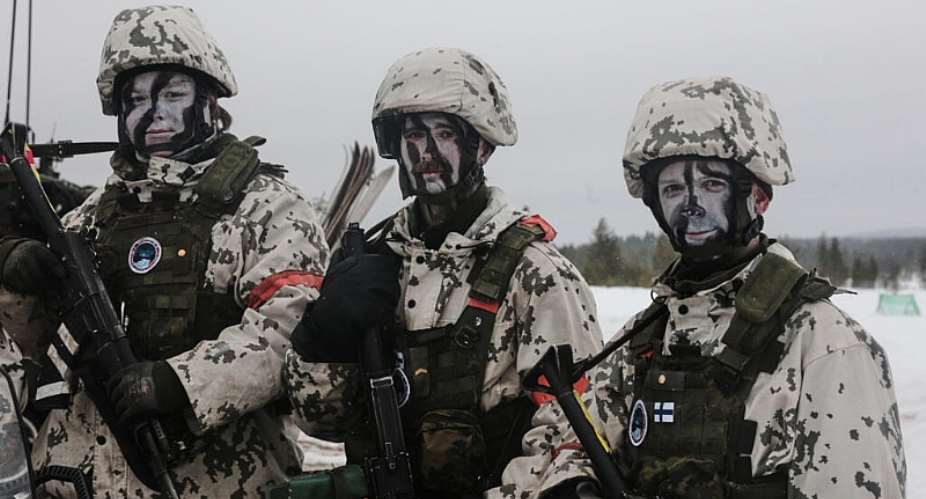
From icebreakers and undersea cables to satellite connections and critical raw materials, the strategy aims to give Europe a stronger role in a region increasingly contested by Russia, China and the United States.
European Commission President Ursula von der Leyen announced plans for a Maritime Security Hub to track Russia's sanctions-busting shadow fleet, alongside a centre to monitor, protect and repair undersea cables in the North Atlantic and Arctic.
EU funding would support cameras, sensors and satellites to detect potential threats, and Brussels would also back a secure submarine cable connecting Greenland directly to the bloc.
“When we see that sovereignty, territorial integrity and the rules that have underpinned stability in the region can no longer be taken for granted, we have to act and change our strategic posture,” von der Leyen said on Tuesday.
The plan also aims to expand Europe's icebreaker fleet and strengthen transport links for civilian and military use, connecting Arctic trade routes with European ports, railways and energy terminals.
How Svalbard went from from Arctic outpost to geopolitical flashpoint
'Northern Neighbourhood'
The EU has a direct stake in the region through three of its 27 member states – Denmark, Finland and Sweden – and more than half a million EU citizens live in the Arctic. In the region, non-EU countries Iceland and Norway belong to Europe's single market.
For Brussels, the challenge is to expand Europe's presence while responding to a more uncertain relationship with Washington and the security threat posed by Moscow.
The new strategy places cooperation with “like-minded” countries at the centre of the EU's approach, identifying Canada, the United Kingdom and Norway as important partners.
It envisages regular summits bringing together “Northern Neighbourhood” partners and creating a forum for closer coordination on the region's challenges.
The United States is among the countries that could participate but its role is uncertain, reflecting European unease over President Donald Trump's repeated threats to bring Greenland under US control.
Greenland, a vast self-governing territory within the Kingdom of Denmark, has become a particular focus of concern over Washington's Arctic ambitions.
Trump has softened his tone since the beginning of the year, and the US subsequently signed a security agreement with Greenland and Denmark.
EU chief unveils €200m Greenland package amid tensions over Trump claims
European wariness has persisted, however. The strategy mentions the US only a handful of times, compared with almost two dozen references to Canada – according to the document, seen by French news agency AFP ahead of its presentation.
Several initiatives would give Europe greater control over infrastructure serving the region, potentially reducing reliance on US providers.
The proposed cable connecting Greenland directly to the EU would form part of a broader “Pan-Arctic” project also linking Canada, Japan and South Korea.
Brussels is also working to extend satellite connectivity across the Arctic through IRIS², its planned satellite constellation, which aims to rival services such as Elon Musk's Starlink.
Infrastructure and security
Russia's military buildup and activities at sea are another central concern, with the strategy highlighting hybrid threats including drone incursions and sabotage targeting undersea cables.
The planned Maritime Security Hub would improve monitoring of Moscow's shadow fleet – oil tankers used to circumvent sanctions and generate revenue for Russia's war in Ukraine.
Its remit would extend to detecting illegal fishing and pollution, as well as supporting search and rescue operations.
How Russia's shadow fleet keeps slipping through Europe's net
Europe also wants to improve its ability to operate in polar conditions. Officials estimate that it has around 10 icebreakers, most of them in Finland, compared with roughly 40 in Russia.
Brussels will explore joint procurement and arrangements for pooling and sharing polar vessels with partners, helping countries make better use of expensive, specialised ships for navigation and research.
Alongside those security measures, the strategy foresees investment in renewable energy and critical raw material projects, linking the region more closely to Europe's wider economic priorities.
The EU has also stressed that its ambitions do not include drilling for Arctic oil and gas, maintaining its opposition to buying fossil fuels extracted in the region, including from partner Norway.
(with newswires)


 Govt to distribute first batch of 129 vehicles to MMDCEs in 12 regions
 UG Vice-Chancellor calls for oral exams, project-based assessment to deal with A...
 'I will use everything I have to clear my name' – Obuasi SHTS headmaster fights ...
 NPA to strengthen ties with UMaT to drive downstream petroleum sector
 'Report school abuse directly to Education Ministry' – Deputy Minister tells stu...
 'It's a curse on you' – Water Minister badmouths 'malware' workers sabotaging Gh...
 Tap water no longer drinkable near South Africa capital
 96 health facilities under construction in Ashanti Region
 Afenyo-Markin files fresh suit against Sammy Gyamfi, Eric Adjei over extortion c...
 GoldBod reforms create 4,866 direct jobs in less than two years — Sammy Gyamfi


