




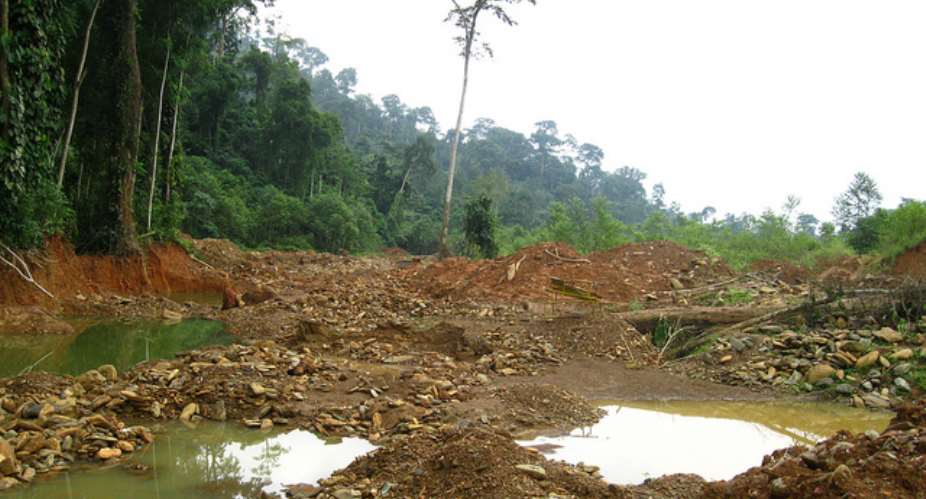
Ghanafuor, there is a concrete pillar standing in the Atewa hills with four letters cut into its top: GSBA. Globally Significant Biodiversity Area. It was planted by the Conservation International team that came to survey the forest in June 2006, and it stands, as it happens, within a parcel of 99.6 acres that my clan holds inside the reserve as an admitted farm, part of a family freehold of some fourteen square miles at Akyem Juaso. The waterfall and its pool are on that same land.
I have thought about that pillar for years, and not with gratitude. It is a strange object: a monument to a verdict delivered elsewhere, in another country's alphabet, on ground our people have held for generations. It tells the visitor that this forest matters. It does not tell the visitor who decided that it matters, or why the decision had to be made in Virginia.
Set the story out plainly. The survey was not philanthropy that happened to fall on a bauxite hill. It was a rapid assessment carried out in 2006 in response to an exploration licence granted to Alcoa, the American aluminium company, to prospect for bauxite in those very hills, and Alcoa supported the work. The resulting bulletin does not hide the arrangement; in its account of the first fieldwork site, at Atiwiredu, it records that Alcoa had been actively prospecting for bauxite there.
That survey, published in 2007 as RAP Bulletin of Biological Assessment 47, is the document that consolidated Atewa's international standing, supplied the species lists and the endemism that every campaign has quoted since, and made the case that finally reached the floor of the IUCN. So the sequence is this: the company that came for the ore paid for the census, and the census condemned the hunt. The prospector financed the science that stopped the mine.
There is a version of that story in which Alcoa behaves honourably, and I am willing to grant it. There is a less comfortable version, and it is the one that should keep us awake. Why did it take an American aluminium company, an American conservation organisation and, later, a Dutch-funded valuation study to hand Ghana the vocabulary for defending a forest that Ghana had already reserved, in 1926, for precisely this purpose?
Because the reasoning was never missing. The Akyem Abuakwa State Native Authority reserved the Atewa Range to protect the headwaters of the Birim, the Densu and the Ayensu, to hold forest on the steep slopes and to arrest shifting cultivation. Our own predecessors worked out the hydrology, the erosion risk and the land use logic without a single foreign consultant, and wrote them into law. In 1994 the forest was designated a Special Biological Protection Area, and a hill sanctuary under the national protection strategy a year later. Everything needed for a national park has existed for three decades except the signature.
And the absence of that signature has consequences far beyond symbolism, because it is now the state's legal defence. When civil society took the government to the High Court over prospecting in Atewa, the Attorney-General's answer, in substance, was that not all of the reserve is designated a Globally Significant Biodiversity Area, and that the parts which are not may therefore be mined. Read that sentence twice. The government is not arguing that mining is safe. It is arguing that our protection is incomplete, and it is right, because we left the designation half made. A boundary surveyed by foreigners and never legislated by Ghanaians can always be argued down in a Ghanaian court.
Now notice the pattern, because it is the real subject of this piece. Every instrument that has actually slowed the destruction of Atewa was imported. The science came from a rapid assessment programme in Arlington. The economic case came from a study funded by the Dutch ministry and IUCN Netherlands. The moral authority came from an IUCN resolution passed in Marseille, by 98 per cent of those voting. The commercial pressure came from BMW Group, Tetra Pak and Schüco International, all members of the Aluminium Stewardship Initiative, who said in February 2021 that they would not accept into their supply chains any aluminium sourced from bauxite mined in Atewa. Meanwhile the two instruments that belong to us, the reserve boundary and the presidential signature, are the two we have never used.
Let me be fair to the borrowed authority, because dismissing it would be the luxury of a man whose taps still run. It worked. The mine has not opened. The IUCN resolution, the supply chain refusals and the American species lists did what our own institutions did not. If the choice is between borrowed protection and none, only a fool chooses none.
But the forest is not waiting for our argument to mature. Twelve men were arrested inside the reserve in September, twenty four in April, five of them minors, and the district manager for Kyebi had already written in March warning of an influx of miners into the Sagyimase and Asikam portions. That is not a distant bauxite project. That is the forest being consumed now, by our own citizens, with mattocks and pumps, while we congratulate ourselves on a resolution passed in France. Borrowed authority wins the argument and loses the ground.
So here is what I would have done, and what I would still have done before the next dry season.
Declare the national park by executive instrument, and do not stop at the announcement. Publish a surveyed boundary with pillar and beacon coordinates, lodged with the Lands Commission and the Forestry Commission, so that the Attorney-General's partial designation argument dies of its own accord. A park whose edge is a line on a poster is not a park.
Commission the science ourselves, in our own universities, and keep it here. The KNUST baseline biodiversity and hydrology studies already prepared for the EPA are a foundation, not a finished edifice. Publish them in full, in Ghanaian journals and Ghanaian depositories, so that the next generation of ministers cannot say the evidence is foreign and therefore arguable.
Register the admitted farms and the customary holdings inside the reserve, parcel by parcel, with names, acreages and boundaries. Occupation that is documented is occupation that can be defended, and occupation that is undocumented is occupation that can be erased by a map drawn in Accra in an afternoon. My family's own trust deed should carry the coordinates of that boundary, and the waterfall, for the same reason the state should carry them for the forest.
And instruct, in writing, that no bauxite from Atewa enters any Ghanaian supply chain or export consignment, whatever any foreign buyer decides. The exclusion should be ours first and BMW's second. A country that waits for its customers to develop a conscience has confused commerce with morality.
None of this requires a new loan, a new donor or a new study. It requires a signature, a survey and an instruction, and it could be done inside one budget year by a government that decided to.
That is what the pillar means to me now. Not that outsiders valued our forest more than we did, but that we allowed the valuation to become the only one on record. The letters cut into that concrete are not an insult. They are a reminder of a gap we left open, and an instruction about what to fill it with.
So, President John Dramani Mahama, one executive instrument, one surveyed boundary, one instruction to the Minerals Commission and GIADEC, and Atewa becomes a national park. The pillar can stay where it is. It will simply stop being the only thing standing there with our worth written on it.
Now. Not tomorrow. Yooooooooooo.
A word to the wise...
Hmmm Anansesemkrom Ghana paaa diy33. Tweaaaaaaaaa...


 Govt to distribute first batch of 129 vehicles to MMDCEs in 12 regions
 UG Vice-Chancellor calls for oral exams, project-based assessment to deal with A...
 'I will use everything I have to clear my name' – Obuasi SHTS headmaster fights ...
 NPA to strengthen ties with UMaT to drive downstream petroleum sector
 'Report school abuse directly to Education Ministry' – Deputy Minister tells stu...
 'It's a curse on you' – Water Minister badmouths 'malware' workers sabotaging Gh...
 Tap water no longer drinkable near South Africa capital
 96 health facilities under construction in Ashanti Region
 GoldBod reforms create 4,866 direct jobs in less than two years — Sammy Gyamfi


