




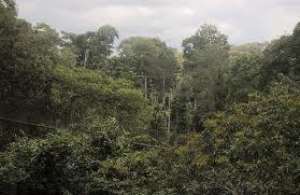
Ghanafuor, the argument about Atewa has now outlived two governments, one loan agreement, a High Court suit and a photograph from 2021 that still turns up in my inbox, forwarded by people who cannot quite believe that nothing has changed on the ground. The forest is still standing. So is the threat against it.
The threat has a history. In 1926 the Akyem Abuakwa State Native Authority reserved the Atewa Range for one explicit purpose: to protect the headwaters of the Birim, the Densu and the Ayensu, to hold forest cover on the steep slopes, and to stop the spread of shifting cultivation. A century later the reserve covers some 25,800 hectares of upland evergreen forest about ninety kilometres north of Accra, the only forest of its kind in Ghana, and the reason it was set aside has not changed.
The Densu runs 116 kilometres from those hills to the Weija dam, which supplies more than a million people in Accra. The Ayensu and the Birim water the Eastern and Central regions. Together the three rivers reach around five million Ghanaians, and some 150,000 people live along the forest's margins and depend on it directly. That is not sentiment talking. It is infrastructure, and it is the cheapest infrastructure this country owns, because it was built by rainfall and geology and requires no maintenance contract, no external loan and no act of Parliament to keep working.
Then there is the ore, and here the argument turns on a fact that is rarely stated plainly. The bauxite at Atewa lies on the ridge top, a relatively flat plateau broken by forested swamps. Those swamps are where the deposits are concentrated. They are also the sponges that hold the rain and release it slowly through the dry season. So when the state says it intends to mine only 1.9 per cent of the range, it is not proposing to take a corner of a forest. It is proposing to take the cistern. Water does not respect the boundary of a mine pit.
And what sits above the ore is irreplaceable. Atewa holds roughly a fifth of all the threatened species known in Ghana, more than a hundred species listed as threatened or near threatened on the IUCN Red List, over 1,100 plants, and 575 species of butterfly, the richest butterfly fauna of any site in West Africa. Four or five species are found nowhere else on earth: a climbing plant named for the forest itself, two butterflies, a hooded spider, and the Togo Slippery Frog, which turns out to be entirely ours, confined to that one range. Extinction is not a cost that appears in any feasibility study. It is simply a line that never gets printed.
Now do the accounting honestly. A study of the Atewa range in 2016 weighed the development options and found that declaring it a national park, with a well managed buffer zone, produced the highest cumulative economic value of any scenario before it: on the order of US$1.16 billion. Government has never answered that study. It has simply continued to behave as though the bauxite is the only asset on the ridge and the water is free.
It is not even the best bauxite. Kyebi, which is the Atewa deposit, is generally put at something like 160 million tonnes out of national resources of roughly 900 million. Nyinahin, in Ashanti, holds around 700 million tonnes, and the first proper mineral resource estimate there revised the figure sharply upward from the historical guess. In January this year a US$60 million facility was executed to advance mining at Nyinahin Hills one to three. In other words, the country is being asked to spend its watershed in order to reach a minority of its ore, while a far larger deposit elsewhere is already being financed for development.
But the decisive fact is financial, and it is one that almost nobody in this debate has absorbed. The barter deal is dead, and it was killed by the government's own bookkeeping. In September 2024 the state disclosed that the US$2 billion Sinohydro deferred payment arrangement, which was structured around proceeds from refined bauxite, had been reclassified as a loan, because the bauxite processing plant never materialised. In June 2025 Parliament approved a US$2.8 billion restructuring with twenty five creditor nations, China among them, under the framework agreed with official creditors. The IMF's debt analysis already covers the Sinohydro financing.
Read that sequence again. There is no longer a legal instrument in existence under which a hectare of Atewa must be mined to satisfy Beijing. The collateral was not a rock in the forest floor; it was a refinery that was never built. Ghana is not being pursued by a creditor demanding bauxite. Ghana is servicing a debt, on restructured terms, like any other sovereign borrower, and telling its own citizens a story about collateral that its own Ministry of Finance retired two years ago.
This matters because it changes who is responsible. It is comfortable to frame the choice as one between China and the forest, as though a foreign power were twisting our arm. China's interest is repayment, and China restructures when repayment is in doubt, as it has done across the continent and as it did with us. The arm being twisted, if there is one, belongs to Accra. Our government has spent eight years invoking an agreement that no longer binds it in the form it describes, rather than walking into a room and asking for repayment terms that do not require the destruction of a watershed.
If collateral is genuinely required, we are not short of alternatives. Gold is the obvious one: Ghana is now Africa's largest producer of it, and a gold backed or gold indexed instrument would be a more honest pledge than a forest we cannot replace. A country can borrow against what it can dig up twice. It cannot borrow against water.
Which brings us to the alternative that has been on the table since 2016 and has never been enacted: a national park. It requires no new money. It requires an executive instrument, the Wildlife Division of the Forestry Commission and the political will to sign. The IUCN's members voted on it in a formal resolution and 98 per cent of those voting were in favour, a verdict no Ghanaian government has ever had to explain away at home. A park would give the forest a legal status stronger than that of a reserve, a revenue line in tourism and research, and a reason for the communities around it to defend it rather than merely to endure it.
Here I must be honest with my own side. A park declared on paper and unenforced would be a monument to our habits. The Forestry Commission arrested twelve men in the reserve in September, and twenty four in April, five of them minors, and the district manager for Kyebi had already written in March warning of an influx of miners into the Sagyimase and Asikam portions. The forest is being eaten now, by Ghanaians, with pumps and mattocks, while we wait for a decision about machinery. Any serious settlement has to put money and authority in the hands of the families who live at the forest edge, so that protecting it becomes their livelihood and not merely their restriction. A park that polices the poor and pays nobody will fail, and it will deserve to.
There is an irony here that should trouble us more than it does. In 1926 a colonial native authority, with no environmental ministry, no donor conferences and no satellite imagery, understood that the headwaters of three rivers were worth more than anything underneath them, and wrote it into law. A sovereign republic, with a Ministry of Lands and Natural Resources, a Ministry of Environment, an EPA and a Forestry Commission, has spent a decade unable to repeat that act. We have gone backwards, and we have done it in the name of development.
I have spent years of my own life on a smaller version of this problem, trying to draft a trust deed that will stop my own descendants from selling land they will need and sharecroppers from being driven off it. The logic of that document is the logic of Atewa, scaled down: some things must be placed beyond the reach of a bad year, a persuasive stranger or a hungry treasury. A nation needs the same instrument. A national park is simply a trust deed written for people who are not yet born.
So, President John Dramani Mahama, the request is not complicated, and it does not require a new loan, a new study or a new committee. Declare the Atewa Range Forest Reserve a national park. Withdraw it, in writing, from all mining consideration, and instruct the Minerals Commission and GIADEC accordingly. Then tell the Chinese government plainly that the bauxite collateral belongs to a 2018 structure that our own treasury reclassified in 2024, and that we will service the debt on the restructured terms already agreed, in good faith and on schedule, without paying for it with the water of five million people.
Full stop. Case closed. Now. Not tomorrow. Yooooooooooo.
A word to the wise, Ghanafuor. Anansesemkrom Ghana paaaa diy33. Tweaaaaaaaaa.


 NPA to strengthen ties with UMaT to drive downstream petroleum sector
 'Report school abuse directly to Education Ministry' – Deputy Minister tells stu...
 'It's a curse on you' – Water Minister badmouths workers sabotaging Ghana Water
 Tap water no longer drinkable near South Africa capital
 96 health facilities under construction in Ashanti Region
 Afenyo-Markin files fresh suit against Sammy Gyamfi, Eric Adjei over extortion c...
 GoldBod reforms create 4,866 direct jobs in less than two years — Sammy Gyamfi
 ‘Obuasi SHTS alleged sexual abuse will not be swept under the carpet’ – Muntaka ...
 'No fresh applicants until existing pool is exhausted’ – Muntaka on security ser...
 Parliament to resume sitting on Tuesday November 3


