




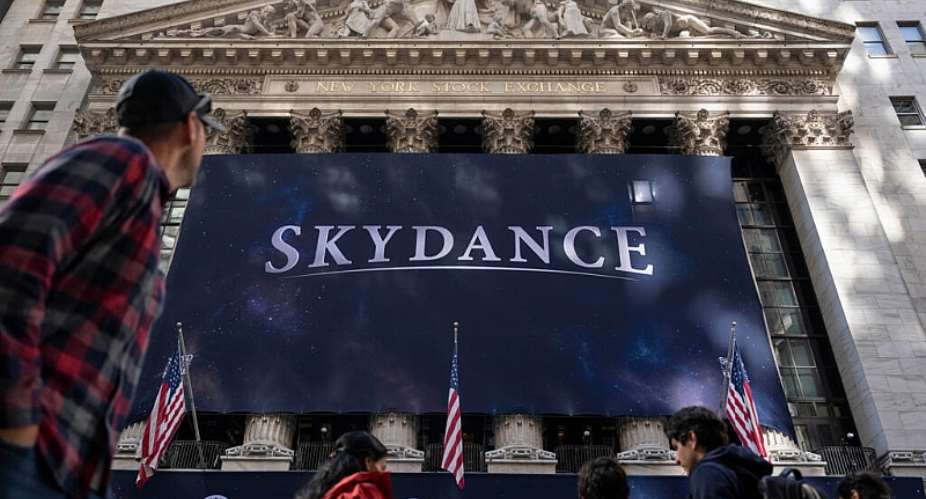
The completion this month of Paramount's $110 billion acquisition of Warner Bros. Discovery has created Skydance: a media behemoth that, as a result of the transaction, comprises some of Hollywood's most recognisable studios, including Warner Brothers, Paramount Pictures, HBO, Paramount +, a vast television portfolio, as well as news platforms, CNN and CBS.
The takeover was months in the making and garnered much public attention. What started as a tête-à-tête bidding war at the end of 2025 against Netflix culminated in a federal ruling against the 12 US states that tried to block the transaction on antitrust grounds at the end of September – just a week before final approval.
Read more Paramount completes takeover of Warner Bros, creating media behemoth Skydance
As film industry opponents feared job cuts, media groups worried about the editorial independence of a news platform under David Ellison, whose family has close ties to Republican US President Donald Trump. But from a French perspective, the development may cultivate a narrative that is less a question of whether yet another media giant can succeed in presenting true competition against the likes of Netflix or Canal+, and more about how a heavily indebted, consolidated global studio can operate profitably inside of one of the world's most protected audiovisual markets.
Creative works and cultural products are required to be handled differently when it comes to international trade laws, according to France's “cultural exception” policy. It hinges on a unique arrangement: international films and platforms may sell to French audiences, but they must actively contribute to preserve, invest in and stimulate France's creative economy. Ellison's deal therefore interrogates whether this principle can remain viable when the counterparty becomes larger, more leveraged and more focused on global scale.
Can Skydance afford French content?
Skydance began life with nearly $80 billion in debt, though it aims to reduce company costs by $6 billion in “structural and tech-stack cost savings” over the next three years, according tothe Financial Times. One of its first post-merger moves has included price increases on Discovery+, while reports indicate the firm's plans to combine the Paramount+ and HBO Max streaming services into a single platform or bundle.
This doesn't make French investment impossible. Indeed, consolidation may benefit French cinema by increasing the amount the company is required to invest locally under France's SMAD regime.
Introduced in 2021 and enforced by France's multimedia regulator, Arcom, the SMAD regime requires any foreign on-demand audiovisual service provider targeting France to contribute 20-25 percent of its French revenue towards European and French-language productions. A subsequent Paramount-HBO operation would aggregate subscription revenue, increasing the firm's local content obligations.
Read more Paramount CEO says politics fueling Warner Bros. merger battle
In the streaming universe, a related battle is underway among Netflix, Prime Video and Disney+. In July, the platforms filed appeals with France's highest administrative court – the Conseil d' État – to contest an amendment to the rule introduced in January this year that requires them to dedicate 20 percent of their investment requirement in French content specifically to animation, documentaries and live performance programming. The streamers argue that this “over-regulation” infringes on creative freedom and creates an unsustainable financial burden. But the court has not yet issued a final ruling on the legal challenges.
"These new rules suddenly double our obligation to invest in these genres, target streaming services exclusively and end up dictating our content offerings without taking audience expectations into account," Pauline Dauvin, vice president of Netflix France, said in an opinion column.
Pledging plurality
But scale does not guarantee cultural diversity.
Considering that the deal would enable Skydance to wield significant purchase power alongside other Hollywood heavyweights Sony, Disney and Universal, the transaction was submitted to the European Commission (EC) for regional approval, which it passed in July, subject to specific conditions.
At film production level, the EC found the conglomerate's studios to be suitably competitive. But at a distribution level, it stipulated that the company would need to unravel its ties from its Universal-Paramount joint venture, United International Pictures, within thirteen months of financial close, noting a “high concentration” in European Economic Area markets.
The transaction would have meant Skydance had advantageous distribution channels leading to “worse rental and distribution terms for cinema operators, ultimately disadvantaging consumers”, the EC wrote. It added that the conglomerate would also need to refrain from entering joint distribution arrangements for ten years and to avoid sharing releases with those also handling Universal or Disney rights in relevant markets.
Such redress is important for French exhibitors and distributors. While it does not prevent Skydance from fulfilling its role as a formidable supplier of content – indeed, as part of the firm's legally binding antitrust settlements with the 12 US states and the US Department of Justice, Skydance is required to produce at least 30 films per year for its first two years; rising to 32 films for the subsequent three, with penalties for shortfalls – it at least preserves a measure of plurality in how its films reach French cinemas.
Bloody broadcast
The key question perhaps is what type of content receives the funds?
In a joint statement titled “Bleeding public broadcasting: the shame of the Republic” and published last month via the Civil Society of Authors, Directors and Producers, France's leading film production and director unions, including the Trade Union for independent film, animation and audiovisual production (SPI), expressed fear that a merged giant is likely to favour global franchises, English-language formats and algorithm-friendly brands over smaller French films and original dramas.
Watch more Cannes, Canal+, Bolloré, blacklists: Is France's cultural diversity under threat?
In the context of bargaining asymmetry, it is possible that independent French producers – already navigating funding pressures and platform concentration – could come face-to-face with a single transatlantic buyer with the capacity to demand self-serving favourable rights and production models. And with every euro of compliance likely to be contested, there is potential for the long-term value of French intellectual property to erode, even where headline investment obligations are formally met.
'Chronologie des médias' under strain?
France's chronologie des médias constitutes a pillar of its system. It is a framework that sees box office features wait around 15-17 months before moving from screen to subscription platforms. The delay serves to protect cinema owners and ticket sales while channelling levies into the state-managed National Centre for Cinema and Moving Image's financial ecosystem.
And so Skydance's creation sharpens this tension. If the group wants its blockbusters to reach French viewers quickly, it must either respect the long release date windows or limit its cinema-wide releases (and box office turnover). But with a leveraged deal that puts the firm under pressure to monetise its strongest franchises across as many territories and platforms as possible – leaning on speed and scale, either option is likely to cost.
The danger is perhaps less that Skydance will bypass France, and more that the country may concede to the pressures of international dominance, resulting in fewer, safer, more commercial films. The firm could balance French release windows and funding local content if it treats the market as strategic ground rather than a regulatory obstacle course. But debt service, revenue targets and shareholder pressure risk rendering French-language content as compliance costs over creative priority. A possible outcome is selective investment: visible flagship French productions alongside reduced appetite for mid-budget and independent work.


 Appointment of Emelia Agbenyo as EC deputy chair was well calculated, reasoned –...
 Relief for students as GAUA and TUSAAG call off strike; declare return to work o...
 Who gave Cabinet authority to decide for Ghanaians to join BRICS without parliam...
 Mahama urges Ghanaian businesses to tap CSIR innovations
 Partisan EC appointments could set dangerous precedent — NPP's Kamaldeen
 Winneba: Afenyo-Markin commissions police apartments at Fetteh-Osakam
 Council of State failed Mahama over Emelia Agbenyo’s EC appointment – Prof. Asa...
 CDD‑Ghana: EC Deputy Chair Should Step Down Now
 Family Announces October 23 Memorial Mass for Nana Konadu Agyeman-Rawlings
 Eduwatch Urges Nationwide Audit of Sexual Misconduct in Secondary Schools


