




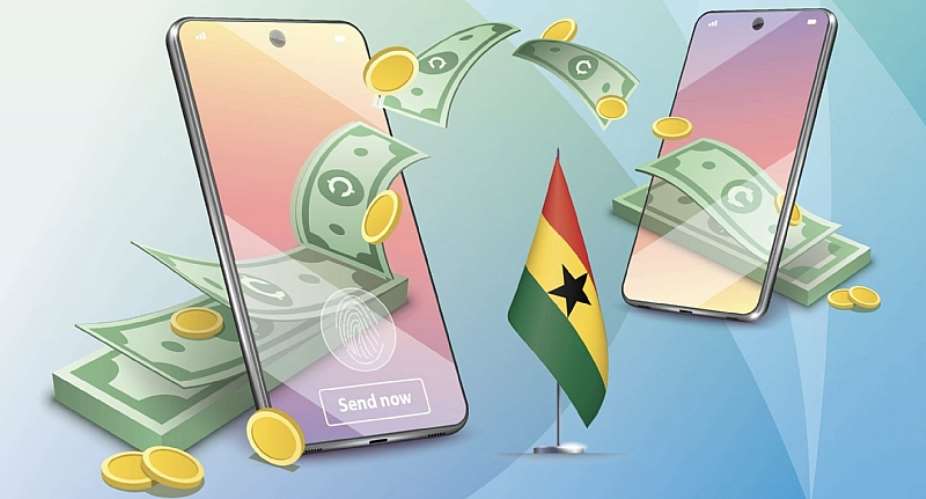
Ghana has largely solved the first-order problem of mobile-money access. The harder question now is what the country does with the financial infrastructure and economic visibility that access has created. In 2025, Ghana's mobile-money ecosystem processed approximately 9.70 billion transactions valued at GHS4.54 trillion.
In 2021, the corresponding figures were 4.25 billion transactions worth GHS978.32 billion. In only four years, transaction volume more than doubled while transaction value increased by roughly 364%. By the end of 2025, there were approximately 80.5 million registered mobile-money accounts, 26.7 million active accounts, almost 960,000 registered agents and a mobile-money float balance of approximately GHS39.6 billion.
These numbers are extraordinary, but they require careful interpretation. The 80.5 million registered accounts are not 80.5 million individual Ghanaians. Customers may hold multiple accounts. More importantly, GHS4.54 trillion is not Ghana's GDP, household income or newly created wealth, and it is certainly not GHS4.54 trillion of dormant money waiting to be lent to businesses. It is gross transaction value generated as money moves, sometimes repeatedly, through the payment system. The year-end float balance, at about GHS39.6 billion, provides a clearer sense of the stock of electronic money outstanding at a point in time.
Yet none of those qualifications diminishes the economic importance of what Ghana has built. They simply tell us where to look for the real opportunity. Ghana has constructed a financial highway of extraordinary reach. The next stage of the country's financial-development story should therefore be judged less by how much traffic passes along that highway and more by what the infrastructure enables households and enterprises to do once they are connected to it.
The first revolution was access
Mobile money solved a distribution problem that conventional banking had struggled with for decades. Physical branches are expensive to establish and operate, particularly where transaction values are small or customers are geographically dispersed. Formal account-opening, documentation and underwriting requirements can also impose costs that are disproportionately difficult for informal households and microenterprises to meet. Mobile money changed those economics by allowing a handset, an agent network and telecommunications infrastructure to perform functions that previously required a much heavier physical banking presence.
That transformation should not be underestimated. Ghana's payment architecture has become one of the most developed mobile-money ecosystems in the world, and Bank of Ghana's 2025 report records 9.70 billion mobile-money transactions in a single year. But access is ultimately an input into financial development rather than its final outcome. The gap between 80.5 million registered accounts and 26.7 million active accounts is itself a warning against treating registration as synonymous with transformation. A financial system becomes deeper when people and firms can use it not only to transfer money but also to save, insure themselves, invest, obtain appropriately priced credit, manage risk, and accumulate productive assets.
The next revolution, therefore, should not simply be another increase in the number of wallets. It should be the conversion of digital participation into deeper financial capability.
The missing bridge is financial intermediation
Mobile money has become exceptionally efficient at moving value. Allocating capital is a more difficult task. A trader may receive hundreds of electronic payments each week and still struggle to secure affordable working capital. A manufacturer may demonstrate years of turnover but lack conventional collateral. A farmer can participate in digital payments all year round yet still be unable to finance inputs between planting and harvest. An exporter may have a credible purchase order and customers willing to pay, yet still lack the short-term capital necessary to fulfil it.
This creates an economy that can become transaction-rich while significant parts of its productive sector remain capital-poor. Bank of Ghana's own findings illustrate the distinction. Its 2025 report says 22% of adults were accessing credit through mobile money platforms, yet the same report identifies limited access to credit for MSMEs as an enduring financial inclusion challenge. More digital credit therefore does not necessarily mean more productive enterprise finance. The purpose for which capital is provided, its price, tenor and relationship to underlying cash flow matter at least as much as the number of loans disbursed.
Traditional lenders also have legitimate reasons for caution. Many small enterprises lack audited accounts, mix household and business finances, experience volatile revenues and possess little property that conventional lenders will accept as collateral. Information asymmetry is consequently significant. But it would be a mistake to suggest that information alone explains the restriction in MSME lending. The price of credit also reflects funding costs, expected default losses, recovery prospects, operating costs and the wider economic environment. Better transaction data cannot eliminate those factors. What it can do is improve one important component of the equation: the lender's ability to understand the underlying business.
Let’s move from transaction history to bankability
Ghana's digital infrastructure is beginning to create an enormous quantity of potentially useful financial information. Consider a small retailer unable to produce three years of audited financial statements but capable of showing two years of consistent merchant receipts, supplier payments, wallet-to-bank transfers, inventory cycles, utility payments and recurring settlements. None of that is collateral in the conventional legal sense. It does however constitute evidence about the operation of the business.
With appropriate customer consent, reliable identification and strong data governance, such information can help a regulated lender ask better questions. Is turnover stable or highly volatile? How seasonal is the business? What share of incoming funds is immediately withdrawn as cash? Does recurring revenue appear sufficient to support the proposed repayment? Is turnover expanding or contracting? How does the enterprise behave relative to comparable businesses? A lender still has to make a credit decision, but that lender is making that decision with a richer picture of the borrower than a title document and a short application form alone can provide.
There is evidence behind this proposition. Research by the Consultative Group to Assist the Poor (CGAP) on micro- and small-enterprise lending found that transactional data can have predictive power comparable to traditional credit history, and that combining transaction data with credit history can further improve predictive performance. That is precisely why alternative underwriting deserves attention, not because an algorithm can magically turn every mobile-money user into a creditworthy borrower, but because better data can reduce some of the uncertainty surrounding firms that conventional underwriting struggles to see.
That distinction matters. Technology should improve underwriting rather than abolish it. Algorithms can misinterpret temporary shocks, reproduce biases embedded in historical data or encourage lenders to automate loans that customers cannot sustainably repay. The objective should therefore not be more digital debt for its own sake. The objective should be better productive credit, with financing structured around genuine repayment capacity and economically useful activity.
Ghana now needs to measure depth, not merely access
The first policy shift should be in what Ghana measures. Registered accounts, transaction volumes, transaction values and agent numbers remain useful indicators, but they are no longer enough to describe the maturity of the financial system. The next generation of indicators should ask how many businesses receive payments through identifiable merchant accounts, how many households regularly save or invest digitally, how many people maintain insurance or pension products, how many enterprises obtain sustainable regulated credit and how many borrowers graduate from small short-term facilities into larger and longer-term forms of capital. The more important question is no longer simply how many Ghanaians have entered the financial system, but what participation in that system enables them to become.
The second shift should be towards clearer digital business identity and better transaction classification. If a microenterprise receives its entire turnover into a personal wallet, commercial revenue is mixed with family transfers, personal spending, remittances and other activity. The resulting data trail may be large but economically noisy. Merchant accounts, interoperable business identifiers, electronic receipts and better classification of payments can turn a stream of transactions into something much closer to a usable financial record. Ghana already created a tiered merchant-account framework several years ago; the next task is to make formal merchant behaviour attractive enough that enterprises actually use these channels rather than permanently disguising business turnover as person-to-person activity.
The third shift should be to operationalise consent-based financial-data sharing. Ghana is not starting from zero. The Bank of Ghana says its Open Banking Service Initiative began in 2024 and underwent proof-of-concept testing in 2025. Its proposed framework allows regulated financial institutions to share customer-consented financial information through APIs, with explicit requirements around purpose, security and the customer's ability to revoke consent. Properly implemented, this can allow a customer to use financial behaviour spread across banks, wallets and other regulated providers to obtain a more complete assessment from a lender without surrendering permanent control of the data.
The fourth shift should be to design more credit around productive cash flows. The opportunity is much larger than another instant consumer loan. It includes inventory finance for merchants, seasonal agricultural facilities, invoice discounting, purchase-order finance, receivables finance and equipment lending for enterprises with demonstrable repayment capacity. Ghana's new digital-credit framework is useful but should not be confused with the entire enterprise-finance agenda. Bank of Ghana defines regulated digital credit in that specific category as short-term lending below 12 months and capped at GHS10,000. Financing a manufacturer's machine or a substantial export order will frequently require larger facilities and other appropriately licensed financial institutions.
The fifth shift should be to turn the wallet into a gateway to the wider regulated financial system rather than attempting to transform every wallet provider into a bank. Mobile-money float represents electronic-money liabilities and should not simply be treated as unrestricted capital available for speculative lending. Ghana's regulatory architecture already points towards a more sensible model in which electronic-money issuers may facilitate investment, savings, credit, insurance and pension products through partnerships with banks and other duly regulated institutions. The strategic challenge is therefore less about inventing a new regulatory principle and more about making those partnerships seamless, interoperable, intelligible and useful to ordinary customers and small businesses.
The scale of payments also needs to be understood correctly
There is another reason to resist equating mobile-money value with economic output. In 2025, agent-to-agent transactions accounted for 41% of the total mobile-money transaction value. Third-party transfers accounted for another 14.9%, while cash-in and cash-out together represented 16.1%. Agent-to-agent transactions largely perform the essential function of redistributing liquidity across the agent network; they cannot simply be interpreted as consumer spending, business revenues or productive economic output.
But the composition of the system still tells us something important. Cash-in and cash-out have declined as a share of transaction value, while mediated and account-based activity has become increasingly important. The financial system is gradually becoming more than a digital wrapper around physical cash. The challenge is to identify which digital flows contain reliable information about genuine commercial behaviour and then, with the customer's permission, make that information usable by regulated financial institutions.
That is a more defensible proposition than saying GHS4.54 trillion can somehow be converted into credit. We do not need to convert the money. We need to convert information embedded in legitimate economic transactions into better financial decisions.
Here’s the real economic test
Ghana's National Payment Systems Strategy for 2025–2029 is already oriented towards the right infrastructure. The Bank of Ghana describes the strategy as anchored in interoperability, instant payments, cybersecurity and the modernisation of core infrastructure, with the wider objective of making digital payments accessible, affordable, and secure. The next step is to connect that payment infrastructure more deliberately to the financing of productive activity.
That requires banks, fintechs, telecommunications companies, credit bureaus, insurers, pension providers, regulators and technology firms to stop thinking of the payment itself as the final product. Payments are infrastructure. Their deeper economic value emerges from what can responsibly be built on top of them, such as records that help businesses demonstrate turnover, data that improve risk assessment, savings products that accumulate capital, insurance that absorbs shocks, and credit that finances economically productive activity.
By the end of this decade, the most important question should therefore not be whether Ghana processes GHS5 trillion, GHS8 trillion or GHS10 trillion through mobile money each year. It should be whether a market trader with no conventional financial statements can now obtain appropriately priced working capital because her real business activity is visible; whether a farmer can finance the planting cycle against credible production and payment history; whether a manufacturer can finance another machine; whether an SME can insure its risks and accumulate long-term savings; and whether an exporter can convert a credible purchase order into the capital necessary to deliver it.
Those measures are harder than counting transactions. They are also much closer to the purpose of a financial system.
Ghana has already built the rails. The task now is not simply to make more money move across them. It is to make those rails carry economic information into creditworthiness, financial access into investment, and millions of digital transactions into a deeper system of productive capital.
Thank you for reading. I welcome your reflections, questions, and suggestions for future topics. Subscribe to the ‘Entrepreneur In You’ newsletter here: https://lnkd.in/d-hgCVPy, follow me on all social platforms at @thisisthemax, or get weekly updates via my official WhatsApp channel: www.bit.ly/whatsappthemax.
Wishing you a purposeful and successful week ahead!
'-'-'-'-'-'-'-'-'-'-'-'-'-'-'-'-'-'-'-'-'-'-'-'-'-'-'-'-'
The author, Dr. Maxwell Ampong, is an entrepreneur, investment and strategy executive & CEO of Maxwell Investments Group. His work spans finance, technology, sustainability, trade, enterprise development and institutional partnerships. He serves in executive and advisory capacities across business, academia, culture, agriculture and social development. He is Nana Kwadwo Marfo Ampong I, Aboafuohene of Kona in Asanteman. Dr. Ampong holds postgraduate qualifications in finance, law, business administration, international relations, artificial intelligence and machine learning. He writes on economics, investment, entrepreneurship, technology, social and sustainable development. Entrepreneur In You operates under the auspices of the Africa School of Entrepreneurship, an initiative of Maxwell Investments Group.
Disclaimer: The views, thoughts, and opinions expressed in this article are solely those of the author, Dr. Maxwell Ampong, and do not necessarily reflect the official policy, position, or beliefs of Maxwell Investments Group or any of its affiliates. Any references to policy or regulation reflect the author’s interpretation and are not intended to represent the formal stance of Maxwell Investments Group. This content is provided for informational purposes only and does not constitute legal, financial, or investment advice. Readers should seek independent advice before making any decisions based on this material. Maxwell Investments Group assumes no responsibility or liability for any errors or omissions in the content or for any actions taken based on the information provided.


 Appointment of Emelia Agbenyo as EC deputy chair was well calculated, reasoned –...
 Relief for students as GAUA and TUSAAG call off strike; declare return to work o...
 Who gave Cabinet authority to decide for Ghanaians to join BRICS without parliam...
 Mahama urges Ghanaian businesses to tap CSIR innovations
 Partisan EC appointments could set dangerous precedent — NPP's Kamaldeen
 Winneba: Afenyo-Markin commissions police apartments at Fetteh-Osakam
 Council of State failed Mahama over Emelia Agbenyo’s EC appointment – Prof. Asa...
 CDD‑Ghana: EC Deputy Chair Should Step Down Now
 Family Announces October 23 Memorial Mass for Nana Konadu Agyeman-Rawlings
 Eduwatch Urges Nationwide Audit of Sexual Misconduct in Secondary Schools


