




This blog exists solely to challenge orthodoxy. We make it our business to ask the most uncomfortable questions. We don’t relish combativeness; we’re just appalled by the conditions we see in Africa and in the Collective Black World (CBW) in 2026, and by the hypocrisy that made it happen and continues.
Unfortunately, the truth be told, most of us are bloody, butter-will-not-melt-in-my-mouth hypocrites. The irrepressible Fela Anikulapo sang about us in his “Suffering and Smiling.”
Over four decades later, we continue to suffer and smile as the well-curated plantation managers we call leaders keep wreaking havoc on lives.
And, most baffling, we refuse to find it shameful that, close to seventy years of self-governing ourselves, we still cannot feed, clothe, or house ourselves without foreign input. And we still live in darkness even though we live near the equator where vast solar energy is wasted daily. Water, light, and food remain major production challenges, even as we sit on one of the world's most gifted lands and weather systems.
A few posts ago, I wrote that I am done with all those senseless and meaningless conferences we Africans relish organizing to cope with our sense of powerlessness. Instead of getting the real deal from our misleaders, we thunderously comfort ourselves by dredging up our ancestors' achievements in Ancient Egypt, Monomotapa, etc.
Mind you, I used to find that stuff important and necessary, but after four decades, I think the question should be: What are we doing today that our children will praise in the future?
I think these are questions that refuse to die because we are too cowardly to provoke them and answer them. Why do Africans find anything powerful or meaningful in continuing to hold conferences on development without ever developing? Why do we gather in air-conditioned hotels, read papers to each other, high-five one another, swap business cards, pose for photographs and issue communiqués nobody will read, then return to the same shattered roads, the same imported food, the same dead factories, the same legions of unemployed graduates, and the same governments that loot our resources on behalf of the sponsors in the West?
Fellow Africans, we need to ask this pungent question: At what point does the conference stop solving the problem and become the problem itself?
John Henrik Clarke, among the twentieth century's most formidable African intellectuals, saw this pathology with brutal clarity. In Christopher Columbus and the African Holocaust, he did not waste his breath lamenting African weakness. He asked what Africans were actually doing with what they had.
His words here deserve to be nailed to the door of every conference center on the continent: "We spend too much time celebrating, too much time with our fists in the air, too much time talking about Black power (without having any of it). We made White hotels rich by having our conferences there. All the conferences Black people hold each year would let us build ten major hotels at once. We could employ each other."
Ancestor Clarke avoided academic fog, diplomatic throat-clearing, and fashionable development jargon.
He had just one word for us: build.
Dr. Clarke grasped what generations of African intellectuals have missed: power is not a speech. Power is an institution; you either have it, or you don’t. Power is productive capacity and ownership. Power is the ability to feed yourself, employ yourself, educate yourself, and manufacture what you need, and to defend your interests without waiting for someone to rescue you.
Unfortunately, we in Africa keep waiting for Godot, except that, this time, our Godot has a Washington, London, Brussels, or Beijing address and a lending schedule.
Meanwhile, we Africans (especially our Diasporan Community) have become the world's most accomplished talkers about Africa. Dressed in expensive, fanciful African fashion designs, we forever hold conferences on African development, unity, industrialization, youth, women, democracy, climate change, the Continental Free Trade Area, Pan-Africanism, and decolonization.
Then we fly home. Meanwhile, the foreign-owned hotels have banked their money. So have the airline (also foreign-owned), the caterer, the organizer, and the consultants, whose invoices arrive faster than their reports.
The irony is exquisite, and we appear to be the only people incapable of seeing it: the delegates who denounce neocolonialism do so from the ballrooms of foreign-owned hotel chains, paying in hard currency for the privilege.
Meanwhile, Africa remains exactly where we found it. If you judged the development industry by its output rather than its attendance, it would be bankrupt.
I am not against meetings, conferences, or seminars. Africans must meet; ideas must collide and be shared; strategies must be fought over. One of my mentors, Mr. Udochukwu Uwakaneme, taught me early on how to brainstorm issues.
But there is a world of difference between meeting to build and meeting instead of building.
A conference that produces a factory is useful. So is one that produces a farming cooperative, a publishing house, a pharmaceutical company, a transport network, a hospital, a laboratory or a chain of African-owned hotels.
A conference that produces nothing but the next conference is not activism; it is consumption in a three-piece suit, or an Agbada or a Dashiki.
Ancestor Clarke was merciless in his denunciation of this point. He looked at the vast acreage lying idle across the continent and asked why Africans could not organize themselves to feed themselves instead of pumping fists and holding conferences.
His example was almost insultingly simple: one African puts something into the ground, another takes it out, a third puts it on a truck: one agricultural act, three livelihoods.
This is economics stripped of its academic costume, and we do not need a thousand-page report from a Western consultancy firm to grasp it.
Production creates employment; employment creates income; income creates purchasing power; purchasing power creates markets; and markets demand more production.
That is how wealth is made.
And yet we in Africa, with our plentiful arable land and armies of well-muscled unemployed youth, continue to import food. We import medicine, machinery, furniture, clothing, technology and expertise, and then convene a conference to ask why Africa is poor.
What species of madness is this?
Why do we lack the capacity to consider the absurdity of our situation? Ghana and Côte d'Ivoire grow much of the world's cocoa, yet Switzerland and Belgium profit from chocolate.
Since the dawn of the cocoa industry, we have shipped raw beans for a pittance and imported the finished bar at a premium. We export cotton and create a whole industry for secondhand clothing (Okrika in Nigeria, Obroni Wawu (the whiteman is dead) in Ghana). Our Ghanaian folks are very funny
Until Dangote came with his magic, Nigeria exported crude oil and imported petrol for decades; the continent that digs the ore buys back the finished machine, and we call this integration into the global economy.
It is nothing of the kind; it’s the economics of the plantation supervised by well-curated plantation supervisors, with the whip replaced by the price list.
No communiqué has ever reversed it. Why does the simple fact that a single processing plant would do more than a decade of declarations elude us over the years?
Clarke put the question that should haunt every serious African thinker: "What did we lose everywhere? The concept of national responsibility. This is what has been taken away from us during these five hundred years."
National responsibility: there is the missing ingredient. We have trained ourselves to regard Africa as somebody else's burden. The World Bank will help. The IMF will help. The Chinese will help, and so will the Europeans, the Americans, the United Nations, some NGO, some donor, some foreign investor.
Everyone will help Africa except ourselves, and when no help comes, we call another conference to discuss the crisis.
Self-respecting people must eventually ask themselves the most uncomfortable question of all: what can we do without anybody's permission, money, or approval?
This is where Clarke's metaphor of the mirror becomes devastatingly practical: "How do we become a whole people again? Let us begin by finding a mirror and liking what we see."
Ancestor Clarke’s metaphor is not Trumpian narcissism. It is self-recognition, the psychological foundation of sovereignty. A people who despise themselves will forever beg others for validation. A people who believe everything foreign is superior will forever consume and never create. A people who hold their own languages, histories, philosophies, and institutions in contempt will keep importing other people's answers to questions they should be answering themselves.
But liking what we see is not enough; the mirror must become our workshop. We should learn that self-respect without production is vanity. Pan-Africanism with only dated slogans and without economic organization is absurd theatre. Nationalism without national capacity is self-appeasing noise-making. Political independence without productive independence is dependency wearing a fanciful flag.
For us Africans, no amount of flag-waving will change the fact that we are still paying rent on our own continent.
Clarke was never summoning Africans to another emotional carnival of African greatness. He was demanding that Africans become capable of greatness, and that difference is the whole argument.
We can go on congratulating ourselves as descendants of great civilizations. We can recite Nkrumah, quote Garvey, invoke Du Bois, celebrate Cheikh Anta Diop and hang their portraits behind every podium. But our ancestors cannot build our factories. Nkrumah cannot plow this season's fields. Diop cannot machine tomorrow's parts. Garvey cannot launch our shipping lines. Clarke cannot build our hotels.
We must.
Marx said philosophers have only interpreted the world, and the point is to change it. Our conference-goers have not even managed to interpret it; they have merely described the wreckage with increasing eloquence.
We have spent far too long mistaking consciousness for accomplishment, and the speech about liberation for liberation itself.
So, fellow Africans, put the microphone down or marry it to practical actions as I did.
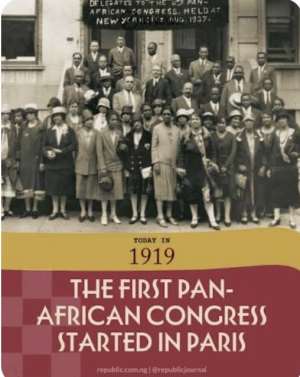
End the endless Pan-African congresses. File away the toothless communiqués where they belong, in the dustbin. Bring the raised fists down and stop posing for the cameras.
Somebody must pick up a shovel. Somebody must plant, manufacture, employ, own, and create.
The ultimate test of our liberation as Africans is not how beautifully we can describe our chains, but whether we have acquired the capacity to break them.
That is the mirror Ancestor John Henrik Clarke held up to us.
Perhaps it is time we stopped admiring the reflection and started building the man standing in front of it.
That’s why I call myself a Practivist.
©️ Ọ̀dọ̀fin Fẹ́mi Akọ́mọláfẹ́ (1st Dan, Ọ̀dọ̀fin I of Kasoa)


 Partisan EC appointments could set dangerous precedent — NPP's Kamaldeen
 Council of State failed Mahama over Emelia Agbenyo’s EC appointment – Prof. Asa...
 Winneba: Afenyo-Markin commissions police apartments at Fetteh-Osakam
 CDD‑Ghana: EC Deputy Chair Should Step Down Now
 Family Announces October 23 Memorial Mass for Nana Konadu Agyeman-Rawlings
 Eduwatch Urges Nationwide Audit of Sexual Misconduct in Secondary Schools
 Obuasi SHTS alleged sexual abuse: Kwasi Kwarteng criticises Education Minister o...
 ECOWAS’ $250,000 flood relief donation arrives in Ghana – Ablakwa
 State failure, not GoldBod, driving galamsey – Daryl Bosu
 A Rocha Ghana raises alarm over human rights abuses in mining communities



Comments
À very insightful article. Thanks