




Cop31 will run from 9-20 November in the Turkish resort city of Antalya. In a compromise that ended their rival bids to host, Turkish Environment Minister Murat Kurum will hold the presidency, while his Australian counterpart for climate and energy, Chris Bowen, will lead the negotiations.
Pacific countries had an opportunity to stress their priorities at last week's lead-up meeting in Fiji, known as Pre-Cop. Around 4,000 people from more than 100 countries attended, with limiting global warming and getting climate money to vulnerable communities central to the discussions.
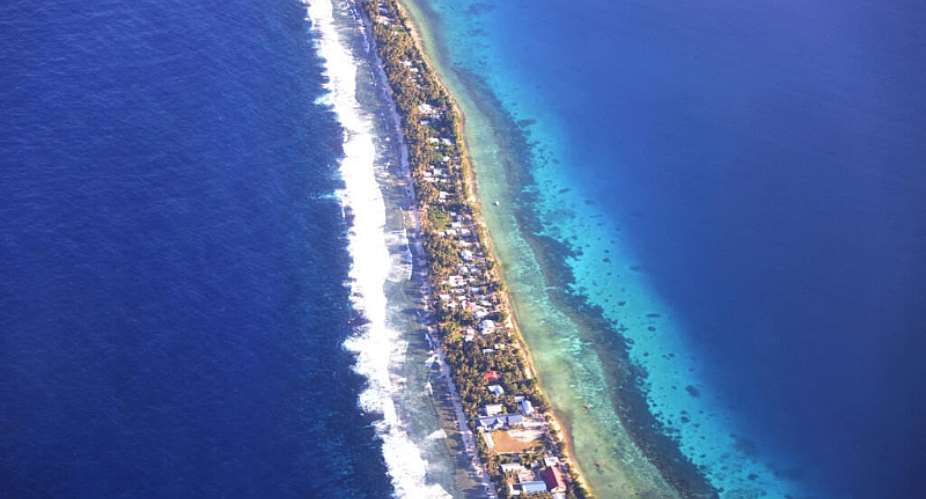
Leaders also travelled to Tuvalu, a low-lying Pacific atoll state, where rising seas threaten to make much of the country uninhabitable.
“Tuvalu has made no contribution to this crisis, but unfortunately, they are faced with the threat,” Kurum told reporters in Fiji. “They are faced with an existential crisis, and they are paying the heaviest price.”
Locked in Arctic ice, the floating lab studying climate and wildlife
Hotter seas, higher stakes
El Niño, a natural warming of the tropical Pacific that changes weather patterns worldwide, is forecast to peak in December – with heat, drought and flood risks increasing in different regions.
Sea temperatures in a key stretch of the Pacific near the equator are forecast to average around 3.7C above average from October to December, a record for the El Niño index, the World Meteorological Organisation (WMO) last week warned.
The event releases heat stored beneath the ocean surface, helping make strong El Niño years unusually hot. “The ocean it's drawing from is the warmest we've ever measured it,” WMO secretary-general Celeste Saulo told this month's Global Heat Forum in Bangkok.
El Niño returns every few years, but this event is adding to long-term warming already approaching the goals of the Paris Agreement, which commits countries to strive to limit warming to 1.5C.
That threshold is projected to be breached in the early 2030s, the UN's Intergovernmental Panel on Climate Change has said. Every additional fraction of a degree increases the risks, making rapid emissions cuts essential to limiting the damage. A farmer tends crops during prolonged dry conditions in Coatepeque, El Salvador, on 1 September 2026. The country declared a national emergency on 7 October over the effects of El Nino.
The missing billions
Of the more than US$16 billion in climate finance committed to Pacific countries since the Paris Agreement was adopted in 2015, more than US$5 billion is yet to be paid out, Pre-Cop organisers warned.
“We need adaptation finance to reach the communities that are already experiencing the impacts of climate change,” Lenora Qereqeretabua, Fiji's assistant foreign minister, told reporters.
While adaptation helps people prepare for and cope with floods, drought and rising seas, getting the money to the communities that need it can be a slow and complex process.
Australia used the Pre-Cop to launch a plan aimed at simplifying access to climate finance and getting funds moving faster, with other countries and development banks invited to sign up.
That backlog is separate from a far larger target agreed at Cop29 in Baku in 2024 to mobilise at least US$300 billion a year for developing countries, including Pacific nations, by 2035.
EU finance ministers reaffirmed that goal on Friday, backed efforts to triple adaptation finance by the same deadline and urged other countries with the means to contribute.
But a separate draft EU strategy says there is “no scope” for new climate funding commitments at Cop31. Drawn up by Ireland, which holds the bloc's rotating presidency, it focuses instead on emissions cuts and putting existing pledges into practice.
Climate support should arrive reliably and mainly through grants rather than loans, the aid group CARE International said in its Cop31 policy paper. Wealthy countries also need to explain how they will deliver the promised US$300 billion a year by 2035.
Niue, the tiny island selling the sea to save it from destruction
Fossil fuel fault line
Brazil, which hosted last year's Cop30, is preparing a roadmap for the transition away from fossil fuels outside the formal talks. How to take that plan forward will fall to the hosts of the November summit.
A voluntary target to raise electricity's share of global energy use from around 20 percent to 35 percent by 2035 is a priority.
Electrification means swapping petrol cars, gas boilers and other fossil-fuelled technology for electric alternatives. But the target does not say how the extra power should be produced, and switching to electricity only cuts emissions if that power comes mainly from renewables.
“If you electrify and you increase coal, then what are you doing?” Alden Meyer, an analyst at the climate policy think tank E3G said at the mid-year UN climate talks in Bonn.
In Turkey, wind and solar supplied 22 percent of electricity in 2025, up from 12 percent in 2020, Climate Action Tracker, an independent research project, found. Fossil fuels still generated 56 percent, and power-sector emissions hit a record high.
Australia, which will lead the negotiations, meanwhile faces scrutiny over its coal exports.
On Wednesday, the country's High Court dismissed an appeal by mining company MACH Energy, blocking approval for an expansion of its Mount Pleasant mine in New South Wales.
Planners had failed to consider conditions to minimise emissions from coal burned overseas, the court found. A coal-fired power station beside the Ohio River near New Haven, West Virginia. Cop31 co-hosts Turkey and Australia are promoting electrification, but its climate benefits depend on how the power is generated.
Ocean beyond the margins
For Pacific countries, the fossil fuel debate is inseparable from the health of the ocean.
Around a quarter of the carbon dioxide released by human activity and more than 90 percent of the excess heat trapped by greenhouse gases have been absorbed by the ocean, Fiji's lands and mineral resources minister Filimoni Vosarogo reminded the Pre-Cop.
That has come at a cost to ocean health, with warming waters and increasing acidity. Pacific nations used the meeting to press for the ocean to be given a bigger place in UN climate negotiations.
“So, the resounding message from the Pacific Pre-Cop should be that never again should Mother Ocean, the planet's primary climate regulator, be consigned to the back rows of deliberations,” said Peter Thomson, the UN secretary-general's special envoy for the ocean.
Ocean warming, acidification and sea level rise are recognised in the Taku Pakasoa Declaration adopted by leaders last week. Tuvalu has invited other countries to endorse it before the Antalya summit.
Turkey has also promised to work towards an Antalya Ocean Declaration recognising the ocean's vital role in regulating the planet's climate.


 Partisan EC appointments could set dangerous precedent — NPP's Kamaldeen
 Council of State failed Mahama over Emelia Agbenyo’s EC appointment – Prof. Asa...
 Winneba: Afenyo-Markin commissions police apartments at Fetteh-Osakam
 CDD‑Ghana: EC Deputy Chair Should Step Down Now
 Family Announces October 23 Memorial Mass for Nana Konadu Agyeman-Rawlings
 Eduwatch Urges Nationwide Audit of Sexual Misconduct in Secondary Schools
 Obuasi SHTS alleged sexual abuse: Kwasi Kwarteng criticises Education Minister o...
 ECOWAS’ $250,000 flood relief donation arrives in Ghana – Ablakwa
 State failure, not GoldBod, driving galamsey – Daryl Bosu
 A Rocha Ghana raises alarm over human rights abuses in mining communities


