




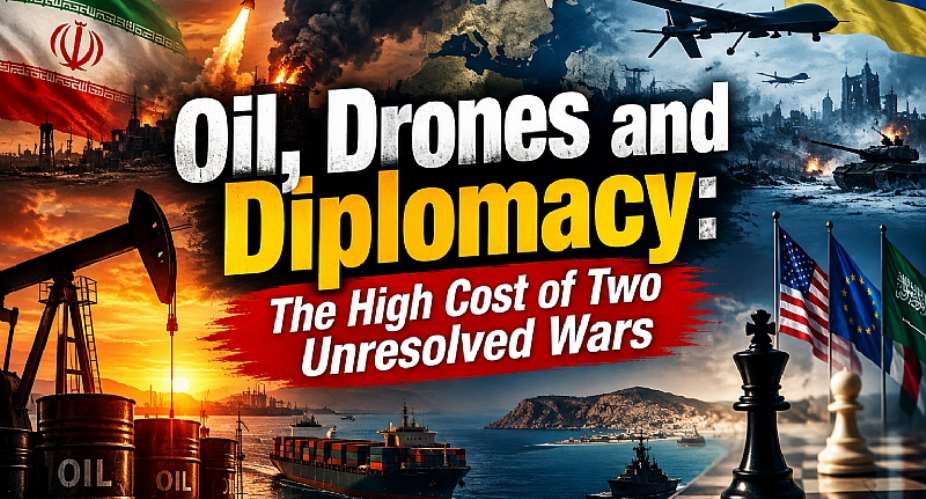
You may survive without certain comforts, but modern economies cannot function for long without energy. Electricity, fuel and the uninterrupted movement of goods are the engines of national survival. Yet when wars become instruments of strategic pressure, the consequences extend far beyond the battlefield. The continuing Iran–Israel confrontation, renewed Russia–Ukraine strikes and escalating Houthi attacks against Saudi Arabia are creating interconnected risks for global markets. Can diplomacy prevent these separate conflicts from converging into a wider energy emergency?
The Houthis: A Calculated Pressure Point?
A chain is only as strong as its weakest link. In the Middle East, the Houthis may be attempting to exploit precisely this strategic vulnerability. With Washington maintaining pressure on Tehran, attacks against Saudi Arabia could increase the economic and political costs of a prolonged regional confrontation. If reports of a US preference to avoid direct escalation before the midterm elections reflect Washington’s calculations, could regional adversaries interpret restraint as an opportunity to expand their leverage?
Reports of attacks involving commercial shipping near Oman’s coastal areas raise additional concerns about maritime security. However, responsibility, timing and operational connections must be established through reliable evidence rather than assumption. The central question remains: Is Tehran testing Washington’s limits directly, or is the wider regional environment creating opportunities for indirect pressure?
Iran and the Houthis have overlapping strategic interests, although their objectives are not necessarily identical. The Houthis have their own political and economic demands, reportedly including an end to Saudi military operations, fewer restrictions on Yemeni ports and airports, regular flights to Iran, public-sector salary payments, war compensation and an end to Riyadh’s support for Yemen’s internationally recognised government. Meeting these demands could consolidate Houthi authority over substantial parts of Yemen.
Geopolitically, the movement may also seek greater regional recognition and a route towards international legitimacy through negotiations involving Saudi Arabia. Can Riyadh secure its borders without strengthening the political position of the very movement it considers a security threat?
Has Washington Left Riyadh Exposed?
Saudi Crown Prince Mohammed bin Salman’s security calculations face a difficult test. According to reports attributed to Reuters, Riyadh sought greater American assistance against the Houthis, but Washington initially favoured intelligence-sharing and targeting support rather than direct US strikes. Subsequent statements from President Donald Trump and Secretary of State Marco Rubio condemned Houthi attacks, while the precise scope of any future American military response remained uncertain.
This creates an uncomfortable strategic question: Can Saudi Arabia rely on American security assurances when Washington’s priorities do not always align with Riyadh’s immediate needs?
The imbalance is significant. Saudi Arabia possesses valuable energy infrastructure, commercial centres and development projects that could suffer from sustained attacks. The Houthis, meanwhile, operate with fewer conventional assets at risk. Their geographical position near the Bab el-Mandeb Strait also provides potential leverage over an important maritime corridor.
Analysts have warned that this asymmetry could produce a war of attrition. A conflict that Riyadh might prefer to contain as a security challenge could become a wider regional dispute if other states become involved. The breakdown of the Saudi-backed 2023 peace roadmap, which offered a potential path towards reconstruction and salary payments, adds another layer of uncertainty. Without Gulf cooperation, particularly between Saudi Arabia and the United Arab Emirates, can any durable settlement emerge?
Ukraine: Another Front in the Energy Crisis
Meanwhile, the Russia–Ukraine conflict is placing renewed pressure on energy infrastructure. Following a reported pause in attacks on energy targets, Russian missile and drone strikes again damaged critical facilities, disrupting electricity supplies for hundreds of thousands of people.
Ukrainian President Volodymyr Zelensky subsequently indicated that Kyiv’s restraint regarding Russian oil refineries had ended. He also argued that restrictions affecting Ukraine’s military use of Starlink reflected a policy decision rather than a technical failure. Elon Musk stated that Starshield systems were owned and controlled by the US government, with usage restrictions ultimately determined by American authorities.
These developments expose Ukraine’s dependence on foreign technology and Washington’s influence over its operational capabilities. Zelensky’s insistence that political leadership should ultimately reflect the will of voters also highlights the tension between national sovereignty and external security dependence. European governments face a related challenge: how to develop greater strategic autonomy while remaining dependent on American capabilities.
If military escalation continues alongside disputes over weapons, technology and political influence, can diplomatic initiatives regain momentum before energy markets face further disruption?
The Cost of Strategic Deadlock
The danger is not simply that two wars continue, but that their consequences reinforce one another. Disrupted shipping, damaged infrastructure, uncertain oil flows and escalating military expenditure can increase economic pressure far beyond the countries directly involved.
Washington, Tehran, Riyadh, Moscow, Kyiv and European capitals all face different security calculations, but none can entirely insulate itself from the resulting costs. The United Nations and international human-rights institutions should continue pressing for civilian protection, humanitarian access and credible diplomatic channels.
Ultimately, energy security cannot be separated from human security. Every additional strike risks irreversible human losses, deeper economic uncertainty and a narrower path towards peace. Will world leaders treat these crises as separate strategic contests, or recognise that preventing a wider emergency requires coordinated diplomacy before the deadlock becomes more costly than compromise?


 Appointment of Emelia Agbenyo as EC deputy chair was well calculated, reasoned –...
 Relief for students as GAUA and TUSAAG call off strike; declare return to work o...
 Who gave Cabinet authority to decide for Ghanaians to join BRICS without parliam...
 Mahama urges Ghanaian businesses to tap CSIR innovations
 Partisan EC appointments could set dangerous precedent — NPP's Kamaldeen
 Winneba: Afenyo-Markin commissions police apartments at Fetteh-Osakam
 Council of State failed Mahama over Emelia Agbenyo’s EC appointment – Prof. Asa...
 CDD‑Ghana: EC Deputy Chair Should Step Down Now
 Family Announces October 23 Memorial Mass for Nana Konadu Agyeman-Rawlings
 Eduwatch Urges Nationwide Audit of Sexual Misconduct in Secondary Schools


