




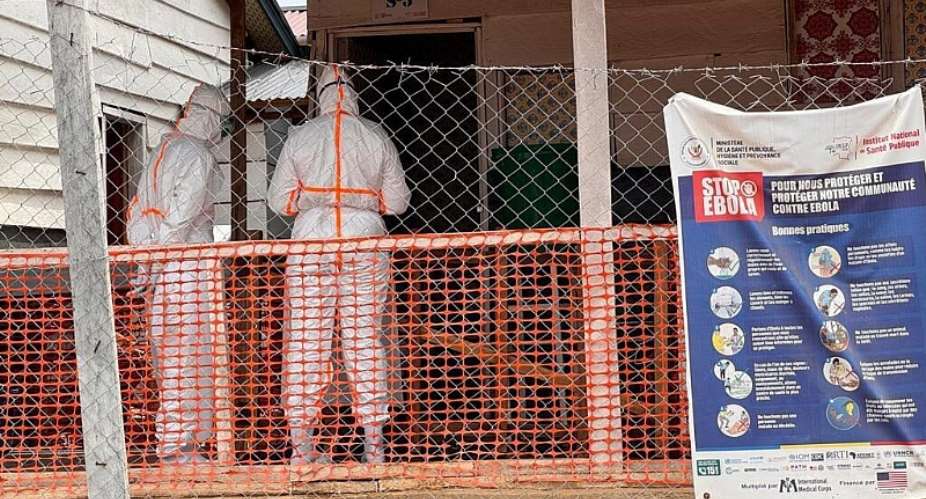
The outbreak, the 17th in the Democratic Republic of Congo (DRC), has been classified by the World Health Organization as a public health emergency of international concern.
In Rwampara, a district on the outskirts of Bunia, community workers have stepped up efforts to contain Ebola. Since the epidemic began, they have increased home visits and stepped up public awareness campaigns and community discussions to inform residents and encourage them to seek medical care.
“We used to have routine activities, but with Ebola we had to change what we do," health worker Emmanuel Birunga, who has done the job for eight years, told RFI.
"We run mass awareness campaigns, we talk to people, we hold community discussions and we have to make home visits to monitor the situation and raise alerts.”
Convincing people was not easy, even for Birunga, who says he knows the area inside out.
“People weren't listening. At first it was complicated because they said it was a common illness – malaria. Or they said it was poison. They went to see traditional healers instead, who told them it was poison.”
Then the deaths mounted. On some days in his area, more than 10 people were buried – sometimes more than 15, Birunga recalled.
“That's when people understood this disease was real.” Community health worker Emmanuel Birunga outside a health centre in Rwampara, Ituri province, eastern DRC, October 2026.
A matter of trust
Health centres are filling up now, as residents begin to regain confidence in them. Maintaining that trust is essential, said Cynthia Stephanie Zoh, who supports community health workers at the United Nations Population Fund (UNFPA).
“Community engagement is always a challenge because when a new disease arrives, you have to find ways to involve communities in the different activities so they can get the right information,” she said.
Informing people, reassuring them and fighting false information have become an integral part of the response.
A short walk away, the maternity ward at Rwampara health centre was quiet when RFI visited on a Sunday morning. There were no new patients, and four women who had given birth the previous Thursday had already gone home.
A race against time to prevent an outbreak follows Kenya's first Ebola death
“This is where we do the triage and then we bring her through. If she has come to give birth, she arrives here and we welcome her,” said midwife Victorine Kwikiriza, using the lull to give a tour of the ward.
No Ebola cases have been recorded there, but the epidemic has deeply disrupted the maternity unit's work. At first, health workers feared becoming infected because they did not have enough protective equipment.
“At the start we were afraid of the women, the patients and the pregnant women, because we had no protection,” Kwikiriza said.
Pregnant women were also reluctant to give birth at health facilities, and births there fell by half.
To bring women back, the medical teams had to go out and meet them.
“There are door-to-door awareness sessions in the community and that has helped people understand that they need to come to the health centre for sexual and reproductive health services, as well as all primary healthcare services,” UNFPA midwife Esther Mosseka explained. Midwife Victorine Kwikiriza at the maternity ward of the Rwampara health centre in Ituri province, eastern DRC, October 2026.
Mothers at risk
Women are particularly vulnerable to Ebola because their roles caring for the sick and taking part in funerals bring them into closer contact with people who may be infected.
“If someone is sick, it's the woman who looks after them. If a funeral has to be organised, the woman is there,” Mosseka said. “Women are involved in almost every activity, so the role they play in the community really puts them more at risk.”
Attendance has fallen at antenatal consultations, childbirth services, family planning and care for survivors of sexual violence, said Paulin, a doctor in charge of sexual and reproductive health at UNFPA.
“Because people stopped using health services, we saw maternal deaths rise. Before the epidemic, we had around three maternal deaths a week on average, and in Bunia that went up to almost five a week.”
Fear of infection has compounded the problems in a health system already under strain.
France earmarks a further €7m to help fight DRC's worst-ever Ebola crisis
Babies under watch
At Bunia's Evangelical Medical Centre, UN children's agency Unicef has set up a nursery beside the Ebola treatment centre for children whose parents are in hospital. Some have tested negative for the virus but remain under observation because they may have been exposed.
“He's a boy, he's two months old and he has been discharged. His mother is here at the treatment centre – she has tested positive, but he is negative,” carer Neema said as she introduced a baby.
At least 1,900 children have been separated from a parent or guardian during the epidemic, Unicef said. It has established 12 nurseries directly linked to health facilities to care for the children of patients.
Neema is herself an Ebola survivor and a doctor in training.
“I chose to come and help the children here because their parents don't have the strength and the children feel cut off from them,” she said. “A lot of people don't want to help the children. I really love paediatrics, I really love children. That's why I decided to come and help them here.”
“At the treatment centre, nurses come round to keep checking on the children, take their temperature and see whether they have developed symptoms. If something is wrong, we take the child to the treatment centre so we can keep a close eye on them,” Unicef specialist Marlin Bisimwa said.
The agency wants nurseries like this to become standard alongside treatment centres during Ebola epidemics. It's also considering creating accommodation for parents whose children are in hospital.
Ebola outbreak slows in parts of DR Congo but crisis remains severe
Life after Ebola
In Rwampara, RFI met with Sarah – another carer who is also an Ebola survivor. Early in the outbreak she lost much of her family, including her husband. Seven months pregnant, she then became ill herself.
“Because so many people in my family had died in a centre, at first I didn't want to go there,” Sarah recalled. “Then my husband died at home. I was very sick, so in the end I went to a centre.”
It was there that she gave birth to a healthy baby girl, whom she named after herself. While Sarah was being treated, her baby was cared for at the nursery at Rwampara's Ebola treatment centre.
After surviving Ebola, she was reunited with her daughter and they returned home.
“My house was completely empty. My family thought I was going to die, so they sold everything,” she said. “I found myself alone, with nothing, and five children to look after.”
Now working at the nursery that took in her daughter, Sarah is trying to get back on her feet.
In Bunia, while treatment centres are no longer overwhelmed, Ebola continues to claim lives. In the Beni-Butembo region of North Kivu, the situation remains worrying. The presence of the ADF jihadist armed group is making it harder to deploy response teams in the area between North Kivu and Ituri.
The humanitarian crisis is still underfunded, the United Nations has warned.
This article was adapted from the original version in French by Paulina Zidi.

 Ms. Emelia Affi Agbenyo must honourably resign as new EC Deputy Chairperson to p...
 Why have US-Ukraine relations soured ahead of the midterms?
 Govt to meet Free Zones Authority, Trade Ministry over Customs Act concerns
 Kojo Bamba was never my driver or bodyguard — Nana B
 Ekow Assafuah petitions OSP to probe alleged World Cup visa facilitation irregul...
 Africa attracting wrong waste management solutions – GAIA report
 Summon Kofi Adams, GTA boss over 2026 World Cup visa scandal — NPP tells Parliam...
 Obuasi SHS headmaster accused of sexual abuse is NDC constituency secretary – Ma...
 Family demands answers over death of 14-year-old student at Abomosu STEM SHS
 Osahen Afenyo-Markin reflects on loneliness of public service, says survival is ...


