




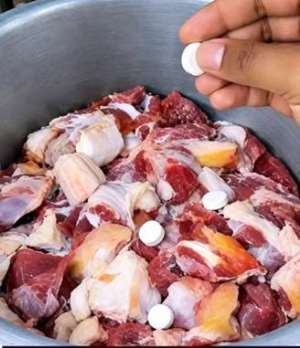
Imagine walking into your favourite local chop bar or open-air eatery. The rich aroma of light soup, palm nut soup, or groundnut soup fills the air. The meat on your plate appears perfectly cooked—soft, succulent, and falling effortlessly from the bone.
You take a bite, impressed by its tenderness. Yummy!
But what if that tenderness did not result from culinary skill, patient cooking, natural tenderisation, or the use of a pressure cooker? What if someone had secretly dropped paracetamol tablets into the pot?
To save a few Ghana cedis on cooking gas, charcoal, or firewood, an unscrupulous food vendor may expose an entire family to an undisclosed pharmaceutical substance. What appears to be an innocent meal could become a vehicle for involuntary drug consumption.
The reported use of paracetamol to soften meat is not a clever culinary shortcut. It is not innovation, resourcefulness, or economic survival. It is food adulteration, a violation of consumer trust, and a direct threat to public health.
No medicine belongs in a cooking pot.
Paracetamol Is Medicine, Not a Meat Tenderiser
Paracetamol, also known as acetaminophen, is manufactured to relieve pain and reduce fever when taken in carefully measured doses. It is not a seasoning, preservative, marinade, food additive, or meat tenderiser.
Once tablets are crushed or dropped into a cooking pot, every safeguard associated with responsible medicine use disappears. There is no prescribed dose, medical supervision, accurate measurement of individual exposure, or consideration of each consumer’s age, weight, health condition, nutritional status, or other medications.
No food vendor can determine how much of the drug remains in the meal, how evenly it has spread, or how much each customer will consume. More importantly, customers have no way of knowing that they have been exposed.
That is not cooking. It is the secret administration of a drug.
A customer who unknowingly consumes paracetamol in food may later take additional paracetamol for a headache, fever, toothache, menstrual pain, or body aches. The person may also take a cold or flu medicine containing the same active ingredient. Without knowing what was placed in the meal, the consumer cannot accurately calculate their total exposure.
This danger is intensified by the fact that serious paracetamol poisoning may initially produce only mild or nonspecific symptoms. Nausea, vomiting, sweating, weakness, abdominal discomfort, or loss of appetite may be dismissed as an ordinary illness until severe internal damage has already begun.
How Paracetamol Damages the Liver
When paracetamol is taken correctly, the body processes most of it through established metabolic pathways. A smaller proportion is converted into a highly reactive substance called N-acetyl-p-benzoquinone imine, commonly known as NAPQI. Under normal circumstances, the liver neutralises NAPQI using glutathione, a naturally occurring protective substance. Excessive paracetamol exposure, however, can overwhelm this defence system. NAPQI may then accumulate and damage liver cells. Severe paracetamol poisoning can cause acute liver failure, necessitate liver transplantation, or result in death. Serious cases may also involve kidney injury and other life-threatening complications.
The risk is especially disturbing when exposure occurs without the consumer’s knowledge. A person cannot protect themselves from a drug they do not know they have consumed.
Heating Paracetamol Creates Further Uncertainty
Heating paracetamol introduces additional chemical uncertainty. Scientific stability studies indicate that heat can accelerate its degradation under certain conditions, potentially producing compounds that include 4-aminophenol. Toxicological research has linked 4-aminophenol particularly to injury of the kidney’s proximal tubular cells.
The critical point is that a kitchen is not a pharmaceutical laboratory.
A cook cannot determine how much paracetamol remains unchanged, how much has degraded, which compounds have formed, or what concentration has entered each serving. The safety of the contents cannot be established by tasting, smelling, washing, reheating, or boiling the food again.
Without proper laboratory analysis, nobody can know precisely what chemical changes occurred or how much of the drug—or its degradation products—a consumer may receive.
Anyone who places paracetamol in food is therefore conducting an uncontrolled chemical experiment on unsuspecting people.
Economic Hardship Is No Justification
Food vendors face genuine economic pressures. The rising prices of cooking gas, charcoal, firewood, ingredients, transportation, rent, and utilities continue to increase the cost of preparing meals. Tough cuts of meat may also require prolonged cooking and greater fuel consumption.
None of these difficulties justifies secretly exposing customers to medicine.
The few cedis saved by shortening cooking time cannot outweigh the potential cost of emergency treatment, hospitalisation, laboratory investigations, lost income, liver injury, kidney complications, disability, or death.
A customer may be a child, an older adult, a pregnant woman, a person living with liver or kidney disease, someone experiencing malnutrition, or someone already taking medicines containing paracetamol. The vendor does not know—and the customer is never given an opportunity to refuse.
This practice is therefore more than an issue of poor hygiene. It is a profound violation of bodily autonomy, informed consent, and public trust.
People pay for food, not for an undisclosed dose of medication.
A Food-Safety and Regulatory Violation
Ghana’s Food and Drugs Authority requires food-service establishments to use appropriate ingredients and protect food from toxic substances and contamination. Its Code of Hygienic Practice also prohibits the addition of unapproved substances intended to alter food or make it appear better than it is (Food and Drugs Authority Ghana, 2022).
Putting paracetamol into meat is incompatible with responsible food preparation and the fundamental obligation to protect consumers.
Food served to the public must be prepared with approved ingredients under hygienic and controlled conditions. Medicines cannot be treated as culinary additives simply because they are readily available or relatively inexpensive.
Ghana Must Strengthen Surveillance and Enforcement
Warnings alone are not enough. Ghana requires coordinated surveillance, public education, scientific testing, and enforcement.
The Food and Drugs Authority, environmental health officers, Metropolitan, Municipal, and District Assemblies, market authorities, and public-health institutions must treat credible reports of medicines being added to food with the seriousness they deserve.
Food-service operators found deliberately adding pharmaceutical substances to meals should face appropriate investigation and sanctions under Ghana’s public-health and food-safety laws. Enforcement must cover markets, chop bars, restaurants, street-food operations, catering establishments, and every other setting in which food is prepared for public consumption.
Training programmes for food handlers should explicitly state that medicines must never be used as food ingredients. Public-health education must communicate the dangers in local languages through radio, television, schools, markets, community organisations, professional associations, and social media.
Researchers and regulatory laboratories should also investigate the prevalence of this reported practice in Ghana. Food samples should be scientifically tested whenever credible suspicions arise.
National action must be guided by evidence. However, the absence of comprehensive prevalence data must never become an excuse for silence or inaction. A potentially lethal practice does not become acceptable merely because its full extent has not yet been documented.
Consumers Must Report Evidence Responsibly
Unusually soft meat alone does not prove that paracetamol was used. Pressure cooking, prolonged simmering, mechanical tenderisation, natural enzymes, and the type or cut of meat can all affect texture.
Consumers should therefore avoid making public accusations without evidence. Unsubstantiated allegations can unfairly damage businesses and individuals.
However, anyone who witnesses tablets or an unidentified pharmaceutical substance being added to food should refuse the food and report the incident immediately to the Ghana Food and Drugs Authority or the appropriate local environmental health office.
Where possible, the person should provide accurate information about the location, date, time, food involved, and what was observed. Reports should be made through official channels so that trained authorities can investigate and, where necessary, collect samples for laboratory analysis.
Seek Medical Assistance Promptly
Anyone who has consumed food known or strongly suspected to contain paracetamol should seek medical advice promptly.
They should explain what was eaten, when it was eaten, and, if known, how many tablets or what quantity of the substance was added. They should not wait for severe symptoms before seeking assistance.
Paracetamol poisoning can initially appear mild even when serious liver injury is developing. Early medical assessment is therefore essential.
Keep Medicines Out of Cooking Pots
Medicines belong in pharmacies, hospitals, clinics, and properly supervised homes. They do not belong in cooking pots.
The use of paracetamol to tenderise meat is indefensible. It exposes consumers to an undisclosed and unmeasured pharmaceutical substance, removes every safeguard associated with responsible medicine use, and transforms an ordinary meal into an uncontrolled health risk.
To vendors engaging in this practice: stop immediately. Economic hardship does not give anyone the right to gamble with another person’s liver, kidneys, or life.
To regulators: investigate credible reports, strengthen inspections, test suspicious food, educate vendors, and enforce the law.
To consumers: remain vigilant, report evidence through official channels, and demand food prepared with safe and approved ingredients.
No plate of soft meat is worth organ failure. No fuel saving is worth a human life. No vendor has the right to turn a customer into an unwilling participant in a chemical experiment.
Keep paracetamol out of cooking pots. Protect the public plate. End this deadly practice before another unsuspecting person pays the price.
Prof. Victor Wutor
Faculty of Public Health Pharmacy
Ghana College of Pharmacists


 Ms. Emelia Affi Agbenyo must honourably resign as new EC Deputy Chairperson to p...
 Why have US-Ukraine relations soured ahead of the midterms?
 Govt to meet Free Zones Authority, Trade Ministry over Customs Act concerns
 Kojo Bamba was never my driver or bodyguard — Nana B
 Ekow Assafuah petitions OSP to probe alleged World Cup visa facilitation irregul...
 Africa attracting wrong waste management solutions – GAIA report
 Summon Kofi Adams, GTA boss over 2026 World Cup visa scandal — NPP tells Parliam...
 Obuasi SHS headmaster accused of sexual abuse is NDC constituency secretary – Ma...
 Family demands answers over death of 14-year-old student at Abomosu STEM SHS
 Osahen Afenyo-Markin reflects on loneliness of public service, says survival is ...



Comments
Massa, how do you know this? How did they even get to know this practice till soften the meat faster? Thank you