




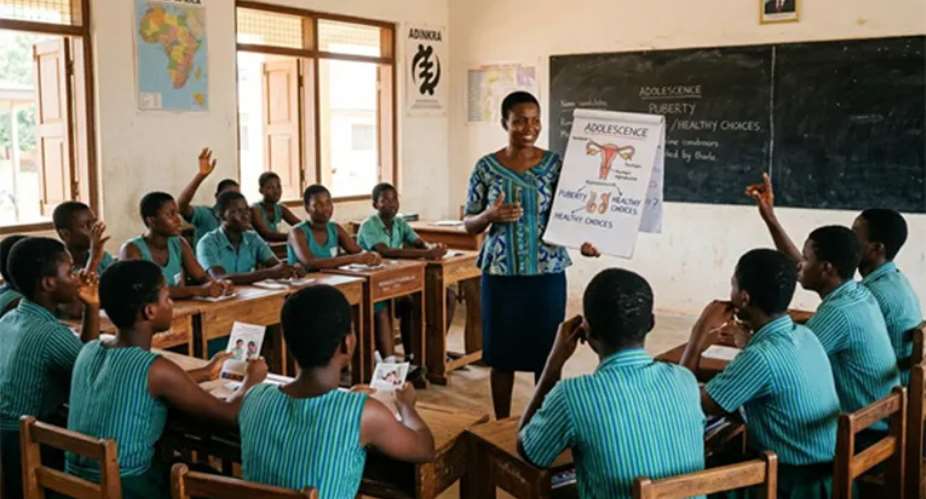
What good is a reproductive health lesson if the teacher delivering it lacks the confidence to answer students' questions? What happens when an adolescent seeking contraception or health advice is met with judgment instead of understanding? And how can Ghana expect young people to make informed decisions about their health when the very people entrusted with guiding them are not adequately prepared for the task?
These questions expose a critical gap in Ghana's efforts to strengthen Reproductive Health Education (RHE). While policies, textbooks and adolescent-friendly health facilities are important, their impact ultimately depends on the people responsible for putting them into practice. Without appropriate training, practical skills and institutional support, investments in RHE risk falling short of their intended purpose.
Beyond the Textbook: Preparing Teachers to Deliver RHE
Teaching reproductive health is not simply about familiarity with a textbook. It requires the ability to explain sensitive issues accurately, respond to difficult questions and create a classroom environment where students feel comfortable seeking information. Teachers therefore need appropriate preparation and practical skills to deliver RHE effectively.
In Ghana, reproductive health education is integrated into existing school subjects and the School Health Education Programme (SHEP), rather than being taught as a stand-alone subject. A January 2025 report by the Population Council, MSI Reproductive Choices, the Ghana Education Service (GES) and the Ghana Health Service (GHS) examined the perspectives of SHEP coordinators and identified challenges and opportunities in delivering RHE in schools. The report also highlighted the potential of establishing RHE as a stand-alone subject to strengthen implementation (Population Council et al., 2025).
The report reinforces the need to look beyond the presence of RHE topics in the curriculum and consider how consistently and effectively they are taught. UNESCO's International Technical Guidance on Sexuality Education also emphasises the importance of preparing educators to deliver structured, evidence-informed sexuality education (UNESCO et al., 2018).
When teachers are uncertain about how to address sensitive questions or lack the skills to facilitate these discussions, students may receive uneven levels of information. Strengthening teacher preparation should therefore be part of Ghana's wider effort to improve the quality and consistency of RHE delivery.
Building a Workforce That Can Deliver
Closing this gap requires a sustained institutional commitment, not isolated training activities. The Ghana Education Service should work with teacher training institutions to strengthen RHE in pre-service teacher education, ensuring that teachers acquire the necessary knowledge and practical teaching skills before entering the classroom.
Continuous professional development should also be supported through regular, adequately funded opportunities. A standardised teaching guide would provide clear, accurate and culturally relevant content, helping teachers deliver RHE more consistently across schools.
Equally important is the support teachers receive after training. School Health Education Programme coordinators should provide ongoing mentorship, while clear institutional guidance should help teachers respond to sensitive questions and address concerns raised by parents or community members.
Training teachers is essential, but empowering them to apply that knowledge confidently is what will make the difference.
Adolescent-Friendly Facilities Need Adolescent-Friendly Professionals
The workforce challenge does not end at the school gates. Ghana has developed policies and guidelines to improve health services for adolescents. The Ghana Health Service and UNICEF's Adolescent Health Service Policy and Strategy (2016–2020) sets out the importance of providing quality health care that responds to adolescents' needs. The GHS's National Operational Guidelines and Standards for Adolescent and Youth-Friendly Health Services also establishes standards intended to improve the quality of services available to adolescents and young people (Ghana Health Service and UNICEF, 2016; Ghana Health Service, n.d.).
However, the existence of policies and designated service spaces does not, by itself, demonstrate that every adolescent receives a positive experience when seeking care.
Adolescents need health professionals who can communicate respectfully, protect confidentiality and provide appropriate information without judgment. If young people fear being scolded or embarrassed when seeking contraception, counselling or other reproductive health services, they may be less willing to ask questions or seek care.
This is why the Ghana Health Service must continue to strengthen the capacity of professionals providing adolescent health services. Standardised training for health workers assigned to adolescent service points should cover relevant clinical protocols, effective communication, confidentiality and respectful care. ARHR should advocate for such training to be a defined requirement for placement, rather than an optional opportunity dependent on available funding.
Training must also be reinforced through routine supervision, confidential feedback channels for adolescents and regular refresher courses. These measures would help health facilities assess young people’s experiences, identify gaps in service delivery and strengthen accountability for the quality of care they provide.
From Infrastructure to Impact
Ghana’s progress in establishing policies and facilities for adolescents must be matched by investment in the people who make these services work. Teachers need the competence and confidence to deliver accurate RHE, while health workers must be equipped to provide respectful, confidential and appropriate care.
This responsibility also extends to the wider community. Journalists, media influencers, religious leaders and traditional leaders should be engaged to address misinformation, strengthen public understanding and build support for reproductive health education.
Ultimately, the effectiveness of RHE cannot be measured by the availability of textbooks, the number of training workshops conducted or the presence of adolescent-friendly health corners alone. What matters is whether young people receive accurate information in classrooms and can access health services without fear of judgment.
If Ghana is serious about improving adolescent health outcomes, it must invest in the people responsible for delivering these services. A trained, supported and accountable workforce is not an optional addition to RHE; it is central to its success.
References
- Population Council, MSI Reproductive Choices, Ghana Education Service, and Ghana Health Service. (2025). Reproductive health education in Ghana: Perspectives of School Health Education Programme (SHEP) Coordinators. Accra: Population Council. Read the report .
- UNESCO, UNAIDS, UNFPA, UNICEF, UN Women, and WHO. (2018). International Technical Guidance on Sexuality Education: An Evidence-Informed Approach, Revised Edition. Read the publication .
- Ghana Health Service and UNICEF. (2016). Adolescent Health Service Policy and Strategy (2016–2020): Improving the Quality of Adolescent Health Care in Ghana. Read the policy .
- Ghana Health Service. (n.d.). National Operational Guidelines and Standards for Adolescent and Youth-Friendly Health Services. Publication year not confirmed from the source page. Read the guidelines .
Source: Alliance For Reproductive Health Rights (ARHR)
 Ms. Emelia Affi Agbenyo must honourably resign as new EC Deputy Chairperson to p...
 Why have US-Ukraine relations soured ahead of the midterms?
 Govt to meet Free Zones Authority, Trade Ministry over Customs Act concerns
 Kojo Bamba was never my driver or bodyguard — Nana B
 Ekow Assafuah petitions OSP to probe alleged World Cup visa facilitation irregul...
 Africa attracting wrong waste management solutions – GAIA report
 Summon Kofi Adams, GTA boss over 2026 World Cup visa scandal — NPP tells Parliam...
 Obuasi SHS headmaster accused of sexual abuse is NDC constituency secretary – Ma...
 Family demands answers over death of 14-year-old student at Abomosu STEM SHS
 Osahen Afenyo-Markin reflects on loneliness of public service, says survival is ...


