




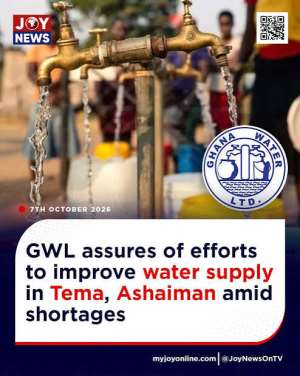
For months during 2026, residents across numerous suburban subdivisions—including communities spanning hundreds of homes in the Tema East Region—watched their taps run completely dry. For a consecutive stretch of several months, virtually no potable water flowed through the main trunk lines. Residents relied on private storage solutions, boreholes, and emergency deliveries. Yet, month after month, the bills arrived with unrelenting bureaucratic precision.
The paradox reached a glaring peak recently in Hillview Estate, Sebrepor, where a resident, after installing a 10.5 cubic meter poly-tank to capture the sporadic trickle of water, recorded a meter jump from 1040 to 1072 - a sudden, unexplainable billing surge of 32 cubic meters of water, despite the storage tank having a maximum capacity of only 10.5 cubic meters. Where did the remaining 21.5 cubic meters go? Simple physics dictates an unvarnished truth: water that does not flow cannot be consumed. The meters, it appeared, were simply charging residents for measuring compressed air.
This localized absurdity mirrors a much larger, highly controversial macroeconomic narrative at the national level. According to the State Interests and Governance Authority (SIGA) 2025 State Ownership Report, the Ghana Water Company Limited (GWCL) pulled off a staggering financial magic trick, turning a massive loss of GH¢3.06 billion in 2024 into a net profit of GH¢635.23 million in 2025.
How can a utility service provider declare hundreds of millions in profit when its core mandate - producing and distributing potable water - suffers from prolonged, catastrophic failure along its main transmission arteries?
The Accounting Illusion vs. The Dry Reality
A rigorous examination of the SIGA report reveals that GWCL’s celebrated turnaround was not primarily driven by an operational renaissance or increased water delivery to households. Rather, it was heavily anchored by favorable foreign exchange movements and macroeconomic adjustments. In fact, SIGA’s own sectoral breakdown notes that GWCL’s operating profit turnaround was significantly supported by favorable currency movements and debt revaluations, at a time when millions of citizens faced acute water shortages - exemplified by severe supply crises in Tema, Ashaiman, and surrounding residential enclaves.
When primary production is crippled, how are revenues generated? The answer lies in the systemic flaw of uncalibrated metering and automated billing algorithms that charge customers based on meter revolutions triggered by air pressure surges rather than actual volumetric water flow. If meters spin when air rushes through empty pipes during intermittent supply restoration, households are effectively penalized for municipal infrastructure failure.
Compounding this systemic opacity are recent disclosures by management revealing that an astonishing 62 out of every 100 commercial meters inspected are missing entirely from the Ghana Water database. If the majority of commercial nodes operate outside database tracking while residential customers are billed for phantom cubic meters of air, the integrity of GWCL’s revenue reporting collapses under basic scrutiny.
A Legacy of Broken Promises and Structural Debt
This financial disconnect is symptomatic of a deeper, systemic rot within Ghana’s water infrastructure management. One need only look back at legacy failures - such as the infamous $235 million judgment debt arising from unexecuted water plant deals meant to supply 500,000 people - to understand that capital allocation and operational oversight have long been plagued by systemic inefficiency.
When state entities can report stellar paper profits while citizens resort to makeshift rainwater harvesting and neighborhood community forums to debate whether upcoming inspection teams are checking for illegal boosters or merely engaging in intrusive data collection, a profound governance crisis is underway. An automated billing system that registers consumption without production is not a viable commercial enterprise; it is an extractive tax on a desperate populace.
Conclusion
The reported turnaround of Ghana Water Company Limited in the 2025 SIGA report must be interrogated beyond celebratory fiscal headlines. Paper profits derived from foreign exchange gains and phantom air-metered billing do not quench the thirst of communities enduring months of dry taps. Until GWCL aligns its financial statements with actual service delivery - ensuring that water actually flows before meters spin - such profits will remain nothing more than an illusion built on empty pipes and pressurized air.


 Ms. Emelia Affi Agbenyo must honourably resign as new EC Deputy Chairperson to p...
 Why have US-Ukraine relations soured ahead of the midterms?
 Govt to meet Free Zones Authority, Trade Ministry over Customs Act concerns
 Kojo Bamba was never my driver or bodyguard — Nana B
 Ekow Assafuah petitions OSP to probe alleged World Cup visa facilitation irregul...
 Africa attracting wrong waste management solutions – GAIA report
 Summon Kofi Adams, GTA boss over 2026 World Cup visa scandal — NPP tells Parliam...
 Obuasi SHS headmaster accused of sexual abuse is NDC constituency secretary – Ma...
 Family demands answers over death of 14-year-old student at Abomosu STEM SHS
 Osahen Afenyo-Markin reflects on loneliness of public service, says survival is ...


