




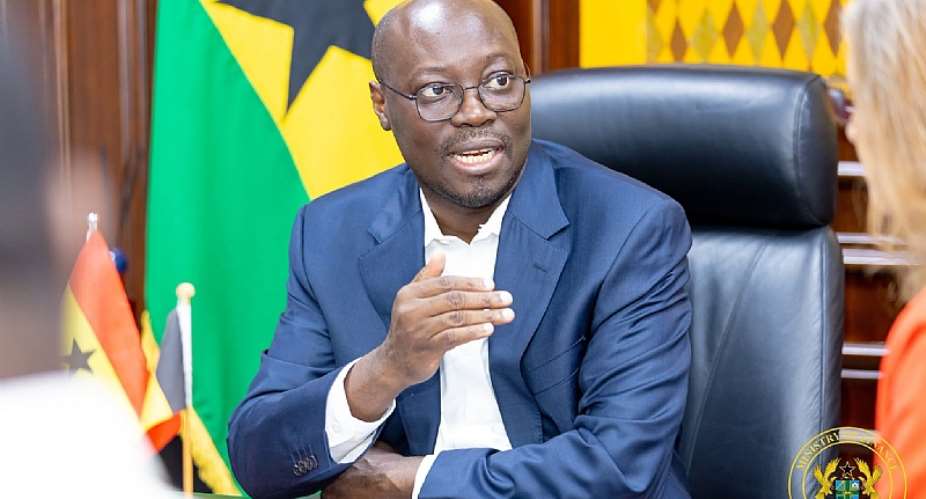
Government expenditure and net lending reached GH¢147.077 billion between January and July 2026, falling 16.4% short of the programmed target of approximately GH¢175.932 billion.
The shortfall was recorded across major spending areas, including compensation of employees, goods and services, interest payments, grants to other government units and capital expenditure, according to the July 2026 Monetary Policy Report.
Despite spending remaining below target, some expenditure categories recorded significant year-on-year increases, particularly capital expenditure and spending on goods and services. Interest payments and grants to other government units, however, declined compared with the same period in 2025.
Compensation of employees accounted for GH¢50.553 billion of government spending during the seven-month period, against a programmed amount of GH¢52.943 billion, representing a shortfall of approximately 4.5%.
The amount nevertheless marked a 12.6% increase over the corresponding period in 2025. Compensation expenditure also accounted for 35.2% of domestic revenue mobilised by the government during the period.
Spending on goods and services stood at GH¢5.482 billion, below the target of GH¢7.897 billion. Despite the lower-than-programmed outturn, the category recorded a 63.4% year-on-year increase.
Interest payments also fell below expectations, with the government spending GH¢25.171 billion against a target of GH¢34.117 billion.
The amount represented a 12.3% decline from the GH¢28.686 billion recorded during the same period in 2025.
The report attributed the reduction mainly to lower domestic interest payments and the front-loading of some Eurobond payments at the end of 2025. Those payments had initially been programmed for 2026, but settling some obligations earlier shifted the expenditure outside the period under review.
Grants to other government units amounted to GH¢30.611 billion, compared with a target of GH¢35.866 billion. The outturn also represented a 1.6% decline from the corresponding period in 2025.
Capital expenditure recorded one of the strongest increases in year-on-year terms, reaching GH¢24.228 billion, equivalent to 1.5% of Gross Domestic Product (GDP).
Although capital spending rose by 157.9% compared with the same period in 2025, it remained 25% below the programmed target for the first seven months of 2026.
Other expenditure amounted to GH¢9.283 billion, falling 13.4% short of its target. The figures provided in the report put expenditure in the corresponding period of 2025 at GH¢8,107 billion.
Overall, the expenditure figures show that government spending remained below its programmed level between January and July 2026, even as some categories recorded substantial annual growth.
The contrasting trends in the figures reflect differences across the government's spending commitments, with increases in compensation, goods and services, and capital expenditure occurring alongside reductions in interest payments and grants to other government units.
 Ms. Emelia Affi Agbenyo must honourably resign as new EC Deputy Chairperson to p...
 Why have US-Ukraine relations soured ahead of the midterms?
 Govt to meet Free Zones Authority, Trade Ministry over Customs Act concerns
 Kojo Bamba was never my driver or bodyguard — Nana B
 Ekow Assafuah petitions OSP to probe alleged World Cup visa facilitation irregul...
 Africa attracting wrong waste management solutions – GAIA report
 Summon Kofi Adams, GTA boss over 2026 World Cup visa scandal — NPP tells Parliam...
 Obuasi SHS headmaster accused of sexual abuse is NDC constituency secretary – Ma...
 Family demands answers over death of 14-year-old student at Abomosu STEM SHS
 Osahen Afenyo-Markin reflects on loneliness of public service, says survival is ...


