




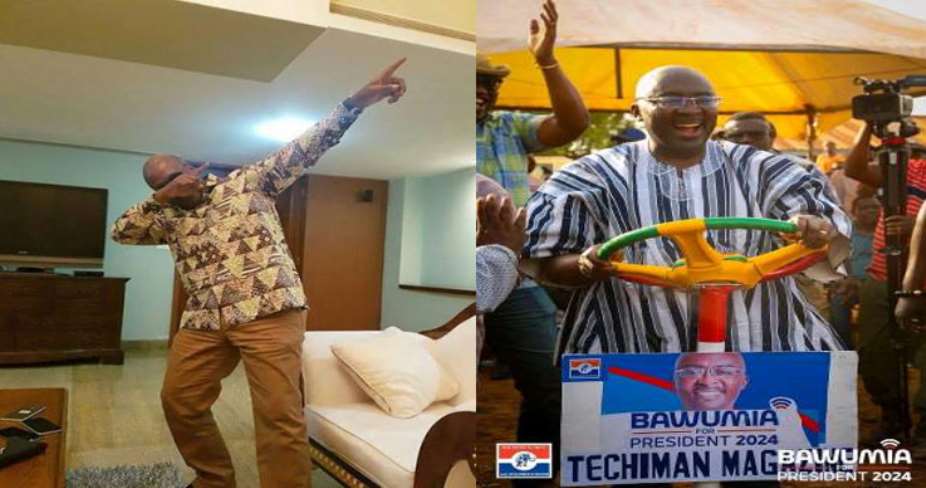
The campaign is over, the votes have been counted, and power has changed hands. But what happens when the very voices that helped sell a political message begin demanding answers from the government they helped bring to power? Ghana may be witnessing one of the most fascinating consequences of modern political communication: the struggle between those who shape the message and those who must ultimately govern.
THE THEATRE OF GHANA’S 2024 ELECTIONS
Ghana’s 2024 general elections now belong to history, but the dramatic scenes that defined the campaign remain memorable.
The National Democratic Congress (NDC) presidential candidate, John Dramani Mahama, popularised the emphatic slogan, “NDC, no turning back,” while the New Patriotic Party’s (NPP) candidate, Dr Mahamudu Bawumia, used the metaphor of a driver seeking the keys to lead Ghana forward.
These campaign performances were more than political entertainment. They were communication strategies designed to make messages memorable, build emotional connections and persuade voters.
Both candidates and their supporters made extensive use of social media to reach eligible voters. The Electoral Commission declared Mahama the winner of the December 2024 presidential election, with Bawumia conceding defeat. The electorate had made its choice. Reuters’ election report.
But the end of a campaign does not necessarily end the influence of those who helped shape it.
BERNAYS AND THE POWER BEHIND PUBLIC OPINION
In his 1928 book Propaganda, public relations pioneer Edward L. Bernays made a provocative observation about the power of persuasion in democratic society.
He wrote:
“The conscious and intelligent manipulation of the organized habits and opinions of the masses is an important element in democratic society.”
Bernays went further, arguing that those who influence public opinion can constitute an “invisible government” because they help shape how people think, what they value and how they respond to public issues. Bernays, 1928, p. 9
This idea offers a useful lens through which to examine modern political campaigns in Ghana.
Political communication is not simply about presenting policies. It is also about deciding which issues receive attention, how problems are framed, which emotions are activated and which political narratives become dominant.
During the 2024 campaign, NDC communicators and activists repeatedly criticized the record of the then governing NPP. Their messaging formed part of a wider contest over economic hardship, public confidence, accountability and the direction of the country.
In my view, the effectiveness of the NDC’s campaign communication deserves examination. However, it would be simplistic to attribute the election result to propaganda alone. Economic conditions, voters’ experiences, policy choices, party organisation and many other factors also shaped the outcome.
The important question is what happens when the campaign machinery continues operating after the election.
WHEN THE CAMPAIGN PROMISES BECOME THE PUBLIC’S SCORECARD
Among the commitments Mahama made during the campaign was a proposal to drill boreholes on cocoa farms and provide water-storage facilities to help farmers irrigate their farms during dry periods. MyJoyOnline reported the proposal in November 2024
The NDC also campaigned on a 24-hour economy, built around three eight-hour shifts intended to increase productivity and create employment.
These were campaign commitments, not merely slogans. They created expectations among citizens who hoped to see tangible improvements in employment, agriculture and living standards.
Whether individual promises have been fulfilled, partially implemented, delayed or remain outstanding must be assessed through current evidence, official implementation records and the experiences of the intended beneficiaries.
But one principle is beyond dispute, “a campaign promise does not become a government achievement simply because it was repeated convincingly during an election.”
It must be measured against what is actually delivered.
This is where citizen journalists, bloggers and content creators become particularly important. They can visit communities, interview farmers, speak to unemployed young people, document unfinished projects and ask questions that may not receive sustained attention in traditional newsrooms.
Their work can help transform campaign rhetoric into public scrutiny.
THE PROPAGANDIST IS NOT THE PRESIDENT
Here lies the central dilemma.
When political activists spend months promoting a candidate, defending campaign messages and challenging opponents, some may come to regard themselves as indispensable to the political victory. They may expect access, influence or recognition once their preferred candidate takes office.
That possibility deserves attention, but it should not be assumed that every supporter expects a position or that every online critic once served as a campaign propagandist.
The broader question is whether political communication can create expectations that become difficult to manage after an election.
A campaign requires persuasion. Government requires administration, evidence, negotiation, public accountability and decisions that must be judged by their results.
Those are different responsibilities.
The people who helped communicate a party’s message do not automatically acquire authority over government decisions. Equally, winning an election does not give a president the right to disregard citizens who helped build public support or who now question the administration’s performance.
The citizen is not a campaign prop, and the content creator is not a permanent public-relations officer for the party he or she supported.
Once the votes are counted, the relationship must change. Supporters, critics and undecided citizens all retain the right to demand answers.
FROM PROPAGANDA TO ACCOUNTABILITY
I do not believe Bernays’s argument means that the public is powerless or that a small group can control every political outcome. People can question messages, compare competing accounts, reject political claims and change their minds when presented with evidence.
That is why the rise of citizen journalism matters.
A viral video is not automatically proof. A trending allegation is not a verified fact. Bloggers and content creators must distinguish evidence from speculation, correct errors and give people accused of wrongdoing a fair opportunity to respond.
Governments, meanwhile, should not dismiss legitimate criticism merely because it arrives through Facebook, TikTok, YouTube or WhatsApp.
Where allegations concern public spending, campaign promises or possible wrongdoing, the appropriate response is to examine the evidence, provide clear explanations and allow lawful accountability processes to operate.
The media’s responsibility is to investigate. The citizen’s responsibility is to question. The government’s responsibility is to account for its decisions.
GHANA MUST MOVE BEYOND CAMPAIGN THEATRE
The 2024 election demonstrated the importance of political storytelling and digital communication. But the real test of democracy begins after the rallies, slogans, campaign videos and victory celebrations have ended.
Bernays helps us understand how public opinion can be shaped. Ghana’s democratic experience must also remind us that public opinion can change, and those who once helped promote a political message can later become among its most determined questioners.
The lesson is not that propaganda alone wins elections or that every campaign activist seeks to control government. It is that political communication creates expectations, and those expectations must eventually confront reality.
President Mahama’s administration should be assessed by its documented actions and results, not simply by the strength of its campaign messaging. The same standard should apply to every government.
And citizen journalists, bloggers and content creators should understand that their greatest public service is not to protect a political party from embarrassment, but to help citizens establish what is true, what remains unfulfilled and what must be done.
The campaign may end on election day, but accountability has no closing date.
In Ghana’s democracy, the microphone belongs to the people. Those who once used it to help a candidate win must remain free to use it to ask what happens next.
That is not betrayal. It is part of the democratic responsibility that begins when the campaign ends.


 ‘We have turned the tide’ – Ato Forson says Ghana is ready to take off
 Sammy Gyamfi refuses to file defence, hides behind technicalities — Lawyers
 Osahen Afenyo-Markin vows to pursue case against Sammy Gyamfi despite high court...
 Let us all be mentors to our younger generation - Mahama
 Court stops Osenase homecoming over security concerns
 Supreme Court dismisses Solomon Asamoah's bid to stop Sky Train trial
 GRA denies imposing new 20% tax on Netflix, Google and Amazon subscriptions
 Police arrest 16 suspects, seize 209 rounds of ammunition at Gbane mining site
 ‘Mahama has lost his moral high ground’ – Dr Zaato on Affi Agbenyo’s EC appointm...
 Cassava, hemp could offer alternatives to plastics – Zanetor challenges scientis...


