




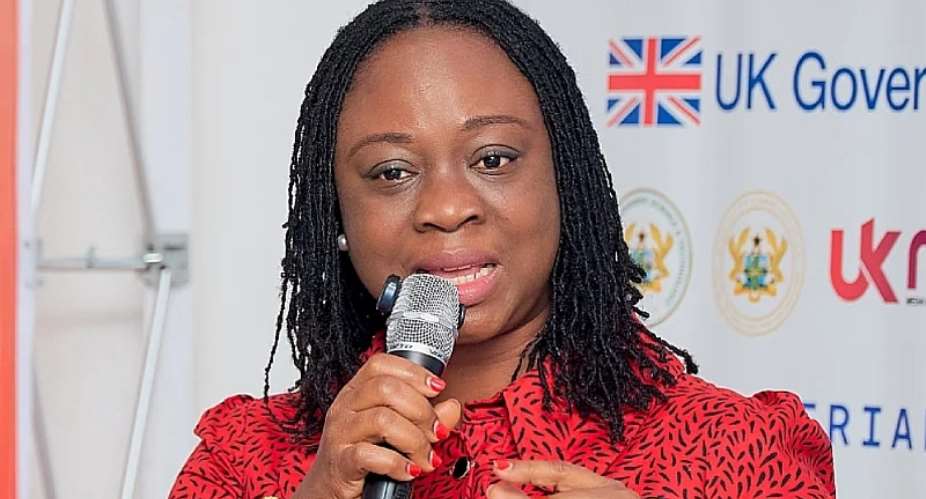
The Acting Administrator of the Ghana National Research Fund (GNRF), Prof. Abigail Opoku Mensah, has said Ghana’s research and innovation cannot depend mainly on foreign donors and that the money needed to accelerate innovation “must first of all come from domestic sources.”
She was delivering the opening keynote address at the Ghana residential of the UK Media Excellence for Emerging Technologies (UK MEET) Fellowship, held on Monday, October 12, 2026, at the Tomreik Hotel in East Legon, Accra. The address was titled “Ghana’s Research and Innovation Journey: The Journey So Far.”
The fellowship brings together 30 journalists and content creators for training on science, technology and innovation reporting. It is delivered by Imperial College London through Imperial Global Ghana, with support from the British High Commission.
Over-reliance on foreign grants
Prof. Opoku Mensah said Ghana’s research has for years been funded in fragments, with most of the money coming from development partners abroad. While she said those partnerships produced excellent work, she warned that depending on foreign grants carries vulnerabilities.
“What happens if a shift in the donor’s foreign policy requires them to pull out their support?” she asked.
She noted that African Union member states committed about four decades ago to investing at least one percent of GDP in research and development and said Ghana, like many African countries, remains well below that mark.
From law to fund
Prof. Opoku Mensah traced the Fund’s origins to calls by academia and industry over many years. Successive governments, including that of the late President J.E.A. Mills, started the process that led to the Ghana National Research Fund Act 2020 (Act 1056).
She cautioned, however, that “a law alone does not automatically translate into a fund.” A Governing Board was inaugurated only in June 2025, five years after the Act was passed, and the government provided seed money of GH¢50 million to establish the Fund.
The GNRF has since built a secretariat and is putting systems in place with support from the UK’s Foreign, Commonwealth and Development Office (FCDO), UNESCO and the National Research Foundation of South Africa.
On June 16, 2026, President John Dramani Mahama formally launched the Fund and announced an allocation of GH¢100 million to operationalize it. The GNRF is working with the Ministry of Finance to fully operationalize the statutory quarterly disbursement of 0.5 percent of national revenue.
Strategy and priority areas
The Fund has adopted a Research and Innovation Strategy for 2026 to 2030 covering six areas: research talent, competitive funding, industry partnerships, policy support, sustainable finance, and strong governance.
The strategy begins with five national research missions: food systems, health innovation and biosecurity, climate and environmental sustainability, digital and industrial transformation, and governance, policy, and social systems.
Two multilateral pilot calls have so far been launched through co-funding arrangements with Canada’s International Development Research Centre (IDRC) and the Science Granting Councils Initiative (SGCI), covering AI, health, and disruptive technologies for SDG solutions. Two other national calls are scheduled to open before the end of the year.
A call to journalists
Prof. Opoku Mensah urged the fellows to sharpen their skills for explaining science, technology, and innovation to the average Ghanaian in simple terms. She said the fellowship’s focus areas of artificial intelligence, climate and environmental risk, biomedical innovation, and circular economy map directly onto the national research missions.
She added that the third object of the GNRF Act is to promote the transfer of knowledge and technology for the benefit of Ghanaians and that journalists have a role in making that happen.
“Act 1056 gave us the road, and the launch in June gave us a vehicle,” she said. “Whether we arrive depends on whether Ghanaians understand, value and adopt technological innovation, and this will be shaped largely by what you publish and communicate.”
She also urged the fellows to be candid in their reporting, as she said she had tried to be in her address.
#UKMEET2026 #UKMEETGH


 Ms. Emelia Affi Agbenyo must honourably resign as new EC Deputy Chairperson to p...
 Why have US-Ukraine relations soured ahead of the midterms?
 Govt to meet Free Zones Authority, Trade Ministry over Customs Act concerns
 Kojo Bamba was never my driver or bodyguard — Nana B
 Ekow Assafuah petitions OSP to probe alleged World Cup visa facilitation irregul...
 Africa attracting wrong waste management solutions – GAIA report
 Summon Kofi Adams, GTA boss over 2026 World Cup visa scandal — NPP tells Parliam...
 Obuasi SHS headmaster accused of sexual abuse is NDC constituency secretary – Ma...
 Family demands answers over death of 14-year-old student at Abomosu STEM SHS
 Osahen Afenyo-Markin reflects on loneliness of public service, says survival is ...


