




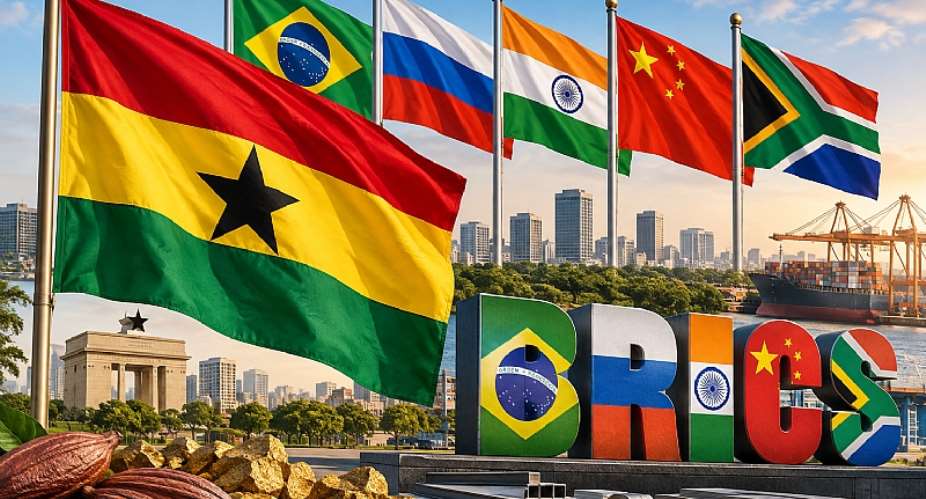
Ghana's decision to seek closer relations with BRICS has opened an important debate about our economic future and place in the world. On 6 October 2026, Foreign Affairs Minister Samuel Okudzeto Ablakwa announced that Cabinet had approved Ghana's intention to join BRICS. He later clarified that Ghana would initially seek partner-country status rather than full membership.
Some see this as an opportunity to reduce Ghana's dependence on Western countries and international financial institutions. Others fear that we may simply replace one form of dependency with another, this time involving China, Russia and other emerging powers.
Both arguments deserve attention. The real question is whether closer cooperation with BRICS will strengthen our economy, create jobs and improve the lives of ordinary Ghanaians.
What can Ghana gain from BRICS?
BRICS brings together major emerging economies, including Brazil, Russia, India, China and South Africa. The group has expanded to include Egypt, Ethiopia, Iran, the United Arab Emirates, Saudi Arabia and Indonesia. Its members seek greater influence in international economic affairs and reforms of institutions such as the International Monetary Fund (IMF) and the World Bank.
For Ghana, closer cooperation could provide opportunities for trade, investment, technology and development finance. China and India are already important economic partners, while Brazil offers useful experience in agriculture and industrial development. Ghana could also explore financing opportunities through the BRICS New Development Bank, although partner status does not guarantee access to its resources.
Another possible benefit is greater diplomatic flexibility. Ghana could strengthen relations with emerging economies without abandoning its traditional Western partners. Having more partners may improve our negotiating position and reduce excessive dependence on any single country or institution. However, these benefits depend on the agreements Ghana negotiates and whether they serve our national interests.
Are we replacing one dependency with another?
One of the strongest criticisms of Ghana's proposed relationship with BRICS concerns economic dependency. Since independence, Ghana has continued to export raw materials while importing expensive finished products. We export cocoa but import chocolate. We export minerals but lack sufficient industries to transform them into finished goods.
If Ghana continues exporting raw materials to China and other BRICS countries while importing their manufactured products, what has fundamentally changed?
This concern recalls Kwame Nkrumah's warning about neo-colonialism. Political independence does not necessarily mean economic independence. A country can have its own government and flag while remaining dependent on foreign capital, technology and markets.
However, trading with powerful countries is not necessarily a new form of colonialism. Foreign investment and international cooperation can support development when agreements are fair and local industries benefit. The key question is whether Ghana will use these relationships to build productive capacity or continue supplying raw materials to more powerful economies.
Why not strengthen African integration first?
Perhaps the most important criticism concerns Africa's unfinished integration agenda. Ghana is already a member of ECOWAS and the African Union. We also host the Secretariat of the African Continental Free Trade Area (AfCFTA) in Accra. Yet trade between African countries remains difficult because of poor infrastructure, border delays, unnecessary checks and other barriers.
Travelling by road from Ghana through Togo and Benin to Nigeria can be frustrating. Traders face delays and additional costs that make regional business unnecessarily difficult. Why are we enthusiastic about joining international economic groupings when we have not fully addressed the barriers preventing Africans from trading freely among themselves?
This is a legitimate question posed by some critics. However, Ghana does not necessarily have to choose between BRICS and African integration. The two can complement each other if international partnerships support African industries, infrastructure and regional trade. Greater African economic integration, including closer monetary cooperation, should remain central to our development agenda.
Can Ghanaian industries compete?
China and India have large manufacturing industries and technological advantages. Ghanaian businesses, meanwhile, struggle with high production costs, expensive credit and competition from imported goods.
Closer relations with these economies could bring affordable machinery, technology and investment. However, local manufacturers could face greater pressure if Ghana fails to strengthen its industries. BRICS is not a free trade area, and partner status does not automatically remove Ghana's trade protections.
Ghana needs affordable electricity, better infrastructure, access to finance, skilled workers and incentives for local processing of raw materials. We must also negotiate agreements that encourage technology transfer and employment opportunities. Without these reforms, changing our trading partners will not transform our economy.
What about security?
Security is another concern, particularly given the threat of violent extremism in the Sahel and parts of West Africa. Some BRICS countries have significant military and technological resources that could support Ghana's security efforts. However, their political interests and approaches to regional conflicts differ considerably.
BRICS is not a collective security organisation. Ghana should therefore not assume that closer relations will automatically strengthen national security. Cooperation with neighbouring countries, ECOWAS and the African Union remains essential, alongside addressing poverty, exclusion and local conflicts that can contribute to insecurity.
Ghana must put its interests first
Foreign Minister Ablakwa has argued that closer relations with BRICS will provide Ghana with more options rather than replace its traditional partners. This distinction is important. Ghana should maintain productive relations with Western countries while exploring opportunities with emerging economies.
But having more partners does not automatically guarantee greater independence. We must ask what Ghana stands to gain in practical terms. Will these relationships create jobs, improve technology, strengthen local industries and increase the value of our exports? Will Ghanaian businesses gain meaningful access to new markets? These questions should guide our engagement with BRICS, not political enthusiasm or opposition to Western influence.
Development must begin at home
The debate about BRICS should not become another ideological struggle between East and West. Ghana's development challenges cannot be solved simply by changing its international partners.
BRICS offers possible opportunities for investment, trade, technology and greater international influence. However, risks of continued economic dependency remain if Ghana does not strengthen its domestic industries and institutions.
Nkrumah's warnings about neo-colonialism remain relevant. Genuine economic independence requires more than rejecting Western influence. It requires productive industries, strong institutions, skilled workers and fair international agreements.
The central question is whether Ghana can use these new opportunities to strengthen its economy, reduce dependency and engage its international partners on more equal terms.
Changing our international partners will not, by itself, change our economy's structure. That transformation must begin at home.
Acknowledgement
I wish to acknowledge my friend, Theophilus Sewornu Dogbeten, Head of the Analytical, Control, and Research & Development (R&D) Department at The Hospital Pharmacies Enterprise in Oslo, Norway, for an insightful discussion on Ghana's proposed relationship with BRICS. His emphasis that meaningful development in Ghana and Africa must begin at home helped sharpen the central argument of this article.

 Ms. Emelia Affi Agbenyo must honourably resign as new EC Deputy Chairperson to p...
 Why have US-Ukraine relations soured ahead of the midterms?
 Govt to meet Free Zones Authority, Trade Ministry over Customs Act concerns
 Kojo Bamba was never my driver or bodyguard — Nana B
 Ekow Assafuah petitions OSP to probe alleged World Cup visa facilitation irregul...
 Africa attracting wrong waste management solutions – GAIA report
 Summon Kofi Adams, GTA boss over 2026 World Cup visa scandal — NPP tells Parliam...
 Obuasi SHS headmaster accused of sexual abuse is NDC constituency secretary – Ma...
 Family demands answers over death of 14-year-old student at Abomosu STEM SHS
 Osahen Afenyo-Markin reflects on loneliness of public service, says survival is ...


