




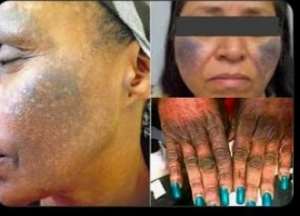
A new kind of skincare entrepreneur has emerged in Nigeria. She mixes powders, oils and creams on a kitchen table, photographs the results, and sells them through Instagram, TikTok and WhatsApp. Buyers see glowing before-and-after pictures. They rarely see the ingredient list, and often there isn't one.
What is in the jar
Many lightening and "glow" products rely on a small set of dangerous ingredients. They often contain one of three harmful ingredients: mercury, hydroquinone, or corticosteroids. The health effects are serious. Inorganic mercury in creams and soaps can cause kidney damage, rashes, scarring, lower skin resistance to infection, anxiety, depression, psychosis and nerve damage.
NAFDAC has warned that some products carry hydroquinone and kojic acid above permissible limits, and says the risks include skin cancer and damage to the liver and kidneys.
Social media does the selling
Entrepreneurs, celebrities and influencers market skin-altering products labelled as organic lighteners, toners, acne erasers and fading gels. The health minister has noted that weak rules on advertising let misleading claims flourish, overshadowing the risks.
The trend has also moved beyond creams: bleaching has evolved into glutathione drips, pills, injections and skin-lightening baths, and now the "organic skincare" trend, which tries to cover bleaching with a deceptive label. Underneath it is colourism, the belief that lighter skin is better, which social media amplifies.
A regulatory gap
Nigeria has rules. The 2019 Cosmetic Products (Prohibition of Bleaching Agents) Regulations ban mercury and cap hydroquinone at 2 per cent. Yet the Ministry of Health's cosmetics safety programme found that 52 per cent of manufacturers add skin-lightening agents to their products. Another source cites a 2020 study finding that 53% of skin-lightening products sold in sub-Saharan Africa contained illegal levels of hydroquinone or mercury.
Enforcement struggles to keep up. NAFDAC says most of the ingredients are smuggled into the country and unregistered, and that it is pursuing online sellers. It recently seized unregistered beauty items worth over ₦170 million from Abuja stores.
An investigation found that some NAFDAC officers lack handheld XRF scanners to test for mercury at ports, so the agency relies on raids after products have already entered the market.
Not every unregistered product is dangerous: small makers say registration costs time and money, which is a reason for a simpler, cheaper path to compliance.
What should be done
Regulate online sales. Hold platforms and influencers accountable for promoting unregistered products.
Equip enforcement. Provide XRF testing at entry points and regular testing of market products.
Make compliance easier for small makers, so honest sellers have no excuse and unsafe ones stand out.
Educate consumers. Check for a NAFDAC number, avoid products with no ingredient list, and see a dermatologist for skin problems.
Mustapha Bature Sallama
Medical/ Science Communicator,
Private Investigator, Criminal Investigation and Intelligence Analysis,
International Conflict Management and Peacebuilding. (USIP)
[email protected]
+233555275880
References
Saturday Independent, front page, "Poison for Sale: How Social Media Is Turning Nigeria's Skincare, Wellness Craze Into Public Health Hazard," October 10, 2026 (cover only; I have not read the full story).
BusinessDay, "Deadly trade: Fair skin at the cost of people's health." https://businessday.ng/investigation/article/deadly-trade-i-fair-skin-at-the-cost-of-peoples-health/
Down To Earth, "Nigeria world capital of skin bleaching: Health minister calls attention to 'continental crisis'." https://www.downtoearth.org.in/amp/story/africa/nigeria-world-capital-of-skin-bleaching-health-minister-calls-attention-to-continental-crisis
Voice of Nigeria/The Sun, "NAFDAC warns on dangers of skin bleaching products." https://von.gov.ng/?p=170204
Prime Progress, "NAFDAC moves to clean up Nigeria's toxic beauty market." https://primeprogressng.com/prime-health/nafdac-toxic-beauty-market/
Prime Progress, "Beneath the glow: the deadly price of a fair skin." https://primeprogressng.com/?p=16511
Republic, on skin bleaching and the Ministry of Health. https://old.rpublc.com/?p=32224


 BoG Drafts New Directive to Regulate AI Use in Ghana’s Financial Sector
 Ghana Ready to Evacuate More Citizens from South Africa if Situation Worsens — A...
 SSNIT Moves to Reintegrate Labadi Beachfront Traders, Promises African Market Be...
 Kpebu Warns Newly Called Ministers and MPs to Put Legal Ethics Above Party Loyal...
 At least 109 migrants dead, more than 100 missing after boat capsizes off Djibou...
 India court orders release of 'cockroach' movement leaders after detention
 Riyadh airport strike kills 12, Saudi Arabia threatens 'decisive' response
 Trump, Zelensky clash over diesel deal as Russian strikes on Ukraine kill 21, in...
 Surrogacy: Supreme Court judge warns of citizenship and inheritance challenges f...
 Ghana has a surrogacy law, but… - Supreme Court Justice


