




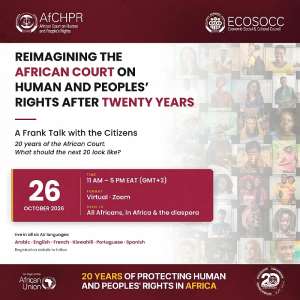
The African Court on Human and Peoples’ Rights will engage citizens across the continent and in the diaspora in discussions on the future of continental justice as it marks 20 years of operation.
The Court, in partnership with the African Union’s Economic, Social and Cultural Council (ECOSOCC), is scheduled to hold a continental Virtual Citizens’ Colloquium on October 26, 2026, under the theme, “Reimagining the African Court after Twenty Years: A Frank Talk with the Citizens.”
The virtual event will run from 11:00 a.m. to 5:00 p.m. East African Time (GMT+3) and is intended to provide ordinary Africans with an opportunity to contribute to discussions on improving access to justice and strengthening the protection of human and peoples’ rights.
According to a statement issued in Arusha, Tanzania, by the African Court’s Senior Communication and Information Officer and copied to Communication for Development and Advocacy Consult (CDA Consult) in Accra, the initiative forms part of efforts to make the Court more accessible and responsive to the people it serves.
The statement noted that after two decades of operation, the Court was seeking answers to a fundamental question: how it could become more accessible, effective and responsive to citizens’ needs.
President of the African Court, Justice Blaise Tchikaya, said the anniversary should serve as an opportunity for accountability and institutional renewal rather than merely a celebration.
"The Court was established to serve the African people. Their experiences and expectations must help shape its future. This colloquium is an opportunity to listen to citizens and hear their proposals on how we can strengthen access to justice and the protection of human and peoples’ rights," Justice Tchikaya stated.
Head of the ECOSOCC Secretariat, Ambassador William Carew, also stressed the need to ground justice reforms in the everyday experiences of citizens.
"Civil society works alongside communities every day and understands the real barriers people face in seeking justice. Those lived experiences must be at the heart of this discussion. Through this colloquium, we want citizens to put forward concrete proposals that can guide action by the Court, the African Union, and civil society alike," Ambassador Carew said.
The discussions will focus on three key areas: assessing the Court’s impact and the persistent challenges surrounding state compliance with its binding decisions; examining how artificial intelligence and digital platforms can improve public understanding of the Court and make its work more accessible; and identifying citizen-driven priorities for the institution’s next two decades.
The organisers expect the deliberations to produce a document titled the “Citizens’ Statement on Reimagining the African Court”. The document will contain practical recommendations for the Court, the African Union and civil society organisations across the continent.
The event is open to African citizens both on the continent and abroad, including human rights lawyers, civil society representatives, academics, students, journalists and digital content creators.
To promote wider participation, simultaneous interpretation will be available in all six official languages of the African Union: Arabic, English, French, Kiswahili, Portuguese and Spanish.
The African Court on Human and Peoples’ Rights is a continental judicial institution established by African Union member states to complement the African Commission on Human and Peoples’ Rights. It comprises 11 independent judges and is based in Arusha, Tanzania.
ECOSOCC serves as the African Union’s advisory organ, providing a platform for civil society organisations to contribute to the Union’s policies and programmes. Based in Lusaka, Zambia, it seeks to strengthen engagement between African citizens and the continental body.

 Surrogacy: Supreme Court judge warns of citizenship and inheritance challenges f...
 Ghana has a surrogacy law, but… - Supreme Court Justice
 Ghana faces challenge to persuade Brics it deserves a seat at the table
 Stop the Sermon Before the Engine Starts: Why Ghana Regulates Preaching on Movin...
 Don’t let speed of information become your judgement — Chief Justice tells new l...
 ‘Big Push’: Government assures contractors of prompt payments
 GES to develop plan to recover teaching time lost during teachers’ strike – Clem...
 'All human emotions': French astronaut Sophie Adenot's first words since returni...
 French astronaut recounts 'astonishing' emotions after return to Earth
 India's 'cockroach' movement chief detained ahead of major protest


