




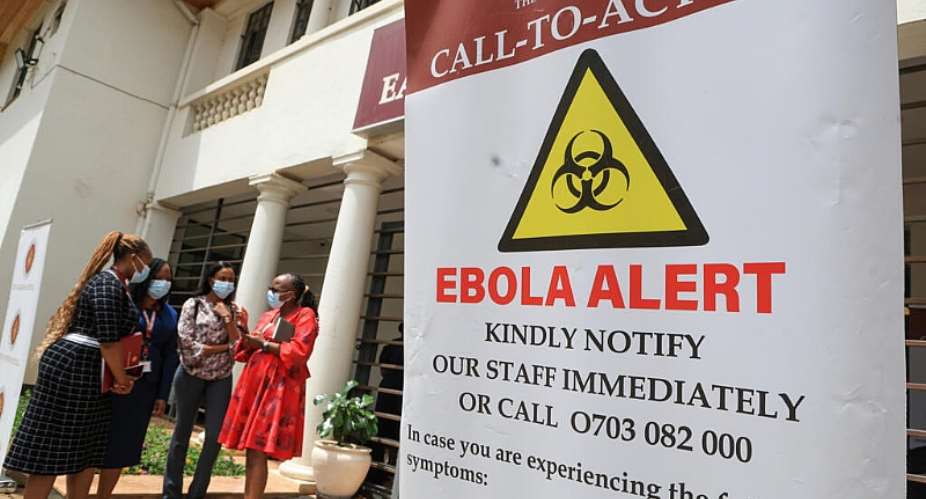
By the time Kenya confirmed its first Ebola case, the patient had already travelled across three countries.
The Kenyan man at the centre of the country's first confirmed case had lived in the Democratic Republic of Congo (DRC) for seven years. He fell ill there and received treatment at several hospitals before beginning his journey home to Kenya.
On 2 October, he travelled by road from Beni in the DRC to Kampala, Uganda. The following day, he boarded a flight to Nairobi, arriving at Jomo Kenyatta International Airport. He was taken to Nairobi Hospital, isolated and assessed.
His symptoms included fever, chills, fatigue, muscle pain, painful swallowing, sore throat and bleeding beneath the skin. Samples taken from the patient tested positive for Bundibugyo Ebola at Kenya's National Virology Reference Laboratory and the Kenya Medical Research Institute.
He died on the night of 5 October. The following day, Kenya notified the World Health Organization (WHO).
Now the race is on for the country's health authorities to trace everyone who may have been exposed.
Health authorities have so far identified 57 contacts, 10 of whom have been quarantined at the National Police Service Hospital.
France pledges more support to fight DRC Ebola outbreak as deaths top 4,000
Symptoms masked
The patient's journey has raised questions about the effectiveness of border screening.
At Uganda's Entebbe Airport, he underwent temperature screening. On arrival in Nairobi, he encountered another screening process and completed a health declaration.
Neither screening flagged him as an Ebola case.
Kenya's director-general for Health, Dr Patrick Amoth, offered a possible explanation.
“Medication can affect the way some symptoms present, including fever. If a traveller has an infection but does not have a detectable fever at the time of screening, temperature checks alone may not identify the person as a suspected case. That is why screening at points of entry must be supported by clinical assessment, surveillance and the ability to respond when symptoms emerge."
DRC school year begins amid Ebola, strikes and conflict
Dr Jean Kaseya, director-general of the Africa Centres for Disease Control and Prevention (Africa CDC), has called for strong regional cooperation to prevent another outbreak.
"I thank the Kenyan authorities for the rapid measures already put in place. An outbreak does not stop at a national border. Countries in the region need to share information quickly, strengthen surveillance at points of entry and ensure that suspected cases are identified, tested and isolated without delay," he said.
The time taken to move through these processes can affect how quickly public health teams can limit further exposure.
Felix Karani, head of the department of public health at Kenyatta University Teaching, Referral & Research Hospital, explains: "The important thing is how quickly we recognise a suspected case and act on it. Once a person is identified, we need to test promptly, ensure appropriate isolation and identify people who may have had contact with that person. The faster those steps happen, the sooner public health teams can assess and manage the risk."
Border control
More than 3,000 people cross the Kenya-Uganda border at Busia every day. The crossing is part of the Northern Corridor, connecting Mombasa through Uganda to Rwanda, Burundi, South Sudan and the DRC.
It is a marketplace, transport hub and workplace. It is also a critical surveillance point.
At the Busia One-Stop Border Post, David Omondi Olong'o, an agent who clears the movement of people and goods across the border, said traders and other workers can sometimes spot that a traveller is unwell before formal screening takes place.
"We are in this market every day. If someone is sick, we see it before anybody at the office does."
Oliver Atsing'a, a port health officer with the Kenya National Public Health Institute, echoes this.
"People who work at the border see travellers throughout the day and may notice when someone appears unwell. Early reporting does not mean that every person who looks sick has Ebola – it means that trained health personnel can make the assessment and decide whether further action is necessary. If a trader notices someone who is unwell and knows exactly who to call, that is early detection."
The WHO reported that screening of small-scale traders at Busia was operating from 8am to 6pm – but night-time screening remains a gap in the process because of staffing constraints.
Violence against healthcare workers in DRC hampers Ebola response
Barriers to treatment
Kenya has been on alert since the WHO declared the Ebola outbreak in the DRC and Uganda "a public health emergency of international concern" on 17 May.
According to its figures, by 6 October the DRC had reported 8,728 confirmed cases and 4,205 confirmed deaths. Uganda has recorded 20 confirmed cases and two confirmed deaths, with its outbreak declared over on 26 August.
By 6 October, more than 652,000 people arriving in Kenya had been screened and 267 suspected samples tested. Nearly 5,000 healthcare workers had received training in Ebola prevention and management.
The country has also established isolation and treatment facilities in high-risk areas, with five designated facilities – Kenyatta National Hospital, Moi Teaching and Referral Hospital, National Police Service Hospital, Port Reitz Hospital and Nairobi Hospital.
For Dr Mohamed Janabi, WHO regional director for Africa, this preparation has provided Kenya with "a head start".
"Preparedness is not simply having a plan on paper. It means having trained health workers, functioning surveillance systems, laboratory capacity, appropriate isolation facilities and clear procedures for identifying and following up contacts. When a suspected case is detected, these systems must work together quickly."
However, he added: "The real test of preparedness is whether the country can identify the case, confirm the diagnosis, protect healthcare workers and trace contacts before further transmission occurs."
One problem preparation cannot solve is that of access to healthcare.
For many families in Kenya, medical care comes with transport costs, consultation fees, medication expenses and lost income – all of which can act as a deterrent to seeking treatment.
With infectious diseases, any delay in care can have consequences that reach far beyond the individual patient.
Kenya's Ministry of Health has now intensified screening at Jomo Kenyatta airport and strengthened surveillance at other points of entry. Contact tracing is under way.
But the next few weeks will determine whether the first death remains an isolated event.

 Surrogacy: Supreme Court judge warns of citizenship and inheritance challenges f...
 Ghana has a surrogacy law, but… - Supreme Court Justice
 Ghana faces challenge to persuade Brics it deserves a seat at the table
 Stop the Sermon Before the Engine Starts: Why Ghana Regulates Preaching on Movin...
 Don’t let speed of information become your judgement — Chief Justice tells new l...
 ‘Big Push’: Government assures contractors of prompt payments
 GES to develop plan to recover teaching time lost during teachers’ strike – Clem...
 'All human emotions': French astronaut Sophie Adenot's first words since returni...
 French astronaut recounts 'astonishing' emotions after return to Earth
 India's 'cockroach' movement chief detained ahead of major protest


