




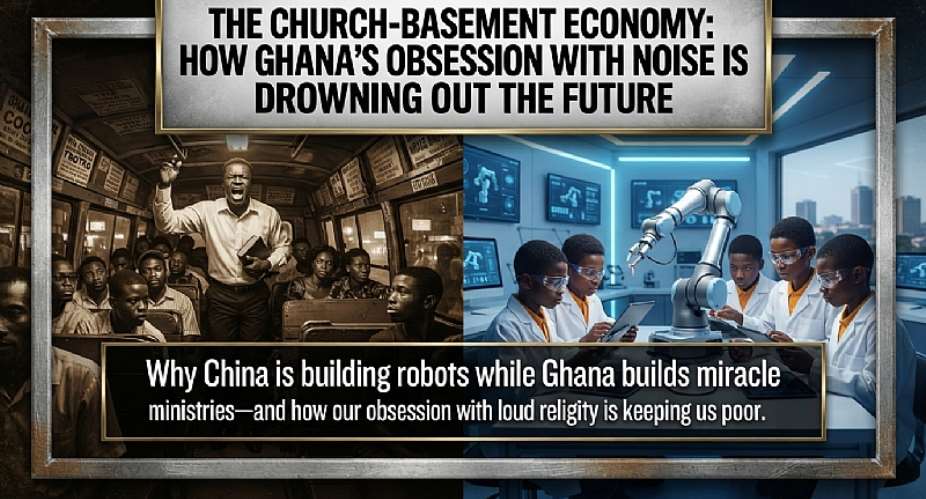
ACCRA, GHANA — In a world moving at supersonic speed toward artificial intelligence, quantum computing, and space exploration, Ghana remains stubbornly trapped in a self-inflicted cycle of loud, disruptive religiosity that confuses noise with righteousness. The recent uproar over Regulation 141 of the Road Traffic Regulations, 2026 (L.I. 2519)—which seeks to ban preaching in moving public vehicles—has exposed a deep structural flaw in our national mindset. While public figures like Prophet Nigel Gaisie threaten to break the law in the name of the gospel, and other religious groups scream persecution, the harsh truth is staring us in the face: Ghana is choking on an over-saturated church culture that prioritizes religious performance over national progress.
We have turned our public transit, marketplaces, and streets into non-stop, high-decibel prayer camps, misinterpreting a captive audience on a trotro as a spiritual harvest. While Ghanaian children are actively encouraged to spend their weekends mimicking pastors, staging mock deliverances, and screaming into microphones, Chinese children are spending their free hours in state-backed laboratories mastering robotics, coding, and advanced mathematics. We are aggressively training the next generation to be professional consumers of miracles, while the rest of the world trains theirs to be the creators of global infrastructure. If we do not ruthlessly evaluate our priorities, our deep devotion will secure nothing but a front-row seat to global poverty.
Global Precedents: How Developed Nations Draw the Line
International legal frameworks make it clear that true national development requires strict boundaries between personal faith and public spaces.
- The "Captive Audience" Protection (United Kingdom & USA): In world-class cities like London and New York, transit authorities strictly prohibit loud preaching, solicitation, or unauthorized amplified noise on subway cars and buses. International human rights law dictates that a commuter who pays for a ticket has a right to a peaceful, safe journey without being forced to participate in someone else's religious ritual.
- The Secular Economic Engine (Singapore): Singapore, a multi-religious nation, enforces strict public nuisance laws that ban aggressive proselytizing in public transit and shared economic spaces. By prioritizing order and absolute focus during work and transit hours, Singapore transformed from a third-world port into a global financial powerhouse.
- The Neutrality of Public Spaces (Rwanda): Closer to home, Rwanda has taken aggressive steps to curb religious noise pollution and unregulated churches, shutting down thousands of substandard worship centers. President Paul Kagame famously questioned if Rwanda needed thousands of churches more than it needed factories, boreholes, and industrial centers.
The Hard Truths: Why Ghana's Hyper-Religiosity is an Economic Hazard
Our current cultural model is structurally designed to keep us dependent on foreign aid while we pray for divine intervention.
- Productivity Drowned in Noise: While developed economies ruthlessly optimize every minute of the working day, Ghana loses millions of man-hours to mid-week all-nights, marathon morning services, and loud transit preaching that leaves workers exhausted before they even reach their offices.
- The Robotics vs. Ritual Gap: The starkest contrast lies in how we prepare our youth. In China, the educational system channels childhood curiosity into robotics, engineering, and manufacturing, positioning the nation to dominate the global supply chain. In Ghana, our culture celebrates children who can replicate pastoral theatricality, effectively teaching them that wealth comes from spiritual manipulation rather than scientific innovation.
- The Misdirection of Capital: Massive amounts of local capital are tied up in building mega-church auditoriums and funding the lavish lifestyles of religious elites. In contrast, advanced nations funnel their national savings into venture capital, technology hubs, and industrial research.
- The Weaponization of the "Great Commission": Opponents of L.I. 2519 argue that stopping a preacher on a moving bus halts the work of God. This is a manipulative argument. True evangelism does not require violating the peace of a commuter or distracting a trotro driver whose primary legal responsibility is getting passengers to their destination safely.
Structural Recommendations for a Progressive Ghana
To salvage our future, the state, the media, and civil society must demand an immediate shift in our cultural and legal priorities.
- Enforce L.I. 2519 Without Fear or Favor: The Ministry of Transport and the Ghana Police Service must ignore the threats of lawbreaking by religious figures. Regulation 141 must be fully implemented. Moving vehicles must remain strictly regulated, quiet zones dedicated solely to public safety and commuter comfort.
- Tax Commercial Church Operations: Religious institutions running commercial transport fleets, real estate portfolios, and media empires must be taxed aggressively. This revenue should be directly ring-fenced to fund STEM (Science, Technology, Engineering, and Mathematics) education and local robotics labs for Ghanaian children.
- Implement Strict Municipal Noise Pollution Laws: The Environmental Protection Agency (EPA) and local assemblies must enforce heavy, unannounced fines on churches using outdoor loudspeakers in residential and commercial areas during working hours. Noise is an environmental hazard, not a spiritual fruit.
- Reorient the Educational and Cultural Curriculum: Parents, schools, and local media platforms like Modern Ghana must actively de-emphasize religious showmanship among the youth. National awards, scholarships, and media airtime should be heavily skewed toward youth innovations in technology, agriculture, and manufacturing rather than scripture-recitation or mock-preaching competitions.
God did not create the Ghanaian brain to be inferior to the Chinese, European, or American brain; we have simply chosen to apply our collective intellect to the wrong ventures. Preaching on a moving trotro does not build roads, fix erratic power supply, or create vaccines. It is a symptom of a society that prefers to scream at heaven rather than work on earth. If we truly want to honor God and escape the humiliating label of a "developing nation," we must start by respecting our own laws and honoring the sanctity of public space. Let the preachers preach inside their chapels, let the drivers focus on the road, and let our children put down the microphones and pick up the coding boards. It is time for Ghana to wake up, turn down the volume, and finally get to work.
✍️ Submitted by:
Retired Senior Citizen
For and on behalf of all Senior Citizens of the Republic of Ghana 🇬🇭
Teshie-Nungua
[email protected]


 Don’t let speed of information become your judgement — Chief Justice tells new l...
 ‘Big Push’: Government assures contractors of prompt payments
 GES to develop plan to recover teaching time lost during teachers’ strike – Clem...
 Fire guts Kumasi Central Market near Aboabo Station
 'All human emotions': French astronaut Sophie Adenot's first words since returni...
 French astronaut recounts 'astonishing' emotions after return to Earth
 India's 'cockroach' movement chief detained ahead of major protest
 Strike suspended, but negotiations for teachers’ benefits not over — GNAT
 CSA rejects FBI claims, insists Ghana led cybercrime operation
 Govt suspends enforcement of ban on preaching in moving vehicles


