




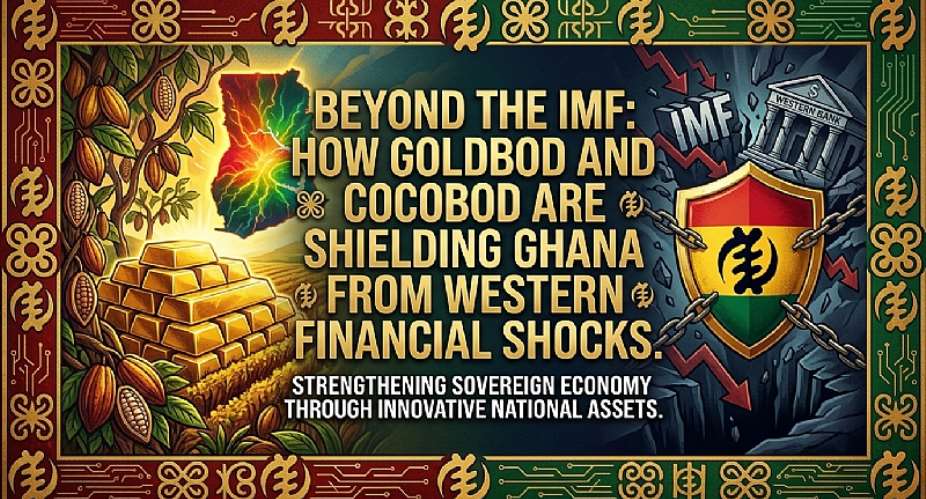
The global financial architecture is undergoing its most profound transformation since Bretton Woods, and Ghana finds itself at the very epicenter of this paradigm shift. For decades, our national economic health has been tethered to the strict policy directives of the International Monetary Fund (IMF) and the erratic fluctuations of the US Dollar. However, the rise of the BRICS economic bloc—comprising Brazil, Russia, India, China, South Africa, and its newly admitted members—is rapidly rewriting the rules of global trade. By aggressively leveraging our local resource giants, the Ghana Cocoa Board (COCOBOD) and the central bank's strategic gold-purchasing frameworks managed by GoldBod, Ghana is no longer just a passive spectator. Instead, the nation is actively building resource sovereignty. Far from launching an outright assault on Western institutions, Ghana’s prudent management of its natural wealth represents a sophisticated dual strategy: satisfying immediate IMF fiscal discipline while systematically laying the groundwork to thrive in a decentralized, multi-currency world.
The IMF, COCOBOD, and the Gold Framework: Friction, Not Threat
To understand where Ghana is heading, we must first dispel the myth that our state-led commodity frameworks are designed to destroy Western financial systems. The IMF does not view these institutions as geopolitical threats, but rather as focal points for urgent structural and fiscal reform.
- The COCOBOD Restructuring: Historically, COCOBOD faced severe financial distress, accumulating billions in debt that weighed heavily on Ghana’s broader debt restructuring efforts. Under the current $3 billion IMF Extended Credit Facility (ECF), the Fund has mandated a rigorous "COCOBOD Reset." This includes eliminating expensive cocoa bills, cutting operational overheads, reducing political appointments, and transitioning toward sustainable, domestic financing models. The IMF’s goal is to turn COCOBOD into a profitable, self-sustaining entity, rather than allowing it to remain a fiscal drain on the national budget.
- The Realities of Cocoa Pricing Sovereignty: For decades, global cocoa pricing kept Ghanaian farmers trapped in low-income cycles, with historical averages between 2018 and 2022 hovering around just £1,750 per tonne. However, structural shifts and global supply shortages pushed prices to historic heights, allowing Ghana to aggressively adjust its farmgate pricing. For the 2025/2026 season, COCOBOD announced a massive producer price boost to GH¢41,392 ($3,500) per tonne, which was pushed even higher for the 2026/2027 crop season to GH¢42,400 ($3,630) per tonne—representing over 71% of the gross Free-On-Board (FOB) value paid directly to the farmer. By locking in these elevated floors, COCOBOD is directly protecting Ghanaian farmers from price manipulations on Western commodity exchanges like ICE Futures.
- The Gold Sector Realities: Gold has risen as the absolute heavyweight of our export market, leaping from 38.5% of total exports in 2004 to a staggering 63.1% of all Ghanaian exports. Driven by high international prices, gold export earnings reached a historic $20.0 billion, outstripping cocoa and oil combined. Central to this is the domestic purchase protocol—pioneered under the Bank of Ghana and now fully absorbed by GoldBod—which helped export $10.9 billion in artisanal gold, driving a massive 7.8% GDP current account surplus. While the IMF flagged $1.7 billion in temporary operational adjustments and transaction costs caused by closing informal exchange gaps, the macroeconomic benefit is undeniable: gross international reserves recovered from a weak $3.66 billion down to a projected $10.73 billion, expanding import cover to 3.7 months.
- A Balance of Power: The relationship is a delicate dance. Ghana is utilizing IMF frameworks to achieve short-term macroeconomic stability, lower sovereign bond spreads, and restore investor confidence. Concurrently, it is using its gold and cocoa assets to ensure that the nation maintains real, tangible collateral that cannot be wiped out by external financial shocks.
De-Dollarization in Action: The Cedi-to-Yuan Payment Route
As Ghana’s Cabinet formally moves forward with its application to align with the BRICS bloc, the traditional monopoly of Western-led financial systems is facing a direct challenge. Nowhere is this change more visible than in our trade relations with China, which reached an astronomical $14.1 billion in bilateral trade.
- Bypassing the US Dollar Middleman: Traditionally, when a Ghanaian trader imports electronics or machinery from China, they must first buy US Dollars with their local Cedis. This double-conversion regime hits traders with double commission fees and subjects the Ghanaian Cedi to relentless downward pressure. To stop this, the Bank of Ghana has given its backing to a direct cross-currency settlement architecture.
- The CIPS and Local Banking Integration: Led by institutions like Stanbic Bank Ghana and GCB Bank, Ghana has systematically bypassed Western correspondent networks by plugging straight into China's Cross-Border Interbank Payment System (CIPS). Under the newly optimized local-currency framework, a Ghanaian importer brings a Yuan-denominated invoice directly to their local commercial bank branch. The bank immediately debits the merchant’s account in Ghanaian Cedis, routes the message instantly across CIPS architecture, and deposits physical Yuan (RMB) directly into the supplier’s account in Beijing.
- Sovereign Accumulation Meets Bilateral Trade: This architecture perfectly feeds into the newly launched Ghana Accelerated National Reserve Accumulation Programme (GANRAP) managed by GoldBod, which targets buying 3 tonnes of gold weekly to yield over $400 million in weekly sovereign assets. By generating massive physical backing at home and routing a significant chunk of our multi-billion dollar Chinese import reliance through direct Cedi-to-Yuan loops, Ghana effectively eliminates the artificial domestic spikes caused by commercial banks constantly hoarding US dollars to fund international trade clearings.
- The New Development Bank (NDB) Alternative: Beyond trade, the BRICS financial ecosystem opens doors to the New Development Bank, focusing heavily on infrastructure and sustainable development with far fewer political strings attached than traditional Western lenders.
Key Recommendations and Suggestions for Ghana’s Forward Path
To fully maximize this historic moment without triggering economic retaliation or internal instability, Ghana's policymakers must execute a highly disciplined strategy:
- Enforce Total Transparency in Commodity Accounting: The state must completely eliminate the quasi-fiscal losses identified in central bank gold programs. Every ounce of gold purchased and every cedi spent must be publicly auditable to maintain international credibility.
- Accelerate Domestic Value Addition: Ghana must aggressively transition away from exporting raw cocoa beans and unrefined gold. To break out of old colonial trade models, we should leverage China's zero-tariff policy on processed African goods to expand domestic chocolate manufacturing and processing hubs.
- Maintain Strict Geopolitical Neutrality: Ghana should not abandon the West for the East. The nation must maintain a policy of strict non-alignment, using IMF programs to anchor fiscal discipline while leveraging BRICS to expand trade, eliminate dollar dependence, and secure cheap infrastructure financing.
- Protect Small-Scale and Local Producers: The benefits of the gold and cocoa frameworks must trickle down directly to the small-scale miners and cocoa farmers through fair, market-reflective pricing and robust social safety nets.
Ultimately, Ghana's economic future does not belong to a single global superpower or a solitary financial institution. By cleaning up the fiscal management of COCOBOD and aggressively stacking physical gold reserves, our nation is building a shield against global volatility. The rise of BRICS does not mean Ghana must wage an economic war against the West; rather, it provides our homeland with the historic opportunity to diversify its dependencies. We are entering an era where resource-rich nations hold the ultimate leverage. If Ghana can successfully marry the strict fiscal discipline demanded by the IMF with the bold, multi-polar opportunities offered by the BRICS alliance, we will secure a prosperous, self-reliant future where the wealth of our soil directly enriches the lives of every ordinary Ghanaian. The global tide is turning, and Ghana is ready to ride the wave.
✍️ Submitted by:
Retired Senior Citizen
For and on behalf of all Senior Citizens of the Republic of Ghana 🇬🇭
Teshie-Nungua
[email protected]


 Don’t let speed of information become your judgement — Chief Justice tells new l...
 ‘Big Push’: Government assures contractors of prompt payments
 GES to develop plan to recover teaching time lost during teachers’ strike – Clem...
 Fire guts Kumasi Central Market near Aboabo Station
 'All human emotions': French astronaut Sophie Adenot's first words since returni...
 French astronaut recounts 'astonishing' emotions after return to Earth
 India's 'cockroach' movement chief detained ahead of major protest
 Strike suspended, but negotiations for teachers’ benefits not over — GNAT
 CSA rejects FBI claims, insists Ghana led cybercrime operation
 Govt suspends enforcement of ban on preaching in moving vehicles


