




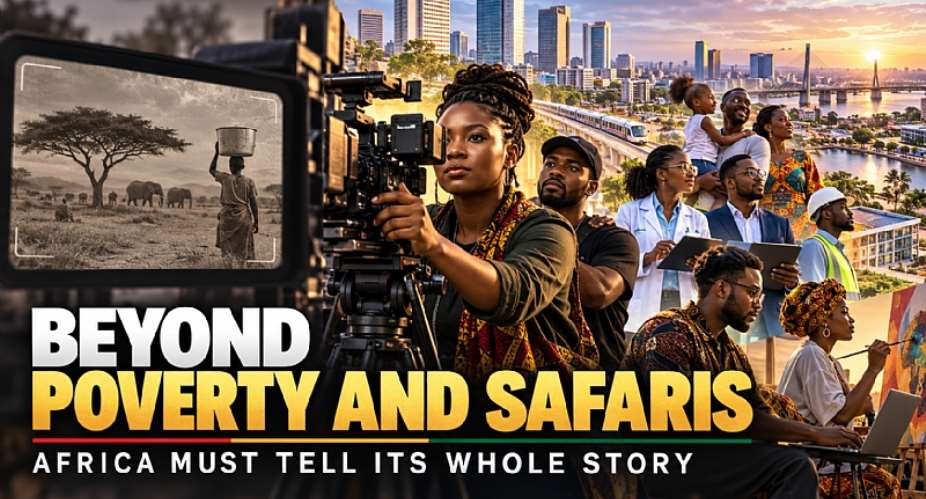
For generations, much of the world has encountered Africa through a narrow camera lens. It is a lens that frequently moves between two familiar images: spectacular wildlife roaming across seemingly empty landscapes and desperate communities overwhelmed by poverty, conflict, disease and hunger.
These realities exist and deserve serious reporting. Africa has wars, humanitarian emergencies and governance failures, just as other regions do. The problem is not that international filmmakers document hardship. It is that hardship is too often presented as the continent’s defining identity, while innovation, ordinary life, professional achievement and economic complexity remain largely outside the frame.
Africa is not a single country or a single experience. It comprises 54 internationally recognised states and an extraordinary range of languages, cultures, political systems and economic conditions. Yet international documentaries and news reports frequently compress this diversity into one emotionally compelling but misleading story.
The roots of this representation stretch back to the colonial era, when photography, literature and film were used to portray Africans as primitive, passive and incapable of governing themselves. Such images helped present colonial conquest as a civilising mission. Although the language has changed, traces of that worldview remain visible in productions that treat African people mainly as victims, background characters or beneficiaries of foreign intervention.
Wildlife documentaries can reproduce a related distortion by presenting African landscapes as untouched wilderness, with little acknowledgement of the communities that have lived in, managed and depended upon those environments for generations. In other productions, the camera enters a settlement during a crisis, records suffering and leaves without explaining the political, historical and international forces that helped create the conditions being filmed.
Commercial pressures also encourage repetition. Broadcasters and streaming platforms operate in competitive markets and often favour stories that audiences immediately recognise. Conflict, famine, disease, wildlife and dramatic rescue missions are easily packaged and marketed. A documentary about middle-class families, scientists, factory workers, software developers or local government reformers may be considered less dramatic, even though such stories provide a more complete understanding of contemporary Africa.
This does not necessarily mean that every filmmaker is deliberately promoting prejudice. More often, the distortion results from commissioning decisions, limited production time, reliance on familiar narratives and the failure to give African researchers, producers and communities meaningful editorial authority. The individual documentary may be well intentioned, but the cumulative result is a continent repeatedly described through deficiency.
Research by Africa No Filter found that the problem is not confined to Western media. Its examination of African news organisations reported that one-third of stories about other African countries came from non-African sources. It also found that 63 per cent of surveyed outlets had no correspondents in other African countries, increasing their dependence on international agencies and the narratives those organisations prioritise.
The consequences are greater than wounded pride. Media representation influences how tourists, employers, investors, lenders and policymakers assess the continent. A 2024 study by Africa Practice and Africa No Filter estimated that stereotypical international coverage could be adding as much as US$4.2 billion annually to African countries’ interest payments by exaggerating perceptions of political and investment risk. The authors presented the figure as an estimate of scale, but the finding illustrates how narrative bias can have measurable economic effects.
Such portrayals also affect Africans living abroad. When global audiences repeatedly see Africans represented as helpless, uneducated or dependent, those assumptions can follow African professionals, students and migrants into workplaces, classrooms and social relationships. The stereotype becomes a barrier that individuals must overcome before their competence is even considered.
The answer is not to replace negative propaganda with positive propaganda. Africa’s storytellers should not be expected to conceal corruption, inequality, conflict or social failure. Credible journalism must remain free to expose uncomfortable truths. What is required is proportion, context and agency: Africans should appear not merely as people to whom events happen, but as thinkers, workers, leaders, innovators and decision-makers shaping their societies.
Digital technology is creating opportunities for that change. African filmmakers, online journalists, podcasters and independent studios can increasingly reach global audiences without relying entirely on traditional foreign gatekeepers. UNESCO has described Africa’s film and audiovisual sector as vibrant but constrained by weak infrastructure, limited financing, piracy and inadequate distribution. Its research estimated that the industry already employed about five million people and generated approximately US$5 billion, with substantial room for growth.
Reclaiming Africa’s narrative will therefore require investment, not slogans alone. Governments and private institutions must support film schools, local newsrooms, documentary funds, cinemas, archives and digital distribution platforms. International production companies must build equitable partnerships in which African collaborators possess genuine authority over research, framing and editing—not merely access to locations and participants.
The camera is never neutral. Whoever finances it, directs it and decides what remains on the cutting-room floor helps determine how millions of people are understood. Africa must increasingly own those cameras, platforms and decisions. The continent does not need the world to ignore its difficulties. It needs the freedom and resources to tell its whole story—in all its hardship, achievement, contradiction and humanity


 Don’t let speed of information become your judgement — Chief Justice tells new l...
 ‘Big Push’: Government assures contractors of prompt payments
 GES to develop plan to recover teaching time lost during teachers’ strike – Clem...
 Fire guts Kumasi Central Market near Aboabo Station
 'All human emotions': French astronaut Sophie Adenot's first words since returni...
 French astronaut recounts 'astonishing' emotions after return to Earth
 India's 'cockroach' movement chief detained ahead of major protest
 Strike suspended, but negotiations for teachers’ benefits not over — GNAT
 CSA rejects FBI claims, insists Ghana led cybercrime operation
 Govt suspends enforcement of ban on preaching in moving vehicles


