




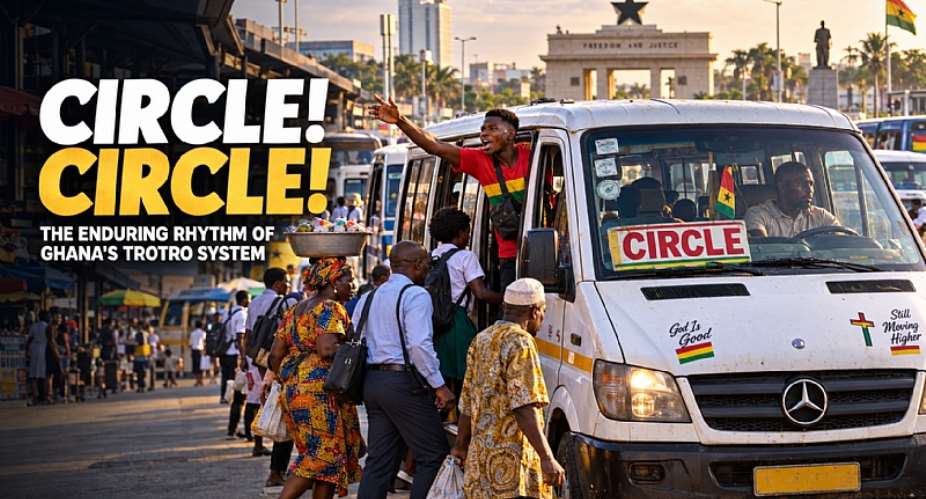
The call rises above the horns, engines and human movement of a busy Accra transport terminal. A conductor leans towards the open door of a minibus, claps the side of the vehicle and repeats the destination until enough passengers respond. Nearby, another voice announces, “Kaneshie, last stop!” In Kumasi, Tamale, Takoradi, Koforidua and other cities, similar calls guide commuters towards markets, schools, offices, hospitals and homes.
This is the language of the trotro, Ghana’s privately operated minibus system and the enduring backbone of urban mobility. It is more than a means of transportation. It is a workplace, a cultural stage, a moving social forum and an essential part of the national economy.
Transport research has estimated that trotros account for about 86 per cent of Ghana’s road-based public passenger market. Although that widely cited estimate is based on older studies and should not be treated as an exact measurement of today’s market, more recent research confirms that collective and informal transport continues to carry most urban commuters. A 2023 mobility study found that collective public transport, including trotros and conventional buses, represented 65 per cent of surveyed travel.
The trotro developed because formal municipal bus systems could not satisfy the transport needs of Ghana’s growing towns and cities. Private vehicle owners and operators stepped into the gap, creating flexible routes between residential communities, commercial centres and transport terminals.
The name is popularly traced to the Ga word “tro,” associated with the three-pence fare once charged for low-cost passenger transport during the colonial period. Through repetition, “tro-tro” became the familiar description for the shared vehicles that ordinary people could afford. Although stories about particular individuals pioneering the system are difficult to verify, the three-pence explanation remains the most widely accepted account of the name’s origin.
The vehicles have evolved considerably. Earlier generations remember converted trucks and wooden-bodied vehicles that rattled noisily along poorly maintained roads. Later came imported Japanese and Korean minibuses such as the Nissan Urvan and Kia Besta. Today, Toyota HiAce vans and Mercedes-Benz Sprinters dominate many routes, carrying larger numbers of passengers across expanding urban areas.
Every trotro depends on two central figures: the driver and the conductor, universally known as the mate. The driver navigates traffic congestion, potholes, impatient motorists and the daily financial target often imposed by the vehicle owner. The mate advertises destinations, attracts passengers, collects fares, calculates change, loads luggage and controls the door.
The mate’s combination of voice and gesture is a transport information system in its own right. Destinations are shortened, stretched or repeated until they become musical codes. Regular passengers can recognise a route from a hand signal before hearing its name. In terminals where several mates are shouting at once, each somehow manages to make his destination understood.
Inside the vehicle, Ghanaian society is compressed into a few square metres. Traders sit beside students, artisans, nurses, teachers, civil servants and office workers. A journey can suddenly become a prayer meeting, a mobile market or a passionate discussion about football, politics and the cost of living. On another day, exhausted passengers sit silently as the vehicle struggles through traffic.
The inscriptions on trotros also tell stories about Ghanaian life. “God’s Time Is Best,” “No Weapon,” “Still I Rise” and other expressions of faith, struggle and hope transform the vehicles into moving noticeboards of popular philosophy. Stickers, music and decorations give each trotro an identity that reflects the personality of its owner or driver.
Yet cultural affection should not prevent an honest assessment of the system’s weaknesses. Trotros are affordable and accessible, but their operations can be unpredictable. Most terminals use the “fill-and-go” system, under which a vehicle leaves only after its seats have been occupied. This protects operators from making unprofitable trips but can leave passengers waiting indefinitely.
Vehicle quality also varies. Some are properly maintained, while others have damaged seats, poor ventilation, leaking roofs or uncomfortable alterations. Complaints about reckless driving, fare disputes, abrupt stops and disrespectful treatment are common. Boarding can be especially difficult for older people, pregnant women, persons with disabilities and adults travelling with young children.
The sector is often described as informal, but it does not operate entirely without rules. Commercial passenger vehicles are subject to licensing, roadworthiness and safety requirements under the Road Traffic Regulations, 2012, L.I. 2180. Transport unions organise routes and terminals, while the police, Driver and Vehicle Licensing Authority, National Road Safety Authority and local assemblies exercise different regulatory responsibilities. The deeper problem is fragmented oversight and inconsistent enforcement.
The solution is not to abolish trotros without providing an affordable alternative. Ride-hailing services may offer greater comfort, but their cost places them beyond the daily reach of many households. World Bank analysis has shown that transport expenses consume a substantial share of the income of Ghana’s poorest urban residents. For millions of commuters, the trotro remains the only practical option.
Ghana should modernise the system while preserving its affordability and flexibility. Government-backed fleet-renewal programmes could help operators replace unsafe vehicles with efficient buses. Better terminals, designated stops, driver training, enforceable customer-service standards and accessible vehicle designs would improve passenger dignity and safety.
Digital route maps could make the system easier to navigate, particularly for visitors and occasional users. Cashless payment options could reduce fare disputes, while reliable passenger information would help people plan their journeys. Larger public buses and proposed electric services should serve high-demand corridors, with trotros operating as organised feeder services within neighbourhoods.
Drivers, mates and transport unions must be included in any reform. They possess detailed knowledge of passenger demand, routes, peak periods and community travel patterns. Modernisation imposed without their participation could destroy livelihoods without producing a reliable replacement.
The trotro is imperfect because it developed as an improvised response to institutional failure rather than as a carefully designed public transport network. Nevertheless, it has carried generations of Ghanaians to opportunity.
“Circle! Circle!” is therefore more than a destination call. It is the sound of Ghana moving—crowded, inventive, resilient and determined. The national challenge is to retain the trotro’s affordability and cultural character while transforming it into a safer, cleaner, more reliable and dignified transport system.


 Don’t let speed of information become your judgement — Chief Justice tells new l...
 ‘Big Push’: Government assures contractors of prompt payments
 GES to develop plan to recover teaching time lost during teachers’ strike – Clem...
 Fire guts Kumasi Central Market near Aboabo Station
 'All human emotions': French astronaut Sophie Adenot's first words since returni...
 French astronaut recounts 'astonishing' emotions after return to Earth
 India's 'cockroach' movement chief detained ahead of major protest
 Strike suspended, but negotiations for teachers’ benefits not over — GNAT
 CSA rejects FBI claims, insists Ghana led cybercrime operation
 Govt suspends enforcement of ban on preaching in moving vehicles


