




Prof. Nii Narku Quaynor stands as a rare breed of pioneer—a visionary who looked at a continent isolated from global computing in the late 20th century and chose the arduous path of liberation over Western comfort. As the first Ghanaian to earn a PhD in Computer Science (State University of New York at Stony Brook, 1977), he rejected the secure, high-budget corporate peaks of Silicon Valley and Digital Equipment Corporation (DEC) to return home and plant the seeds of technology from scratch. He didn’t just introduce the Internet to West Africa; he physically engineered it, turning 10 basic telephone lines in Accra into a continental gateway. Driven by a profound obsession with African identity and technical sovereignty, he spent decades establishing the foundational pillars of the African web—founding UCC’s Computer Science Department, making history as the first African on the ICANN Board, and unifying the continent's data networks through AfNOG and AfriNIC. Even when political malice physically dismantled his corporate empire, it could not dent his composure. Today, at 77, he remains a master systems builder and a practicing Chinese swordsman —breathing life into local AI bots and tokenized assets, and quietly embodying the quiet, unyielding humility of a giant who built a future for millions who may never fully grasp the depth of his sacrifice.
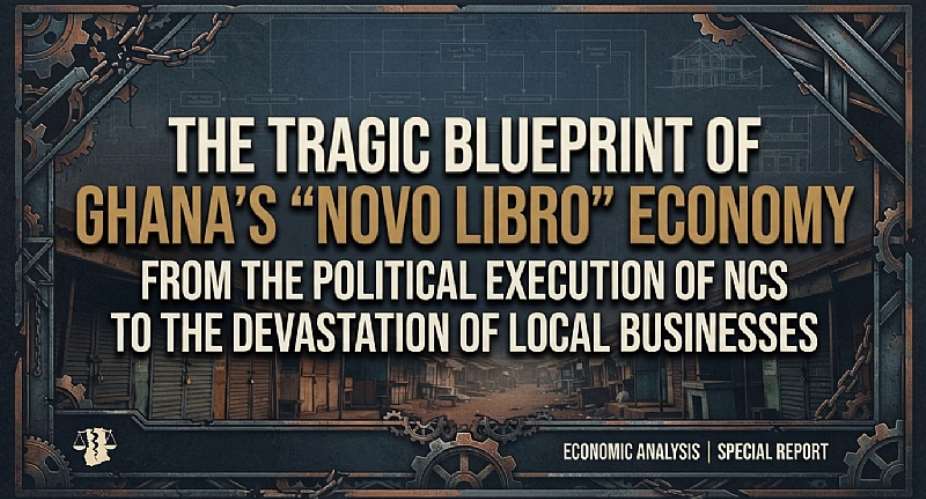
Ghana stands at a critical historical crossroads where the grandest architectures of national development are routinely sacrificed on the altar of partisan warfare. When Prof. Nii Narku Quaynor—the universally acclaimed "Father of the Internet in Africa"—recently opened up about his enduring sense of betrayal, he did not just recount the death of a company; he diagnosed a chronic national sickness. The forced closure of Network Computer Systems (NCS) in 2003 serves as the original blueprint for a toxic political culture that prioritizes the destruction of an opponent's legacy over the survival of the state. From the political execution of the country's premier Internet Service Provider (ISP) to the recent, devastating financial sector "clean-up" that wiped out indigenous banks, Ghana has weaponized state machinery to cannibalize its own economic pillars. It is a dangerous phenomenon born out of the Novo Libro (newly free) mentality: a destructive instinct where successive political regimes view local business success not as a national asset, but as an existential threat that must be forcefully dissolved.
The Execution of Network Computer Systems (NCS)
In the early 1990s, Prof. Nii Narku Quaynor gave up a highly lucrative global career as a Senior Engineering Manager at Digital Equipment Corporation (DEC) in the United States to return home and build Africa's digital nervous system. Through NCS, founded in 1988, he single-handedly placed Ghana on the global internet map by 1993 using just ten phone lines. Yet, by 2003, this pioneering crown jewel was dead.
- The Weaponization of Regime Change: Having worked closely with the previous administration to build digital literacy and state data centers, Prof. Quaynor and NCS became prime targets the moment a political transition occurred.
- The Contrived Land Dispute: Under the guise of a highly suspicious land title claim by a politically backed, wealthy individual, the state cordoned off the NCS head office in Ridge, Accra.
- The Cordon and Forced Collapse: Armed police blocked access to the facility. Technicians were barred from entering server rooms, causing nationwide internet blackouts, dropping the official government portal offline, and scattering a highly trained workforce of 87 local tech pioneers.
- The Smashed Potential: Prof. Quaynor rightfully notes that NCS was executing the exact infrastructure models utilized by early Silicon Valley giants. Had it been protected rather than politically hacked, NCS was positioned to become Africa’s multi-billion-dollar equivalent of Google.
The tragic demise of NCS was not an isolated incident; it was the prologue to a brutal tradition of state-sponsored economic vandalism that culminated in the 2017–2021 financial sector clean-up. Where other developing nations utilize state interventions, under-management cleanups, or structural bailouts to preserve capital and save local jobs, Ghanaian politics actively selects the nuclear option: absolute liquidation.
- Liquidating Indigenous Financial Capital: The financial sector clean-up cost Ghana an astronomical 7.1% of its GDP. Instead of restructuring boards or penalizing bad actors while protecting the banking architecture, institutions like UniBank (owned by Dr. Kwabena Duffuor) and Heritage Bank (founded by Seidu Agongo) were entirely dissolved primarily due to their perceived political identities.
- The Human and Economic Cost: Wiping out these indigenous banks did not clean the system; it severed credit access for local businesses, destroyed thousands of households, evaporated generational Ghanaian wealth, and forced the state to borrow billions through treasury bills just to manage the fallout of its own self-inflicted crisis.
- Shattering Industrial Pioneers: The political death sentence spans across every sector. From the complete destruction of Raymond Archer's multi-million-dollar Universal Labels and Packaging printing industrial facilities at the Trade Fair in 2020, to the systematic poisoning of historical enterprises like City and Country Waste simply due to alignment with opposing political figures, the strategy remains identical: total eradication.
Actionable Recommendations to Safeguard Ghana's Future
If Ghana is to ever transition from a passive consumer economy to a global producer power, the weaponization of state regulatory bodies to target local enterprise must be permanently halted. The following structural reforms are urgently required:
- Sovereign De-politicisation of Regulatory Bodies: The Bank of Ghana (BoG), National Communications Authority (NCA), and the judiciary must be structurally insulated from executive influence. Appointments of heads of these institutions should be handled by independent, non-partisan commissions rather than directly by incoming presidents to prevent regulatory bodies from operating as political enforcement wings.
- Passage of a Mandatory Sovereign Business Protection Act: Parliament must urgently enact legislation that explicitly prohibits the arbitrary revocation of licenses or physical shutdown of operational, high-employing local enterprises during regulatory disputes. State interventions must be restricted to mandatory equity dilutions, board restructuring, and structural bailouts that preserve the company’s operational assets, local workforce, and economic infrastructure.
- Institutionalisation of Land Title Insurance: To completely end the primitive weaponization of land litigation to target multi-million cedi corporations, Ghana must modernize its property registries and enforce mandatory corporate land title insurance to insulate infrastructure from malicious, state-backed claimants.
- Shifting State Focus to the Supply-Side (Producer Support): Governments must stop celebrating "Foreign Direct Investment" that simply turns Ghanaians into a desperate consumer community. State policy must intentionally protect, subsidize, and prioritize local innovators—ensuring we own the underlying hardware, networks, and financial frameworks.
Ghana cannot continue to pray for economic liberation while systematically executing its liberators. The sight of the former premier NCS facility—the birthplace of West Africa's internet—being downgraded into a cement-packing yard is a permanent, visual scar of a nation that trades cutting-edge technological sovereignty for petty, shortsighted political vengeance. Prof. Nii Narku Quaynor’s ultimate forgiveness of his victimizers is a testament to the sober, enduring grace of a true pioneer; but the state he sought to empower cannot afford to forget the lesson. We must actively resolve that no Ghanaian entrepreneur, tech innovator, or financial trailblazer will ever again have their life's work weaponized and broken down by a change in government. True national development will only begin when we cultivate the maturity to protect the institutions built by our opponents, realizing that a house that continuously demolishes its own pillars will inevitably collapse on everyone inside.
The author was deeply involved in early internet gateway installations for diplomatic missions and international resource networks across Accra in the 1990s.
✍️ Submitted by:
Retired Senior Citizen
For and on behalf of all Senior Citizens of the Republic of Ghana 🇬🇭
Teshie-Nungua
[email protected]

 New York mayor to ask Trump for ICE withdrawal after agents shoot man in car wit...
 Ukraine takes Russia fight to 'scorching sands' of Sahel
 Clashes lead South Africa to withdraw asylum processing order
 Brazil’s Flavio Bolsonaro wins third-place candidate’s support against Lula
 OpenAI bans Russian, Iranian ChatGPT propaganda networks
 Mahama to cut sod for Accra Convention Centre project – Kwakye Ofosu
 Mahama administration committed to stamping out cybercrime – Sam George
 Africa must strengthen strategic positioning amid global power shifts – ECOWAS
 PAC grills GHS over transport officer who allegedly sold seven state vehicles wi...
 Pentecost Church elder was arrested over GH¢200,000 fraud case, not kidnapped – ...


