




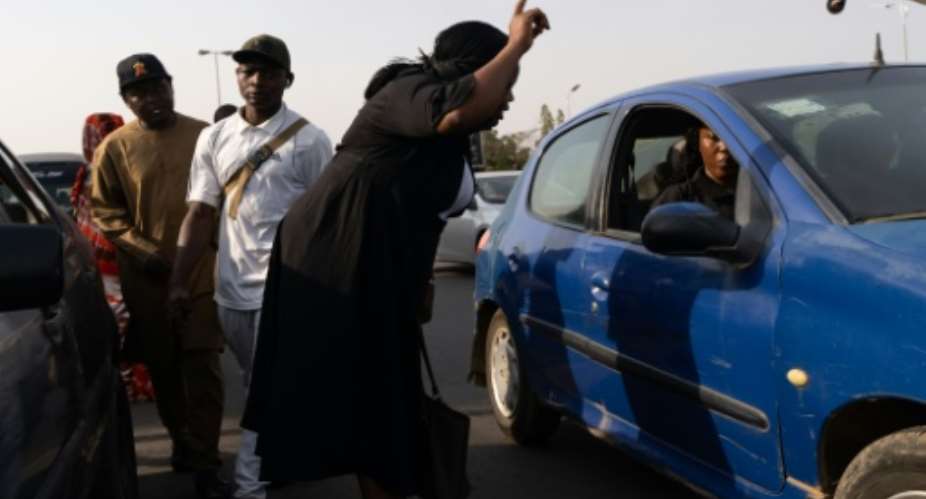
Nigeria's finance minister unveiled a raft of measures Thursday aimed at cushioning against energy shocks as the country prepares to go to the polls, including a petrol discount for public transport operators.
Africa's top oil producer hosts the continent's largest refinery, owned by Africa's richest man Aliko Dangote.
But fuel prices have risen to about 1,400 naira ($1.00) per litre from the 830 naira seen before the war in the Middle East, with the government little to rein in prices and instead deferring to the market.
Petrol had been even cheaper before President Bola Tinubu, seeking re-election in January, removed costly fuel subsidies at the beginning of his tenure -- turning the price at the pump a major political hot potato.
Finance Minister Taiwo Oyedele said the measures were aimed at easing pressure on households and businesses while avoiding a return to fuel subsidies.
"We are offering a discount on petrol dispensed by NNPC Limited for the next 30 days, in the first instance, with priority for public transporters nationwide," Oyedele told journalists in Abuja.
NNPC, Nigeria's state oil company, runs a vast network of petrol stations across the country.
"It's not a subsidy. The government is just saying we sell to you at cost," he said, without specifying the price.
Tinubu, who is seeking a second term, pushed through sweeping economic reforms when he came into office in 2023, including scrapping a major fuel subsidy and floating the naira.
While economists have broadly backed the measures, they have driven up living costs and deepened hardship in Africa's most populous country.
Cheap gasoline -- which in turn had driven down prices of food and goods throughout the country -- had for some been the most important government benefit they received amid decades of poor services and graft.
Tinubu has said the reforms averted an even greater crisis as the subsidy grew fiscally unsustainable.
Opposition leaders criticise move
Opposition candidate Atiku Abubakar criticised Thursday's price relief measures, saying: "What happens on Day 31? Nigerians wake up to the same brutal prices, the same punishing transport fares and the same rising cost of food."
He has floated a plan for a "targeted" subsidy, described as "capped and budgeted production support tied to fuel refined in Nigeria" to help bring down prices at the pump.
Longer term, Tinubu's government said it will also introduce what the minister called "price modulation" to moderate pump price volatility.
"Pump prices should not have to follow every swing in global crude or the exchange rates," Oyedele said, adding that the government was "negotiating a ceiling of 1,350 naira a litre".
"Where costs rise above the ceiling, refiners and importers will carry the shortfall and recover it later when crude prices or exchange rates allow without breaching the ceiling," he said,
He added that the policy was "neither a subsidy nor a price control" and the ceiling would be reviewed every month.
Nigerians go to the polls on January 16, with Tinubu expected to face his main 2023 rivals, Abubakar and Peter Obi.
Obi told AFP in an interview last month he would bring down consumer prices by cracking down on corruption.

 Wontumi’s lawyers want Exim Bank case treated as civil, not criminal
 Mahama to cut sod for Accra Convention Centre project – Kwakye Ofosu
 Mahama administration committed to stamping out cybercrime – Sam George
 Ghana joins International Big Cat Alliance to strengthen wildlife conservation
 Africa must strengthen strategic positioning amid global power shifts – ECOWAS
 PAC grills GHS over transport officer who allegedly sold seven state vehicles wi...
 Pentecost Church elder was arrested over GH¢200,000 fraud case, not kidnapped – ...
 Banning preaching in vehicles will not succeed, we will even preach at the back ...
 Banks threaten to suspend new loans to public sector workers over Controller rep...


