




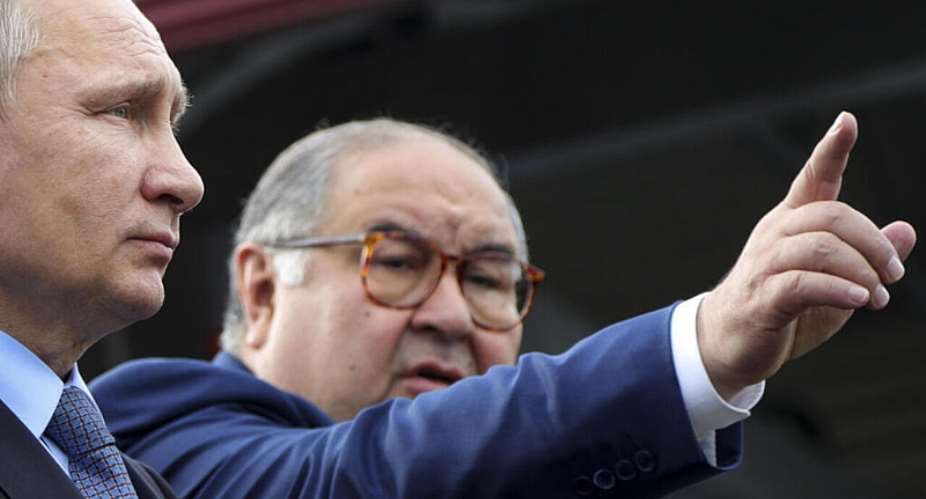
The EU sanctioned Usmanov, a metals tycoon with close ties to Putin, after Russia's full-scale invasion of Ukraine in February 2022 – and removed him from its list on 22 September this year, following a push from France.
Diplomats told news agency Reuters that France had come under pressure from Azerbaijan, which was holding French citizens – a claim Azerbaijan has denied.
France also requested the removal of Russian billionaire Mikhail Fridman. While he was also removed from the EU's list, this was granted at Luxembourg's request.
Kara-Murza was arrested in Moscow in April 2022 after speaking out against the war in Ukraine and sentenced to 25 years imprisonment for treason and other charges. He was freed in a major East-West prisoner exchange in August 2024, and is now vice-president of the United States-based pro-democracy group Free Russia Foundation.
In an interview with RFI in Paris on Thursday, he explains why he believes Putin needs the war in order to remain in power, and that there can be no end to the conflict while he remains in the Kremlin.
RFI: After more than four and a half years of war in Ukraine, Russia is intensifying its strikes – particularly on the capital, Kyiv. Is Putin escalating the war because he sees no way back?
Vladimir Kara-Murza: Vladimir Putin has been in power for almost 27 years. Throughout that time, this man has continued to kill – inside our country, Russia, and outside our borders. Putin's regime means war. Putin's regime means aggression. Putin's regime means reprisals.
So as long as this man stays in power, this war will continue. It's the only way for him to stay in power. He is a usurper. He has no democratic legitimacy because we haven't had elections in Russia for many years.
RFI: There were parliamentary elections in September...
VKM: Yes, of course, so-called elections. And that's without even talking about the government's total control over the media and political system.
Even under these conditions, the only anti-war party, Yabloko – a liberal party that opposes the war in Ukraine and calls for an immediate ceasefire – was excluded from the election by Putin's regime. They were afraid that even in an election that is a farce, millions of Russians would vote for this alternative. But at the same time, they effectively admitted that all the propaganda claiming everyone supports this war is a huge lie. Vladimir Kara-Murza, an exiled Russian opposition figure and former political prisoner, at RFI's studios in Paris on 8 October.
RFI: You were sentenced to 25 years in prison for condemning Russia's invasion of Ukraine and convicted of high treason...
VKM: Yes. In Russia now, speaking publicly against the government, and especially against the war, is a criminal offence.
We now have more than 2,000 known political prisoners in Russia. In the mid-1980s, there were around 750 known political prisoners across the entire Soviet Union – that's 15 of today's countries. Russia alone now has more than 2,000.
RFI: Kremlin spokesman Dmitry Peskov recently denied that there are any political prisoners in Russia. What do you make of that?
VKM: There's nothing new about it. In the 1950s, Nikita Khrushchev, then leader of the Soviet Union, said exactly the same thing. He said there were no political prisoners in the Soviet Union – only criminals or madmen.
What is surprising to me – and I think it's important to talk about this here in Paris – is that two weeks ago France asked for sanctions to be lifted against two major Kremlin oligarchs, Alisher Usmanov and Mikhail Fridman.
The European Union did so following the French initiative. For me, this sends a very dangerous signal that the West, the European Union and France in particular are ready to go back to business as usual with Putin's regime and normalise relations with the Kremlin again.
EDF faces legal action over France's continuing nuclear ties with Russia
If France was so determined, for reasons I don't know, to lift sanctions against these two oligarchs close to Putin, why didn't the French government at least ask for the release of some Russian political prisoners who could die tomorrow or next week?
The fact that France didn't do that is staggering to me. It's incomprehensible. And if you'll allow me the word, in my view it's shameful.
RFI: Why are you so critical of France's position?
VKM: It sends a very dangerous message. It opens a Pandora's box because all the other oligarchs will come along and say: “If them, why not us?”
But I don't want to criticise only France. It's not just France. There's a dangerous trend across the Western world. Canada, for example, has lifted sanctions against Anatoly Chubais [a former senior Kremlin official who left Russia after the 2022 invasion of Ukraine].
RFI: Are you saying there is a broader trend towards thinking countries can – and eventually will have to – talk to Putin?
VKM: That's completely crazy. One of the clearest lessons of 20th-century history is that appeasing an aggressor never leads to peace. It always leads to more war, more blood, more pain and more crimes.
Appeasing an aggressor, appeasing a dictator, only increases his appetite and ambitions. We've already seen that with Vladimir Putin over recent years. And it's absolutely staggering to me that Western countries are going to do it again.
Just a week ago, US President Donald Trump invited Putin to the G20 summit in Miami in December. Putin is the subject of an International Criminal Court arrest warrant as a war criminal, and the president of the United States – apparently the world's most important democracy – is inviting him.
I have no words, not just in French but even in Russian, to describe what I think of all this.
EU and five other countries condemn Russia's 'sham' elections
RFI: Exiled Russian opposition figure Garry Kasparov has said his life is in danger. Last week, he said Lithuanian and US security services had told him to take precautions. You are also an opposition figure in exile. Do you feel that you are in danger?
VKM: I don't know. I don't think about it. Everyone knows the reality of Vladimir Putin's regime and the FSB [Russia's intelligence service]. Putin's security services poisoned me twice, in 2015 and 2017, and then they gave me 25 years in prison. They could have killed me in prison any day I was there. So there's nothing new about that.
The only new thing is that apparently things like this can now happen in the United States too. There's a theory that in the 1970s the American and Soviet intelligence services reached a gentlemen's agreement.
RFI: That they wouldn't eliminate people in each other's country?
VKM: Exactly. But this announcement from the US Justice Department is the news here. We know Putin's regime attacks its political opponents not only in Russia but abroad. We've seen it in London and Berlin.
RFI: Do you take any special precautions?
VKM: No, not really. What can you do? If you spend every day thinking about it, you become paranoid. I have too much work to go down that road.
I believe in what I'm doing. I love my country and I want Russia to become a civilised, modern, European, democratic country. I will do everything I can to make that day come a little sooner.
This interview has been adapted from an audio version in French by Arnaud Pontus and edited for clarity.


 Wontumi’s lawyers want Exim Bank case treated as civil, not criminal
 Mahama to cut sod for Accra Convention Centre project – Kwakye Ofosu
 Mahama administration committed to stamping out cybercrime – Sam George
 Ghana joins International Big Cat Alliance to strengthen wildlife conservation
 Africa must strengthen strategic positioning amid global power shifts – ECOWAS
 PAC grills GHS over transport officer who allegedly sold seven state vehicles wi...
 Pentecost Church elder was arrested over GH¢200,000 fraud case, not kidnapped – ...
 Banning preaching in vehicles will not succeed, we will even preach at the back ...
 Banks threaten to suspend new loans to public sector workers over Controller rep...


