




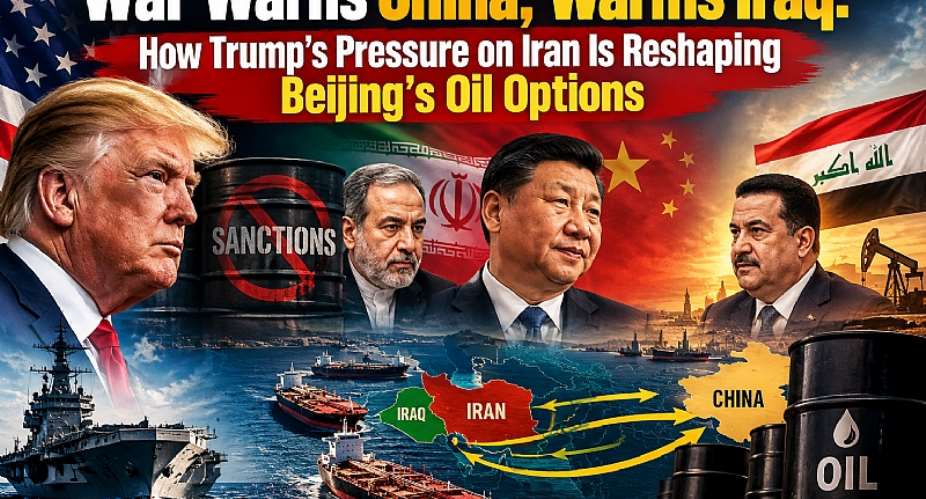
Nation, which initially appeared relatively unaffected by Washington’s naval pressure, is now facing a difficult strategic calculation. China has traditionally pursued strategic balance and avoided taking sides openly. Yet, as the Trump-Xi engagement reportedly produces assurances that Beijing will not provide direct support to Iran, another question becomes unavoidable: will China gradually distance itself from Iran, or will Beijing continue its traditional policy of strategic ambiguity? Iran’s Foreign Minister Abbas Araghchi’s September 18 visit to China before the meeting adds another layer to the question.
How much does China depend on Iranian oil?
China’s private refineries, often referred to as “teapots”, are not necessarily taking sides in the Iran-US confrontation. Their calculations are largely economic. If sanctioned Iranian crude becomes increasingly difficult to obtain, these refineries have an incentive to replace it with discounted supplies from Iraq and Qatar. This creates a new strategic opening for Iraq.
Reuters, citing three major oil-trading houses, reported that Chinese refineries had closed deals for up to 20 million barrels of oil for October and November. This is potentially good news for Iraq, which needs reliable outlets for its crude, but it also highlights the pressure facing Iran. If China can replace Iranian barrels with Iraqi crude, will Beijing challenge US sanctions, or simply adapt to the new market reality?
For years, around 90 per cent of Iranian oil exports have reportedly gone to China, with Iranian exports estimated at about 1.4 million barrels per day in 2025. If naval restrictions reduce those flows dramatically, Chinese buyers will naturally search for alternatives. The reported shift toward Iraqi supplies therefore represents not necessarily a political abandonment of Iran, but a pragmatic attempt to secure energy supplies.
How does a naval blockade affect established oil routes?
The consequences extend beyond the crude itself. Iranian VLCCs carrying oil toward China have traditionally relied on complex ship-to-ship transfers and intermediary arrangements, including areas around the Strait of Malacca and outside Malaysian and Indonesian territorial waters. Such practices become increasingly difficult when naval pressure disrupts established routes.
This raises a broader question: when traditional maritime routes become politically dangerous, does the market simply create new routes, new suppliers and new intermediaries?
The answer appears increasingly affirmative. Pragmatic economic interests are pushing Chinese buyers toward alternative sources, particularly Iraq and Qatar.
How does Iraq enter the equation — and is it a strategic gift?
Iraq could emerge as an unexpected beneficiary. Recent US-Iraq engagement has focused not only on security but also on Iraq’s future relationship with Washington. At the same time, Baghdad needs stable oil exports and security arrangements.
But several questions deserve careful consideration: Why is Iraqi oil acceptable to the international market while Iranian oil remains heavily restricted? Why does the Iraqi supply chain face fewer political obstacles? And why are Iraqi militias viewed differently from groups such as the Houthis in the wider regional security equation?
These differences inevitably raise concerns about consistency in sanctions and strategic policy. Selective restrictions can create market distortions and undermine confidence in the neutrality of international economic rules.
China was already Iraq’s largest oil customer before the current crisis, reportedly purchasing around 1.2 million barrels per day. The growing emphasis on Iraqi crude therefore represents an acceleration of an existing relationship rather than an entirely new one.
China’s “teapot” refineries have historically relied on discounted crude, including sanctioned Russian, Iranian and Venezuelan supplies. Iranian oil was particularly attractive because sanctions created substantial discounts. Now, however, Iraqi crude is reportedly being offered at competitive prices.
Is the GCC still a completely safe energy option?
Transporting Gulf oil to China remains exposed to the risks surrounding the Strait of Hormuz. Iraq, unlike some Gulf producers, relies heavily on buyers and trading houses to arrange shipping. To compensate for the maritime risk, Iraqi crude can become particularly attractive when offered at significant discounts.
For Chinese buyers, the calculation is ultimately commercial: how much risk is acceptable for how much discount?
Trading houses have reportedly purchased discounted Iraqi crude and arranged shipping under the protection of US naval presence before transferring cargoes to Chinese vessels. This creates an unusual situation in which Washington’s pressure on Iran may simultaneously strengthen Iraq’s position in the Chinese oil market.
The larger lesson is that geopolitical pressure rarely produces only one outcome. If Washington restricts Iran, does it unintentionally create new opportunities for Iraq and China? And if Chinese buyers can secure cheaper alternatives, will economic pragmatism eventually prove stronger than geopolitical alignment?
The UAE’s growing investment beyond the Gulf, including in Bangladesh, also demonstrates that regional stability increasingly depends on economic diversification and connectivity beyond traditional geopolitical boundaries.
Ultimately, for a Chinese buyer willing to accept the maritime risk, discounted Iraqi crude can be a very attractive trade. The question is whether this represents a temporary wartime adjustment — or the beginning of a broader restructuring of the Iran-China-Iraq energy equation.


 Wontumi’s lawyers want Exim Bank case treated as civil, not criminal
 Mahama to cut sod for Accra Convention Centre project – Kwakye Ofosu
 Mahama administration committed to stamping out cybercrime – Sam George
 Ghana joins International Big Cat Alliance to strengthen wildlife conservation
 Africa must strengthen strategic positioning amid global power shifts – ECOWAS
 PAC grills GHS over transport officer who allegedly sold seven state vehicles wi...
 Pentecost Church elder was arrested over GH¢200,000 fraud case, not kidnapped – ...
 Banning preaching in vehicles will not succeed, we will even preach at the back ...
 Banks threaten to suspend new loans to public sector workers over Controller rep...


