




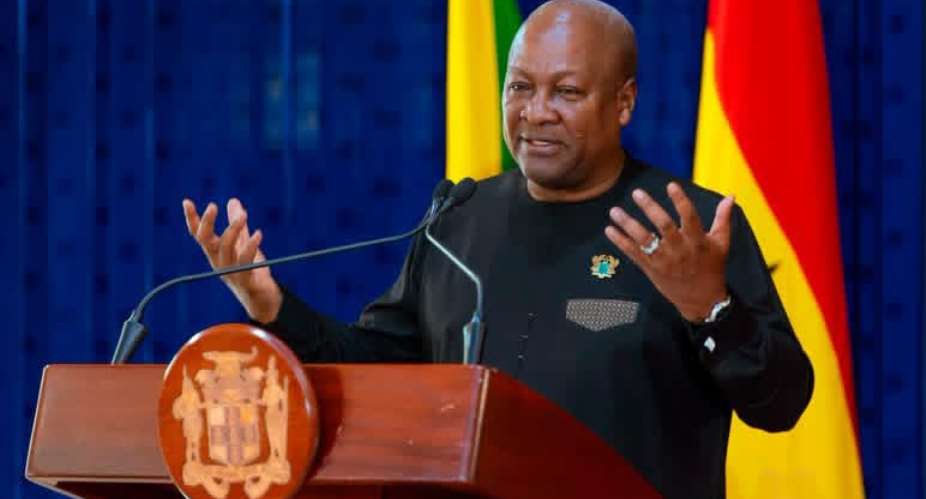
There’s a thought-provoking question we should consider regarding President John Dramani Mahama:
Is Mahama becoming Ghana’s version of the democratic and diplomatic Ibrahim Traoré?
At first, this comparison might seem a bit odd. Mahama is a seasoned civilian politician who has navigated Ghana’s constitutional democracy for many years. He’s experienced the highs of winning elections, the lows of losing them, and has gracefully accepted defeat, only to return to the presidency through the democratic process.
On the other hand, Ibrahim Traoré is a military officer who seized power through a coup in Burkina Faso. When it comes to their backgrounds, these two men couldn’t be more different. However, understanding politics often goes beyond just how leaders rise to power. It’s also about the historical grievances, aspirations, and ideas that shape their political landscapes.
Beneath the surface differences between Mahama and Traoré lies a crucial question that’s gaining traction across Africa:
Who should shape Africa’s future?
For many years, Africa has enjoyed political independence, yet it hasn’t fully achieved economic, strategic, and intellectual independence. While colonial flags have been taken down, many of the international economic, financial, and geopolitical frameworks that influence African destinies have remained largely unchanged. This ongoing contradiction has sparked a new wave of Pan-African political thought and helps explain why Traoré resonates with segments of Africa’s youth.
Traoré’s message revolves around themes of sovereignty, self-determination, economic independence, and a pushback against external control. Whether or not one agrees with his approach is a different discussion. Yet, his popularity is rooted in the frustrations that his message addresses.
Interestingly, Mahama is increasingly tapping into some of these same historical concerns, albeit from a completely different political perspective.
His push for reparations stands out as a prime example. As the African Union’s Champion for Advancing the Cause of Justice and the Payment of Reparations, Mahama has worked to elevate the discussion around slavery, colonialism, and historical injustices from mere remembrance to a matter of international diplomacy. At the United Nations, he has advocated for reparatory justice, called for reforms in the global financial system, pushed for stronger African representation on the UN Security Council, and demanded the return of African cultural artifacts. His assertion that “the future is African” was not just a catchy phrase; it underscored a larger point that Africa should no longer view itself solely as a passive recipient of global decisions but as a dynamic player in shaping the international landscape. (The Presidency, Republic of Ghana)
This is where president Mahama starts to resonate closely with the political language often linked to president Traoré.
Not in approach. Not in constitutional beliefs. But in historical awareness.
This perspective becomes even more intriguing when we look at Ghana’s changing relationship with the United States, China, and the rising Global South.
After the U.S. pulled back its assistance that was previously funneled through USAID, Mahama candidly addressed the financial implications for Ghana, especially in the health sector. His administration has since highlighted the importance of achieving greater health sovereignty and reducing reliance on external funding.
The debate intensified around a proposed U.S.-Ghana health compact, which Ghana ultimately rejected due to concerns over issues related to health data, medical information, pathogen profiles, and the governance of sensitive health information. Mahama labeled certain aspects of the proposed agreement as unacceptable and stood firm in defending Ghana’s right to safeguard its regulatory and data sovereignty.
This might seem like a technical disagreement over health policy, but it’s actually a much larger issue at play.
In the twenty-first century, data is the new currency.
Who holds the reins on a nation’s health information? Who decides how that data is gathered, stored, and shared? Who gets access to sensitive medical and epidemiological data? And what conditions should a developing country consider when accepting help from outside?
These questions are increasingly tied to national sovereignty.
Mahama’s response indicates that Ghana’s ties with development partners can’t just rely on the outdated notion that financial aid automatically grants the donor more power over the recipient.
The emerging philosophy seems to be: Partnership, absolutely. Dependency, not a chance. You can see this same principle reflected in Ghana’s growing economic relationship with China.
In January 2026, Mahama put forth a proposal for a payment and settlement system between Ghana and China aimed at boosting bilateral trade and cutting down reliance on third-party currencies.
That idea has now evolved beyond just a proposal.
Ghanaian importers can now initiate eligible payments to Chinese suppliers directly from their Ghana cedi accounts, with transactions settled in Chinese yuan through China’s Cross-Border Interbank Payment System, or CIPS. This setup lessens the need for businesses to first secure U.S. dollars before making payments to Chinese suppliers. The Bank of Ghana has also mentioned that GCB is gearing up to offer a similar service.
This doesn’t mean Ghana has ditched the U.S. dollar in its international trade. Instead, it means Ghanaian businesses now have an extra payment option, and crucially, more choices.
And in the world of geopolitics, having options is a form of power.
Ghana-China trade hit a record high of US$14.1 billion in 2025, with China standing as Ghana’s largest trading partner. Ghana is also reaping the benefits of China’s zero-tariff initiative, which covers eligible exports from African nations that have diplomatic ties with China.
The importance of this move goes beyond just making it easier for Ghanaian importers to source goods from places like Guangzhou or Shenzhen. It marks a significant step towards diversifying Ghana’s economic ties.
Then came what might be the most telling geopolitical signal yet:
Ghana’s decision to officially apply for BRICS membership.
On October 6, 2026, Foreign Affairs Minister Samuel Okudzeto Ablakwa shared that the Cabinet had given the green light for Ghana’s formal application to join this group of major emerging economies. He emphasized that the goal is to broaden Ghana’s international partnerships, create more economic opportunities, and strengthen cooperation with the Global South.
Importantly, the government has made it clear that joining BRICS would enhance, not replace, Ghana’s existing relationships with the IMF, World Bank, and other traditional development partners. (Ghana News Agency)
That distinction is crucial.
Becoming a part of BRICS doesn’t mean Ghana is turning its back on the West. Instead, it signals a desire for more options. The Foreign Affairs Minister himself highlighted the importance of having choices in development and embracing a multipolar international system. (Ghana News Agency)
This brings us back to the comparison between Mahama and Traoré. Traoré’s Burkina Faso has taken a much more confrontational and revolutionary approach to sovereignty. In contrast, Mahama seems to be advocating for a form of strategic autonomy through diplomacy, economic diversification, and institutional engagement.
Traoré essentially argues:
Africa must seize control of its future. Meanwhile, Mahama’s emerging foreign-policy stance suggests:
Africa should have enough options to shape its own future.
While these philosophies may not be identical, they both tap into a shared historical concern: the idea that Africa shouldn't be limited to just one path for development, one financial system, one dominant currency for international trade, or a single set of traditional partners and political or economic models.
Perhaps the more profound principle at play isn't simply East versus West. It's really about dependence versus strategic choice. Ghana has the opportunity to trade with America, China, and Europe. It can attract investment from India, engage with Russia, stay involved with the IMF and World Bank, and even pursue membership in BRICS.
There's no contradiction in forming multiple international partnerships if the ultimate goal is to enhance Ghana’s national interests. The crucial question is whether Ghana can navigate these relationships from a position of growing strength rather than ongoing dependency. That’s the heart of strategic autonomy.
This is also why Mahama’s Pan-African rhetoric is significant. His campaign for reparations speaks to historical justice. His interventions at the UN tackle global governance issues.
His stance on health policy champions health sovereignty.
The Ghana-China payment initiative aims to reduce monetary and trade dependence. And the BRICS application is all about diversifying international partnerships. On their own, these might seem like disconnected policy choices. But when viewed together, they paint a larger picture:
A Ghana that is increasingly eager to explore its options. And that might just be the most striking link to the political sentiment embodied by Traoré.
The approaches, however, are fundamentally different. Mahama was elected through a democratic process, while Traoré seized power via military intervention. Mahama functions within constitutional frameworks, whereas Traoré leads through a military-led transition.
It's important to clarify that suggesting the two leaders are politically the same would be misleading. However, it’s also an oversimplification to ignore the intellectual ties they share regarding the sovereignty issues they’re facing.
Both leaders are navigating an Africa that’s increasingly questioning whether political independence is enough without economic and strategic autonomy.
The bigger question looms: can Africa reclaim its sovereignty without sacrificing democracy?
Can African nations challenge the unequal global structures without risking isolation? Is it possible to embrace economic nationalism without falling into economic seclusion? How can they maintain ties with Western powers while also strengthening relationships with China, India, Brazil, and the broader Global South? Can Africa diversify its partnerships without simply swapping one dependency for another?
And perhaps the most pressing question of all: can democracy itself serve as a tool for African liberation, rather than just a way to change governments every four years?
That last question is vital.
Democracy can't thrive on elections alone. Ultimately, citizens evaluate political systems based on whether they provide dignity, security, economic opportunities, and a sense of ownership over their futures.
This is why the rise of military-led politics in parts of the Sahel warrants deeper analysis beyond just condemning coups. Understanding why some citizens are drawn to military leaders doesn’t mean endorsing military rule; it means recognizing the frustrations that traditional political systems have often overlooked.
President Mahama now has a chance to show that these frustrations can be addressed through constitutional means.
His engagement with Burkina Faso is a key part of this narrative. Instead of isolating Traoré, Mahama has opted for dialogue. He’s traveled to Ouagadougou, met with the Burkinabè leader, and sought cooperation on regional security and other pressing issues.
This isn’t about endorsing Burkina Faso’s political model.
It’s about diplomacy.
And maybe, just maybe, this is where Ghana can step in and offer a fresh perspective in a region that’s becoming more and more split between constitutional democracies and military-led regimes.
Ghana doesn’t need to morph into Burkina Faso to grasp its situation. It doesn’t have to forsake democracy to stand up for African sovereignty. And it certainly doesn’t have to give up its independence just because it engages with Western nations.
The real challenge lies in figuring out how to interact with the world without losing our own identity along the way.
This could very well be Mahama’s greatest opportunity.
He has the chance to show that a democratically elected African leader can passionately advocate for reparations, sovereignty, global inequality, health independence, monetary diversification, and African dignity, all while staying true to constitutionalism and international diplomacy.
In this light, Mahama might not be Ghana’s Ibrahim Traoré after all.
He could symbolize something different:
A pursuit of the same broad goals that have made Traoré a significant political figure, but through the ballot box instead of the barracks, through diplomacy rather than upheaval, and through democratic institutions rather than military power.
Traoré embodies Africa’s revolutionary impatience.
President Mahama, on the other hand, seems to be representing an Africa that shares that impatience but still believes in achieving freedom through democratic means.
The question that history will eventually answer isn’t which leader Africa should emulate.
It’s whether Africa can forge a political landscape that harmonizes sovereignty with democracy, economic justice with development, health security with self-reliance, monetary and trade diversification with economic stability, and African dignity with global engagement.
That’s the bigger fight.
And it goes far beyond president Mahama.
It’s much larger than president Traoré.
It's the lingering question surrounding African emancipation.
When does political independence truly transform into real sovereignty?
Sulley Kone
Writer, columnist, socio-political commentator
+233244805619

 Wontumi’s lawyers want Exim Bank case treated as civil, not criminal
 Mahama to cut sod for Accra Convention Centre project – Kwakye Ofosu
 Mahama administration committed to stamping out cybercrime – Sam George
 Ghana joins International Big Cat Alliance to strengthen wildlife conservation
 Africa must strengthen strategic positioning amid global power shifts – ECOWAS
 PAC grills GHS over transport officer who allegedly sold seven state vehicles wi...
 Pentecost Church elder was arrested over GH¢200,000 fraud case, not kidnapped – ...
 Banning preaching in vehicles will not succeed, we will even preach at the back ...
 Banks threaten to suspend new loans to public sector workers over Controller rep...


