




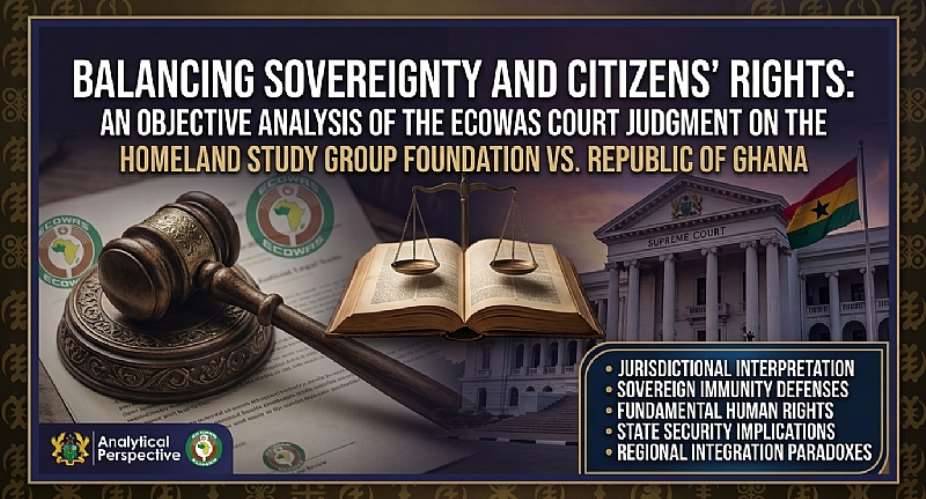
The decision by the ECOWAS Community Court of Justice to dismiss the Republic of Ghana’s appeal regarding its May 16, 2025 judgment marks a defining moment in West African jurisprudence. In the case of Homeland Study Group Foundation & 30 Others v. Republic of Ghana, our national sovereignty confronted our regional treaty obligations. To the casual observer, the news may sound alarming—or conversely, like a political victory. However, a rigorous, objective review reveals a far more nuanced reality. The regional court did not validate secession; rather, it penalised state procedural overreach. As Ghanaians, our commitment to a unified republic must be matched by an unyielding dedication to constitutional due process. This article breaks down the legal, statutory, and historical dimensions of this landmark ruling to inform and educate the public on where the law stands.
THE CORE FINDINGS: WHAT THE COURT ACTUALLY DECIDED
The ECOWAS Court’s final ruling establishes a clear boundary between a state's right to protect national security and its obligation to respect fundamental human rights. The findings can be broken down into three core dimensions:
- The Violation of Due Process: The court found that the state arbitrarily and unlawfully detained 30 individual applicants associated with the Homeland Study Group Foundation (HSGF). Following arrests in May 2019, individuals were held for over a year without formal trial or being processed through a court.
- Constitutional Violations: The three-judge panel, led by Justice Ricardo Gonçalves, ruled that this prolonged detention explicitly violated Article 14(3) of Ghana's own 1992 Constitution—which dictates that suspects must be brought before a court within 48 hours—as well as Article 6 of the African Charter on Human and Peoples' Rights.
- Financial Penalties Imposed: As a remedy for these human rights infractions, the court ordered the Republic of Ghana to pay a total of $75,000 in damages. This breaks down to $2,500 to each of the 30 individual applicants (or the equivalent in Ghanaian Cedis).
THE LIMITS OF THE RULING: WHAT THE COURT DISMISSED
Crucially for our national stability, the ECOWAS Court strictly drew the line when it came to political and territorial claims. It delivered a major legal victory for the territorial integrity of the Republic of Ghana by ruling on the following:
- Dismissal of the Secessionist Agenda: The court completely rejected and dismissed the group's broader claims regarding self-determination and the political recognition of "Western Togoland".
- Lack of Historical Jurisdiction: The court held that it entirely lacked the jurisdiction to review or rule upon the historical status of British Togoland or the validity of the 1956 UN-supervised status plebiscite.
- Upholding Ghana's Laws: The court declined the applicants' request to strike down or invalidate Ghana’s Prohibited Organisations Act, 1976, clarifying that the state has the legal right to outlaw secessionist groups as long as it handles suspects within international and constitutional legal frameworks.
- Disqualification of the Foundation: Notably, the Homeland Study Group Foundation itself was struck out as an official applicant in the suit because it failed to provide valid evidence of official legal registration.
HISTORICAL AND STATUTORY CONTEXT: HOW WE GOT HERE
To understand the friction underpinning this case, we must look to two foundational instruments of our history and law:
- The 1956 British Togoland Plebiscite: On May 9, 1956, a United Nations-supervised referendum offered the citizens of the British Togoland Trust Territory a choice: integrate with the soon-to-be-independent Gold Coast (Ghana) or remain under UN Trusteeship. While 58% of the territory voted for integration overall, the Southern districts voted 55% in favor of separation. This regional divergence has historically been leveraged by secessionist narratives, despite the overarching democratic outcome that legally consolidated modern Ghana.
- The Prohibited Organisations Act, 1976 (SMCD 20): Originally enacted during General I.K. Acheampong’s military regime, this law was specifically designed to suppress separatist movements in the Volta Region. Section 1(1)(b) of the Act strictly prohibits any organization that advocates or promotes the secession of the former British mandated territory. It remains active, valid law.
STRATEGIC RECOURSE: THE MINISTRY OF JUSTICE'S UPCOMING LEGAL PATHWAY
Following the dismissal of the state's appeal, the Attorney General and Ministry of Justice are faced with precise statutory and diplomatic options. Observers expect the Ministry to navigate the aftermath through these distinct technical steps:
- Sovereign Isolation of the Debt: Legal analysts anticipate that the Attorney General will treat the $75,000 award strictly as an administrative judgment debt rather than a diplomatic concession. By categorizing the fine purely as a domestic operational liability, the state can fulfill its payment obligation without conferring any legal recognition, status, or validation upon the secessionist movement itself.
- Invoking Article 24 of the ECOWAS Protocol: While judgments of the Community Court are final and binding, the Ministry may audit the mechanics of execution. Under Article 24 of the 2005 Supplementary Protocol, member states control the enforcement of judgments according to their national civil procedures. The Ministry might choose to disburse funds strictly via monitored national escrow channels to ensure monies are not diverted toward outlawed political operations under SMCD 20.
- Tightening State Security Prosecution Protocols: Moving forward, the Ministry is expected to issue stricter internal directives to the National Security Ministry and the police. To safeguard future high-profile state security trials from similar human rights challenges, state prosecutors will enforce strict adherence to the 48-hour constitutional arraignment rule, utilizing immediate holding charges in domestic courts to keep high-risk suspects lawfully detained.
RECOMMENDATIONS AND SUGGESTIONS FOR THE STATE
Moving forward, this case serves as a critical learning experience for institutional governance in Ghana. The following actions are recommended for state authorities:
- Fulfill the Payout to Protect Diplomatic Credibility: The state should promptly process the payment of the individual damages. Fulfilling this financial obligation signals Ghana’s unwavering respect for regional treaty bodies, protecting our status as a leading democratic beacon within ECOWAS.
- Enforce Strict Adherence to the 48-Hour Detention Rule: Law enforcement agencies, particularly national security apparatuses, must ensure that even in sensitive cases involving state security, suspects are brought before a court of competent jurisdiction within the constitutionally mandated 48 hours.
- Utilize Formally Structured Prosecutions: If the state intends to detain individuals under the Prohibited Organisations Act, it must systematically charge and prosecute them within the lawful timelines outlined by domestic law rather than relying on prolonged administrative detentions without trial.
- De-escalate via Strategic Dialogue: While maintaining a zero-tolerance stance on armed or violent secessionist operations, the state should utilize local governance structures to address the socioeconomic and historical grievances of border communities through targeted developmental projects rather than purely through militarization.
The ECOWAS Community Court of Justice did not break Ghana apart; rather, it held a mirror up to our law enforcement practices. By dismissing the sovereignty claims of the Western Togoland agitators while simultaneously penalizing the state for arbitrary detentions, the court reminded us that a nation cannot effectively defend the rule of law by breaking its own laws. Our republic is indivisible, but our constitutional guarantees must remain inviolable for every single citizen, regardless of the allegations leveled against them. True national strength lies in prosecuting threats to the state with absolute procedural transparency, clean hands, and unwavering respect for human dignity.
✍️ Submitted by:
Retired Senior Citizen
For and on behalf of all Senior Citizens of the Republic of Ghana 🇬🇭
Teshie-Nungua
[email protected]


 GTA CEO Maame Efua Houadjeto faces visa fraud allegations over 2026 World Cup me...
 Senegal and Morocco set for AFCON title rematch – in Swiss sports court
 From the Acropolis, Rubio calls on Europe to emerge from ‘slumber’
 Mahama proposes financing scheme to help Ghanaians complete unfinished houses
 'Free SHS not in crisis; it was suffering under you and we reviewed it' – Haruna...
 Mahama orders sanctions for officials who fail to enforce building safety rules
 2026 World Cup: Minority alleges how GTA charged $7,000–$14,000 for visa process...
 Mahama announces GHS1bn for revolving National Housing Fund
 PAC orders CWSA to recover GH¢2.5m public debt within 30 days
 Former NPP chairman Samuel Odoi-Sykes dies


