




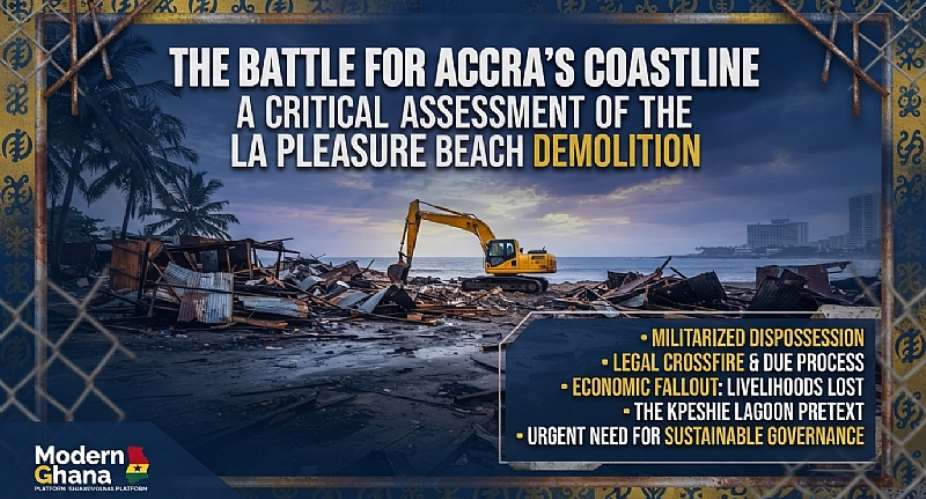
The sudden, military-led flattening of the iconic La Pleasure Beach on Friday, October 2, 2026, represents far more than an administrative clearance. Executed at 4:30 AM by a joint force of the 48 Engineer Regiment of the Ghana Armed Forces and the Ghana Police Service under National Security supervision, the operation reduced established recreational hubs—such as the Polo Beach Club and Vienna City—to heaps of rubble.
This state-sanctioned violence highlights a severe structural crisis in Ghana's urban landscape. It exposes a predatory pattern of coastal governance where neoliberal real estate interests, state corporate capitalism, and elite security apparatuses converge to dispossess the working class and indigenous communities under the guise of "sanitation" and "modernization".
The Political Polarization: Exploitation vs. Justification
The demolition has rapidly become a central flashpoint for hyper-partisan maneuvering, with the two dominant political parties weaponizing the debris to secure electoral capital:
- The NPP’s Populist Condemnation: New Patriotic Party (NPP) flagbearer Dr. Mahamudu Bawumia condemned the demolition as "wanton" and "bizarre." Seizing on local outrage, the NPP has positioned itself as a defender of the informal economy, pledging to rebuild the area into a structured economic hub. Critics, however, view this as opportunistic, given the party's own historical record of state-led urban clearances.
- The NDC’s Internal Contradictions: The National Democratic Congress (NDC) finds itself deeply fractured over the operation. Nationally, key party voices like Mustapha Gbande justified the action, framing it as an essential, non-negotiable "national security exercise" required to protect high-value state investments and curb unregulated encroachment.
- Local NDC Defiance: Conversely, the NDC Member of Parliament for La Dade-Kotopon, Rita Naa Odoley Sowah, openly broke ranks. She confronted security forces on-site, furiously declaring that the local government ministry was completely bypassed. This systemic disconnect exposes a deeply fragmented state apparatus.
- Community Disillusionment: For the residents of La, the partisan bickering has generated profound alienation. Protesting youth and elder community members have expressed equal disgust for both factions, stating: "Next four years, NDC or NPP, we are not going to vote."
The Human Cost: Voices from the Rubble
The human toll of this operation falls heaviest on the vulnerable informal workforce, particularly single mothers, whose precarious livelihoods were dismantled in minutes:
"We were given two weeks' notice to start packing, but we thought it was a joke. How can they bring soldiers at dawn to destroy our livelihood? I have three children to feed, and schools have just reopened. Where do they expect me to go?"— Amina, a displaced beverage vendor and single mother.
"They treated us like criminals, like squatters. We have been paying our local dues here for years. They gave us 30 minutes to carry what we could before the bulldozers started crushing everything. Thousands of cedis in stock, completely destroyed."— Kofi, a local beach-front artisan.
Theoretical Framing: West African Coastal Privatisation and Tourism Gentrification
The events unfolding at La Pleasure Beach cannot be evaluated in isolation; they are deeply symptomatic of wider, structurally driven economic trends dominating the West African coastline. Critical urban scholars identify this phenomenon as "tourism gentrification" and "spatial polarization".
In peripheral economies, state agencies frequently leverage international tourism and luxury real estate agendas to displace local populations, replacing communal ecosystems with privatized corporate assets.
Academic frameworks contextualize this crisis through several lenses:
- Class-Based Spatial Enclosure: Research on African urban transformations emphasizes that state interventions often pathologize informal uses of space to legitimize state corporate capitalism. In Accra, this manifests as an alliance between state financial bodies like SSNIT and elite hospitality actors. This dynamic effectively criminalizes the presence of working-class vendors while normalising the expansion of upscale enclaves.
- The Tourism Development Area (TDA) Paradox: Studies exploring the nexus between tourism and gentrification demonstrate that state-driven land confiscations along West African beaches—justified under the banner of macro-economic development and jobs—consistently yield local land conflicts, cultural displacement, and violent confrontations between security agencies and indigenous rights holders.
- Indigenous Land Alienation: The historical tension over the state's use of executive instruments to seize Ga stool lands highlights a profound institutional crisis. Scholars document how prime, public coastal land is systematically reallocated away from communal management, transferring territorial control to non-indigenous private developers and politically exposed elites.
Ecological Pretext: The Kpeshie Lagoon Dilemma
A critical layer of this coastal restructuring is the ongoing ecological crisis surrounding the adjacent Kpeshie Lagoon. State authorities have frequently used environmental restoration—specifically the urgent need for dredging the heavily choked Kpeshie Lagoon—as a convenient ecological shield to justify sweeping evictions.
While the Greater Accra Regional Security Council and NADMO argue that clearing the buffer zone is vital for flood mitigation and waste management, the state's selective enforcement raises serious academic and activist concerns:
- Selective Environmentalism: High-end, permanent corporate entities like the Labadi Beach Hotel sit directly adjacent to these sensitive marine ecosystems, yet their presence is normalized and protected.
- Targeting the Vulnerable: Conversely, informal, low-income operators are aggressively targeted as the primary ecological scapegoats.
- Ignoring the Real Culprits: True ecological reclamation requires comprehensive, scientific dredging of the Kpeshie Lagoon and a halt to corporate waste dumping, not the targeted destruction of vulnerable traders.
Key Recommendations for Sustainable and Just Coastal Governance
To shift away from a legacy of violent dispossession toward an equitable urban model, Ghana must radically realign its coastal policies:
- De-militarize Land and Civil Disputes: The state must permanently halt the use of elite military units—such as the 48 Engineer Regiment—to resolve civil land disputes, ensuring that active cases currently before the Court of Appeal are decided by the judiciary, not state machinery.
- Enforce Ecologically Integrated, Non-Permanent Architecture: Future developments along La Pleasure Beach must strictly prohibit permanent concrete structures. Regulatory frameworks must mandate modular, bamboo, or wood structures that preserve the coastal buffer zone while allowing working-class vendors to operate safely.
- Execute Holistic Lagoon Dredging Over Human Eviction: The Ministry of Environment, Science, Technology and Innovation must decouple ecological restoration from class-based displacement. True revitalization of the Kpeshie Lagoon requires investing in modern waste-trapping infrastructure and industrial dredging, rather than flattening informal vendor kiosks.
- Co-Design a Tripartite Coastal Masterplan: Local authorities (LaDMA) and the Ministry of Tourism must co-author a new coastal management blueprint alongside the La Traditional Council and informal beach unions, ensuring that public beaches remain accessible common spaces rather than privatized corporate enclaves.
- Institutionalize Immediate Restitution and Reparations: An independent accountability board must be established to calculate the exact asset losses incurred by single mothers and informal workers, providing immediate financial restitution and guaranteed placement within the newly proposed beach layout.
The destruction at La Pleasure Beach is a sobering manifestation of a flawed urban philosophy that prioritizes elite aesthetic capitalization over human rights and local livelihoods. Reclaiming Accra's coastline under a hyper-militarized, state-corporate alliance offers only a hollow version of development—one built on exclusion, community trauma, and ecological hypocrisy.
As the debris is cleared, Ghana faces an institutional crossroads:
- We can continue to tolerate a predatory governance model that relies on dawn military raids, legal overreach, and the selective deployment of ecological narratives.
- Or we can champion an emancipatory, sustainable coastal governance model that treats ecology, traditional stool rights, and working-class livelihoods as deeply interconnected.
The future of Accra’s coast must not be forged through violence, but through a committed adherence to environmental justice and human dignity.
Open Letter to the Minister of Tourism, Arts and Culture
The Honourable Minister,
Ministry of Tourism, Arts and Culture,
Ministries, Accra, Ghana.
SUBJECT: URGENT CALL FOR A PARADIGM SHIFT IN COASTAL GOVERNANCE FOLLOWING THE LA PLEASURE BEACH DEMOLITION
Honourable Minister,
I write to you with a profound sense of urgency and civic responsibility regarding the recent dawn demolition at La Pleasure Beach on October 2, 2026. While your ministry champions the global marketing of Ghana under successful flags like "December in Ghana", the actions of state corporate actors and national security forces on the ground have painted a sharply contradictory picture—one of structural violence, forced displacement, and urban exclusion.
The flattening of vibrant local commercial spaces and indigenous enterprises at La Pleasure Beach cannot be accepted as standard regulatory protocol. When state institutions bypass active legal challenges within our courts to dismantle the livelihoods of hundreds of informal workers, artisans, and single mothers, the reputation of Ghana’s tourism industry is deeply tarnished. True tourism development cannot be measured solely by the security and luxury isolation of state-owned properties like the Labadi Beach Hotel; it must be validated by the economic integration and dignity of the local community.
Furthermore, using environmental protection or the critical infrastructural need to dredge the Kpeshie Lagoon as a retroactive justification for class-based eviction sets a dangerous, unsustainable precedent. True ecological governance requires industrial, scientific solutions targeting root pollution and corporate runoff, not the targeted economic castration of informal beach vendors.
As the sector Minister, you possess the distinct mandate to steer Ghana away from this predatory model of coastal gentrification. I urge your office to take immediate leadership by implementing the following steps:
- Intervene to Halt Unilateral Redevelopment: Actively suspend any exclusive redevelopment designs proposed by SSNIT until a transparent, tripartite consensus is reached with the La Traditional Council and local beach operator unions.
- Establish an Informal Economy Restitution Fund: Oversee the immediate rollout of financial compensation and alternative operating spaces for the displaced traders whose stocks were destroyed without adequate warning.
- Champion an Inclusive Coastal Masterplan: Mandate a spatial policy that enforces eco-friendly, non-permanent, and culturally authentic coastal infrastructure. This will guarantee that Accra's beachfront remain public assets accessible to all socioeconomic classes of Ghanaians, rather than hyper-privatized corporate enclaves.
Tourism should serve as an engine of domestic empowerment, not an apparatus of indigenous dispossession. The eyes of the nation, the diaspora, and the international community are watching how your ministry addresses this crisis.
We look forward to seeing immediate, transparent, and corrective action that prioritizes human rights, ecological sanity, and social justice.
Yours faithfully,
Atitso Akpalu/Concerned Citizens for Sustainable Coastal Governance
✍️ Submitted by:
Retired Senior Citizen
For and on behalf of all Senior Citizens of the Republic of Ghana 🇬🇭
Teshie-Nungua
[email protected]


 GTA CEO Maame Efua Houadjeto faces visa fraud allegations over 2026 World Cup me...
 Senegal and Morocco set for AFCON title rematch – in Swiss sports court
 From the Acropolis, Rubio calls on Europe to emerge from ‘slumber’
 Mahama proposes financing scheme to help Ghanaians complete unfinished houses
 'Free SHS not in crisis; it was suffering under you and we reviewed it' – Haruna...
 Mahama orders sanctions for officials who fail to enforce building safety rules
 2026 World Cup: Minority alleges how GTA charged $7,000–$14,000 for visa process...
 Mahama announces GHS1bn for revolving National Housing Fund
 PAC orders CWSA to recover GH¢2.5m public debt within 30 days
 Former NPP chairman Samuel Odoi-Sykes dies


