




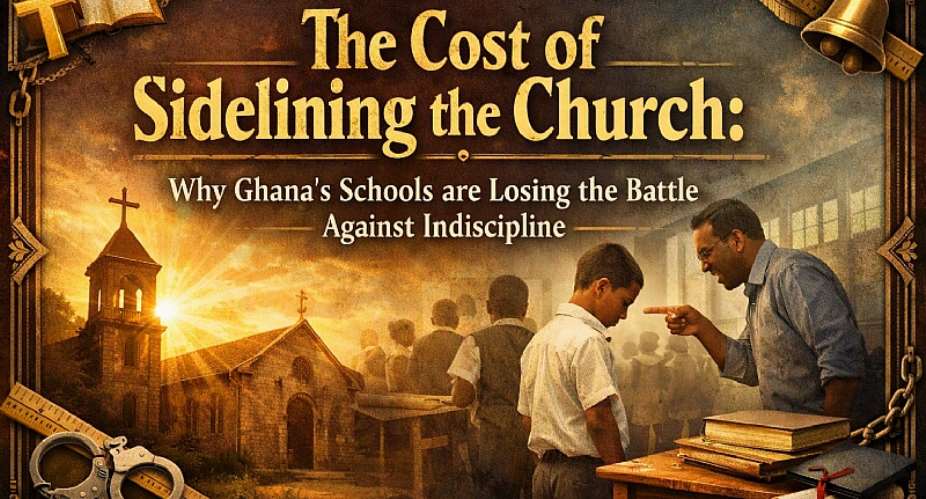
A Crisis of Character in Our Classrooms
Ghanaian public education is wrestling with an existential crisis that cannot be resolved by state-of-the-art infrastructure or digitized classrooms alone. In recent months, our Senior High Schools (SHS) have dominated the headlines not for academic milestones, but for a shocking breakdown of institutional order. We are no longer discussing minor behavioral hiccups; we are witnessing an era of campus lawlessness. From the security deployments required to quell violent riots at Bawku SHS over exam malpractice, to weaponized inter-school clashes between Okuapemman and Mount Sinai SHS that left multiple students hospitalized and property destroyed, our campuses are fracturing. Sociological data further unmasks the structural rot: a recent UNDP-supported study revealed that more than 50% of secondary school students in Ghana report experiencing regular physical violence or systemic bullying. Furthermore, the Moderator of the Presbyterian Church of Ghana, Rt. Rev. Dr. Abraham Nana Opare Kwakye, recently warned that campus truancy and delinquency have reached an all-time high, with students forming dangerous campus subcultures.
For decades, the bedrock of Ghanaian education relied on a deliberate, symbiotic partnership between the State and Faith-Based Organizations (FBOs). While the state provided the funding, the missions provided the moral architecture. However, the systematic legislative sidelining of religious bodies—codified in the Pre-Tertiary Education Act of 2020 (Act 1049)—has effectively evicted the traditional guardians of character formation from decision-making tables. By compressing the collective voice of the Church on the Ghana Education Service (GES) Council down to a single generic seat, policy makers created a massive authority vacuum. As Most Rev. Matthew Kwasi Gyamfi, President of the Ghana Catholic Bishops' Conference, accurately observed, prioritizing cognitive intellect while entirely abandoning affective character formation leaves our youth completely unequipped for the responsibilities of citizenship. To rescue the next generation, we must bridge the gap between rigorous academic policy and authentic moral restoration.
The Root Causes: A Socio-Educational Autopsy
- The Legislative Representation Bottleneck: Under the previous Act 506 of 1995, religious units held three permanent, diverse seats on the GES Council, allowing Protestant, Catholic, and Islamic bodies to actively shape regional and national disciplinary frameworks. Act 1049 completely dissolved this, rendering centuries of religious educational expertise functionally voiceless.
- The Atrophy of Local Institutional Autonomy: Regional and General Religious Unit Managers have been stripped of their historic veto and consultative powers regarding staff placement. Headteachers and housemasters are frequently posted to historic mission schools without proper vetting to ensure they understand, respect, or can enforce that specific school's long-standing moral code.
- The Disciplinary Policy Gap: The abrupt prohibition of traditional corrective measures, implemented without establishing clear, contextually fitting alternatives, has inadvertently triggered a wave of "iatrogenic discipline". Research indicates that teachers now feel legally disarmed and highly hesitant to intervene, creating an environment where truancy and gang subcultures flourish.
- The Externalization of Authority: The modern SHS ecosystem suffers heavily from undue political and parental interference. School administrators face extreme pushback or administrative retaliation when attempting to isolate or expel delinquent students, sending a dangerous signal to the student body that misconduct carries zero systemic consequences.
Deep-Dive Policy Recommendations and Structural Suggestions
To reverse this downward trajectory and rebuild a sustainable, value-driven educational framework, the Ministry of Education, Parliament, and Ghana's Educational Units must look past cosmetic fixes and enforce deep structural reforms:
- 1. Fast-Track the Amendment of Act 1049 with an Expanded FBO Quota:
Parliament must treat the Ministry of Education's current legislative review as a matter of urgent national stability. The impending amendment must explicitly restore a multi-seat system. Rather than forcing a single representative to speak for competing theological structures, the law should allocate distinct, statutory seats for the National Catholic Secretariat, the Christian Council of Ghana, and the Federation of Muslim Councils to ensure comprehensive stakeholder oversight.
- 2. Establish Binding State-Church MoUs on Leadership Appointments:
The Ministry of Education should institutionalize clear, legally binding Memorandums of Understanding (MoUs) with established Educational Units. These agreements must guarantee that a candidate's capacity to uphold a school's unique denominational ethos is a non-negotiable metric before they are appointed to leadership or administrative roles. School boards should have the statutory power to reject postings that threaten the foundational character of the school.
- 3. Operationalize the National Peace Council/COMEU Tolerance Framework:
Rather than letting campus religious friction spark administrative overreach, schools must strictly operationalize the Memorandum of Understanding on Religious Tolerance launched by the National Peace Council and the Conference of Managers of Education Units (COMEU). This policy provides clear, validated guidelines for creating safe, non-discriminatory learning environments while explicitly preserving the founding mission identity and rules of the school. It protects individual constitutional liberties without forcing the school to dilute its traditional moral code.
- 4. Secure and Regulate Institutional Infrastructure:
In alignment with recent directives issued by regional authorities warning against the unauthorized, unregulated use of public school classrooms for external religious services, local Unit Managers must enforce strict facilities-management logs. Preserving school infrastructure from rapid wear-and-tear ensures that the campus remains a highly ordered environment solely dedicated to academic and character formation, rather than an uncontrolled public space.
- 5. Reintegrate Quantifiable Moral Grading into the Free SHS Portal:
Academic report cards should look beyond standardized cognitive test scores and formally bring back continuous character assessment metrics. Tracking accountability, integrity, and civility gives students a tangible incentive to respect institutional rules. High moral grading should be made a prerequisite for national student honors, prefectorial positions, and tertiary scholarship endorsements.
- 6. Resource and Empower Chaplaincies and Guidance Counseling Units:
Transition the roles of institutional Chaplains and Imams from purely ceremonial figureheads into fully resourced administrative counselors. Backed by state psychological frameworks, they must be equipped to proactively run emotional, psychological, and ethical development sessions to counter volatile mob mentalities.
The Way Forward for Ghana
The current epidemic of indiscipline in our Senior High Schools is not a sudden anomaly; it is the predictable byproduct of an educational system that chose to prioritize raw intellect while systematically starving the soul. We simply cannot outsource the moral upbringing of Ghana's future leadership entirely to a secular state apparatus that lacks the local mechanisms to monitor character development. The stellar, centuries-long track record of Christian and Islamic missions in establishing Ghana’s premier "Grade A" institutions proves conclusively that discipline and academic output are deeply interdependent.
The Ministry of Education’s recent admission that the consolidation of FBO seats on the GES Council was a structural error is an encouraging step toward reform, but policy declarations must materialize into statutory changes. As our legislative structures prepare to debate the restoration of the Church’s policy-making influence, the broader Ghanaian public must realize that saving our classrooms requires returning to the values that built them. True education must do more than train an individual to build a career; it must cultivate the conscience required to build a nation.
✍️ Submitted by:
Retired Senior Citizen
For and on behalf of all Senior Citizens of the Republic of Ghana 🇬🇭
Teshie-Nungua
[email protected]

 GTA CEO Maame Efua Houadjeto faces visa fraud allegations over 2026 World Cup me...
 Senegal and Morocco set for AFCON title rematch – in Swiss sports court
 From the Acropolis, Rubio calls on Europe to emerge from ‘slumber’
 Mahama proposes financing scheme to help Ghanaians complete unfinished houses
 'Free SHS not in crisis; it was suffering under you and we reviewed it' – Haruna...
 Mahama orders sanctions for officials who fail to enforce building safety rules
 2026 World Cup: Minority alleges how GTA charged $7,000–$14,000 for visa process...
 Mahama announces GHS1bn for revolving National Housing Fund
 PAC orders CWSA to recover GH¢2.5m public debt within 30 days
 Former NPP chairman Samuel Odoi-Sykes dies


