




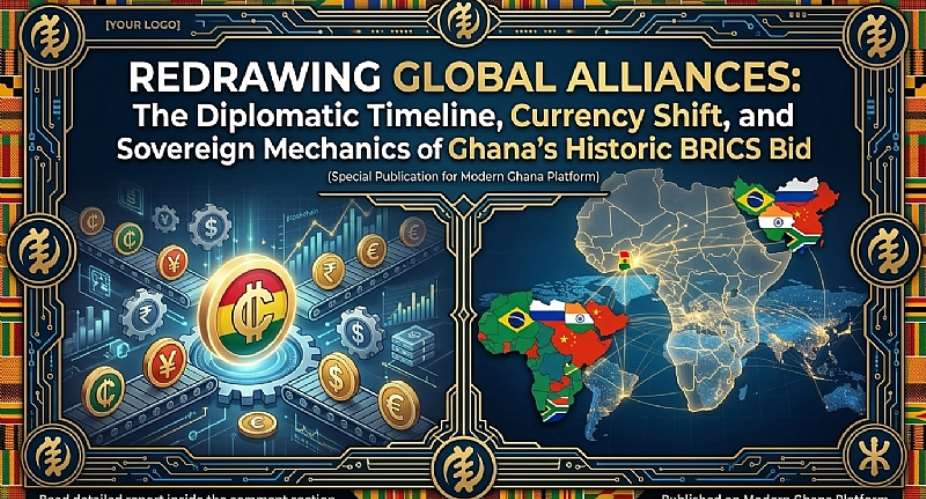
Ghana stands at a definitive junction in its modern history. The Cabinet's formal approval of a membership application to the BRICS economic bloc marks a systemic shift away from the traditional unilateral architectures of global power. For generations, our sovereign options have been rigidly constrained by structural conditionalities tied to Western financial hubs. As global economic weight aggressively recalibrates toward the emerging hubs of the Global South, this application under the administration of President John Dramani Mahama signals a profound geopolitical re-alignment. True independence cannot exist without economic sovereignty. This narrative article unpacks the underlying mathematical, financial, and sovereign mechanics of a transition that aims to move Ghana from an economic rule-taker to a rule-maker.
The Diplomatic Timeline: The Road to the Approval Process
- Cabinet Consensus and Executive Action: The path to BRICS began inside Jubilee House, where the Cabinet under President John Dramani Mahama evaluated long-term economic vulnerabilities and officially gave the green light to pursue an application.
- The Public Disclosure: On October 6, 2026, Foreign Affairs Minister Samuel Okudzeto Ablakwa broke the news to the Ghanaian public during a high-profile diplomatic summit in Accra.
- Leveraging the Indian Partnership: The formal disclosure took place alongside the visiting Indian External Affairs Minister, Dr. Subrahmanyam Jaishankar. Minister Ablakwa revealed that Ghana has explicitly sought India's diplomatic backing to anchor and guide its application process through the alliance.
- The Multilateral Consultation Phase: Following the announcement, Dr. Jaishankar affirmed India's strong support for Ghana's developmental aspirations. However, he emphasized that final admission is contingent on formal evaluation and consensus by all current BRICS member states.
- Expanding Bilateral Horizons: Coinciding with the BRICS timeline, Ghana and India successfully ratified two critical Memoranda of Understanding (MoUs) spanning agriculture, science, technology, and advanced rail transport systems to show immediately actionable alignment.
The Financial Engine: Leveraging the New Development Bank (NDB)
- Bypassing Strict Conditionality: By joining BRICS, Ghana secures direct institutional access to the New Development Bank (NDB), an institution offering developmental liquidity without the aggressive, domestic austerity mandates historically imposed by Western credit bodies.
- Financing Strategic Infrastructure: The NDB’s core mandate focuses strictly on funding massive, high-impact public hardware—specifically targeting critical modernization paths like railway network expansions, digital connectivity infrastructure, and clean energy grids.
- Diversifying Sovereign Debt: Expanding credit options directly insulates Ghana against balance-of-payment crises, providing immediate macroeconomic alternatives whenever traditional capital markets tighten.
Currency Shifts: The Direct Impact on the Ghanaian Cedi (GHS)
- Mitigating Dollar Dependency: The core operational ethos of BRICS centers on de-dollarization—promoting trade settlements using member state local currencies instead of the United States Dollar (USD).
- Cedi Stabilization Through Direct Trade: Settling high-volume imports from key trade hubs like India, China, and Brazil in local currencies removes the constant, artificial pressure on the Bank of Ghana to draw from limited USD reserves just to clear basic merchant trade.
- Gold and Local Currency Settlement: This economic shift structurally aligns with domestic policies aiming to insulate the Cedi through local gold purchases. Shifting toward gold-backed or multi-currency reserve frameworks provides a real safety net against imported currency inflation.
- The Risk of Secondary Depreciation: Conversely, if bilateral trade isn't strictly balanced, the Cedi could face secondary depreciation pressures against major eastern currencies like the Chinese Yuan if imports significantly outpace export growth.
Comparative Framework: IMF vs. NDB
- Primary Institutional Purpose: The International Monetary Fund (IMF) serves as a global lender of last resort focused on macroeconomic stabilization and balance-of-payments rescue. In direct contrast, the New Development Bank (NDB) focuses exclusively on long-term infrastructure funding and sustainable development projects.
- Operational Prerequisites: The IMF demands rigorous structural adjustment programs, including public spending cuts, subsidy removal, and tax overhauls. The NDB evaluates projects strictly on infrastructural feasibility and developmental return, entirely avoiding domestic policy interventions.
- Currency Framework: IMF lending is primarily transacted in Special Drawing Rights (SDRs) or major Western benchmark currencies like the USD. The NDB actively promotes local currency financing and regional swap lines to reduce reliance on third-party reserve assets.
- Sovereign Governance Model: IMF voting rights are directly skewed toward proportional capital contributions, historically giving Western nations veto power. The NDB is built on an equal-voting-share baseline where no single founding country holds structural veto authority.
Reclaiming Geopolitical Sovereignty
- A Modern Return to Non-Alignment: Rooted in the rich philosophical lineage of Dr. Kwame Nkrumah, this move rejects selecting one global superpower over another, asserting our explicit right to engage equally with both East and West.
- Collective Bargaining Power: A seat within the expanded BRICS ecosystem grants Ghana a potent voice in structural reforms regarding global debt resolution, commodity pricing, and international trade laws.
- Strengthened Energy and Resource Security: Operating inside the bloc creates hard strategic buffers, giving Ghana direct diplomatic leverage to negotiate discounted energy and critical technology supply lines amid turbulent global shocks.
Tactical Suggestions and Recommendations for Government
- Establish an Expert Monetary Negotiating Panel: The Bank of Ghana and the Ministry of Finance should immediately inaugurate a specialized panel to evaluate swap agreements and clearing systems to prevent unintended disruptions to the Cedi's global position.
- Mandate Stringent Domestic Value-Addition Rules: Investment agreements negotiated via the NDB must bypass the historical pitfall of exporting raw materials; they must mandate local manufacturing, processing, and technology transfers.
- Proactive African Consolidation: Ghana must immediately align its BRICS ambitions with neighboring continental partners like South Africa, Egypt, and Ethiopia to build a unified West African economic corridor that advances the African Continental Free Trade Area (AfCFTA) agenda.
Compelling Conclusion
Ghana’s pursuit of BRICS membership is not a passive rescue mission for the nation’s treasury; it is a complex, hyper-technical re-engineering of Ghana's macroeconomic future. The real power of this alignment rests in our capacity to strategically balance options, safeguard our resource borders, and use local currency mechanics to stabilize the Cedi. If entered into with rigid clarity and uncompromising focus on domestic industrialization, this historic step will cement Ghana's status as a completely sovereign, financially resilient leader in the new global economy. The era of economic complacency is officially over—Ghana is charting its own path.
FAQ: Debunking Common BRICS Misconceptions
- Misconception 1 — Abandoning Traditional Alliances: Joining BRICS does not mean Ghana is abandoning its relationship with the US, Europe, or the IMF. As explicitly noted by Foreign Minister Samuel Okudzeto Ablakwa, membership complements Ghana's existing diplomatic and developmental frameworks rather than replacing them.
- Misconception 2 — Immediate Currency Replacement: The Ghanaian Cedi will not be replaced by a single physical "BRICS Currency." The alliance focuses on clearing trade using pre-existing domestic currencies (like the Cedi, Indian Rupee, or Chinese Yuan) via independent payment architectures to skip intermediate dollar exchanges.
- Misconception 3 — NDB as an Emergency IMF Substitute: The NDB is not an IMF clone for structural financial crises. The IMF steps in to manage urgent sovereign debt and balance-of-payments emergencies through strict stabilization adjustments. The NDB acts strictly as a project bank, providing capital earmarked to build physically productive infrastructure.
✍️ Submitted by:
Retired Senior Citizen
For and on behalf of all Senior Citizens of the Republic of Ghana 🇬🇭
Teshie-Nungua
[email protected]

 Govt to launch $18.8m REWARD project to boost rice production in November, cut $...
 Ghanaian doctor makes history as first African inducted into world's highest avi...
 Ibrahim Mahama urges stronger support for Ghanaian entrepreneurs as Dzata Cement...
 PAC orders CWSA to engage IGP over GH¢300,000 police water debt
 CPP launches nationwide membership drive, targets Ghanaian youth and professiona...
 Study reveals how climate disasters fuel child marriage, teenage pregnancy
 GJA gives Armed Forces 14 days to probe alleged assaults on journalists at La Pl...
 'Law should not hasten the death of an enterprise which proper intervention may ...
 Government spends GH¢917m on No-Fees-Stress support for 321,807 students
 GTA CEO Maame Efua Houadjeto faces visa fraud allegations over 2026 World Cup me...


